 Although there are a number of proprietary card decks used for specific games and numerous styles of novelty card decks, by far the most common type of deck used is the traditional French style deck which is used for the vast majority of card games played around the world. While the specific makeup and number of cards in a deck used for a specific game may be different, the types of cards are going to be the same. Similarly, while the style and images on the cards (front and back) may be different for specific playing card manufacturers, the representations of the cards and the concepts are exactly the same.
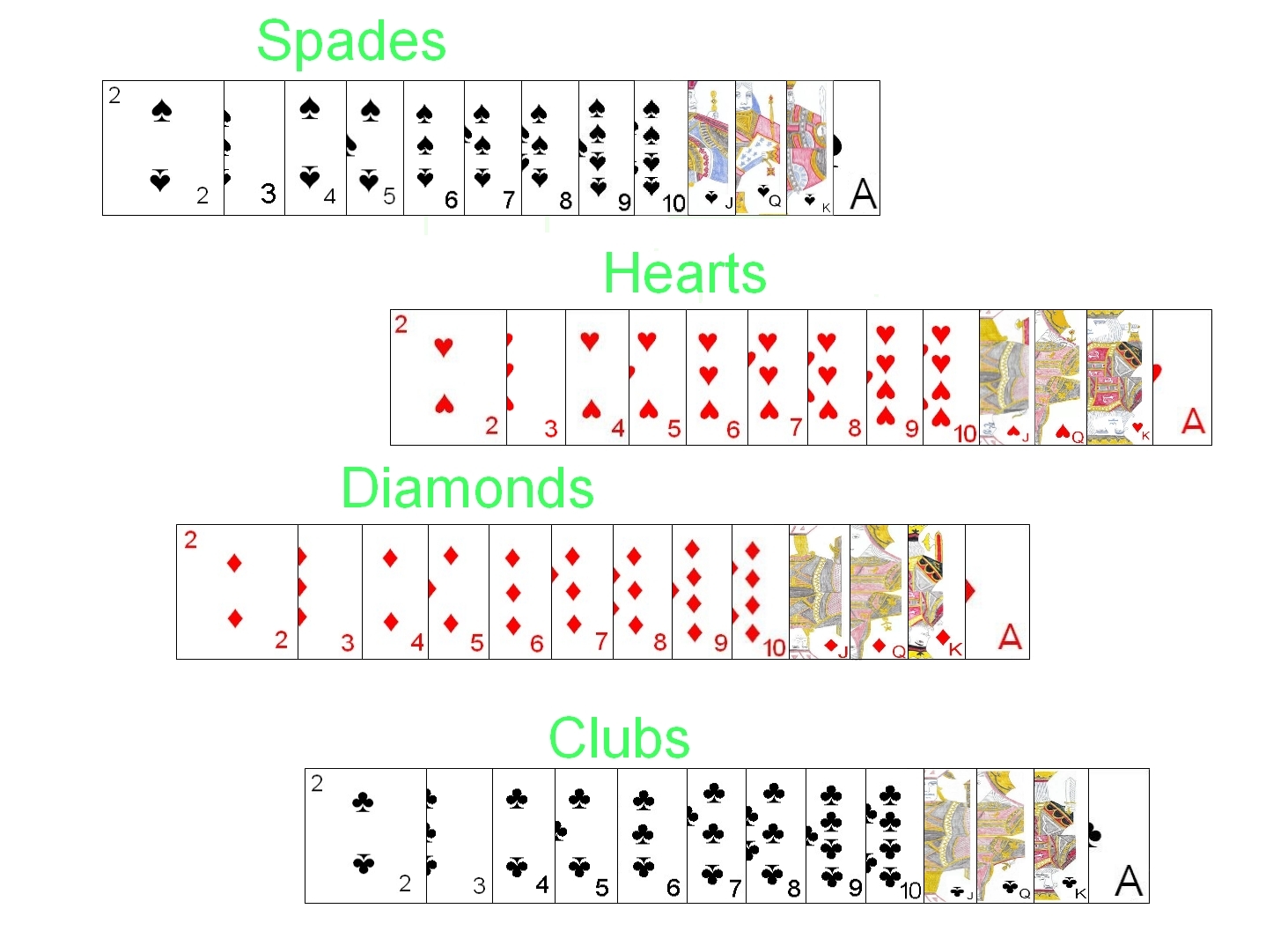 This deck consists of 52 cards consisting of four different suits. These suits are Spades, Hearts, Clubs and Diamonds. In each suit, there is one card bearing each of the following markings: A for Ace, K for King, Q for Queen, J for Jack, 10, 9, 8, 7, 6, 5, 4, 3, and 2.
Each numbered card, in addition to the number marking, usually displays a number of suit marking on its face corresponding to its ranking (which is usually also printed on the card face). The Ace, marked by the letter A usually shows just one such marking, which is usually a bit larger than normal. The King, Queen and Jack usually display a profile of a figure, often in courtly attire. These are called the court cards or face cards, as they usually have a caricature of a royal figure, including the face along with the other distinguishing markings. The Jack card in the deck was originally called the Knave, but due to its similarity in alphabetic marking with the King, over time was changed to "Jack" (in which this card had long been called in the game of All-Fours).
This deck consists of 52 cards consisting of four different suits. These suits are Spades, Hearts, Clubs and Diamonds. In each suit, there is one card bearing each of the following markings: A for Ace, K for King, Q for Queen, J for Jack, 10, 9, 8, 7, 6, 5, 4, 3, and 2.
Each numbered card, in addition to the number marking, usually displays a number of suit marking on its face corresponding to its ranking (which is usually also printed on the card face). The Ace, marked by the letter A usually shows just one such marking, which is usually a bit larger than normal. The King, Queen and Jack usually display a profile of a figure, often in courtly attire. These are called the court cards or face cards, as they usually have a caricature of a royal figure, including the face along with the other distinguishing markings. The Jack card in the deck was originally called the Knave, but due to its similarity in alphabetic marking with the King, over time was changed to "Jack" (in which this card had long been called in the game of All-Fours).
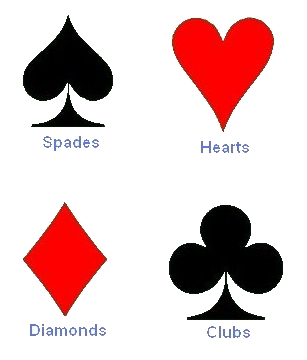 The Suits: As noted previously, the standard deck is divided into four different and distinct suits. These suits are Spades, Diamonds, Hearts and Clubs. Each of these suits contains one card of each numerical ranking in the deck, including the face cards and Ace. Some games may also have a secondary ranking of the suits within the game beyond the normal ranking by the number marked on the card. The Hearts and Diamonds suits are red in color and so are called the red cards and the Spade and Club suits are black in color and are thus called the black cards. In a standard deck of cards there would be 13 cards in each suit. The diagram to the right shows the standard representation of each of these suits. In France, the playing cards suits of Clubs and Spades sometimes are known by alternative names; Clovers and Pikes respectively.
|
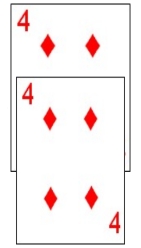
| Size Comparison: A four of diamonds shown in Poker size (top) and Bridge size (lower). |
Common Modifications to the Standard Deck |
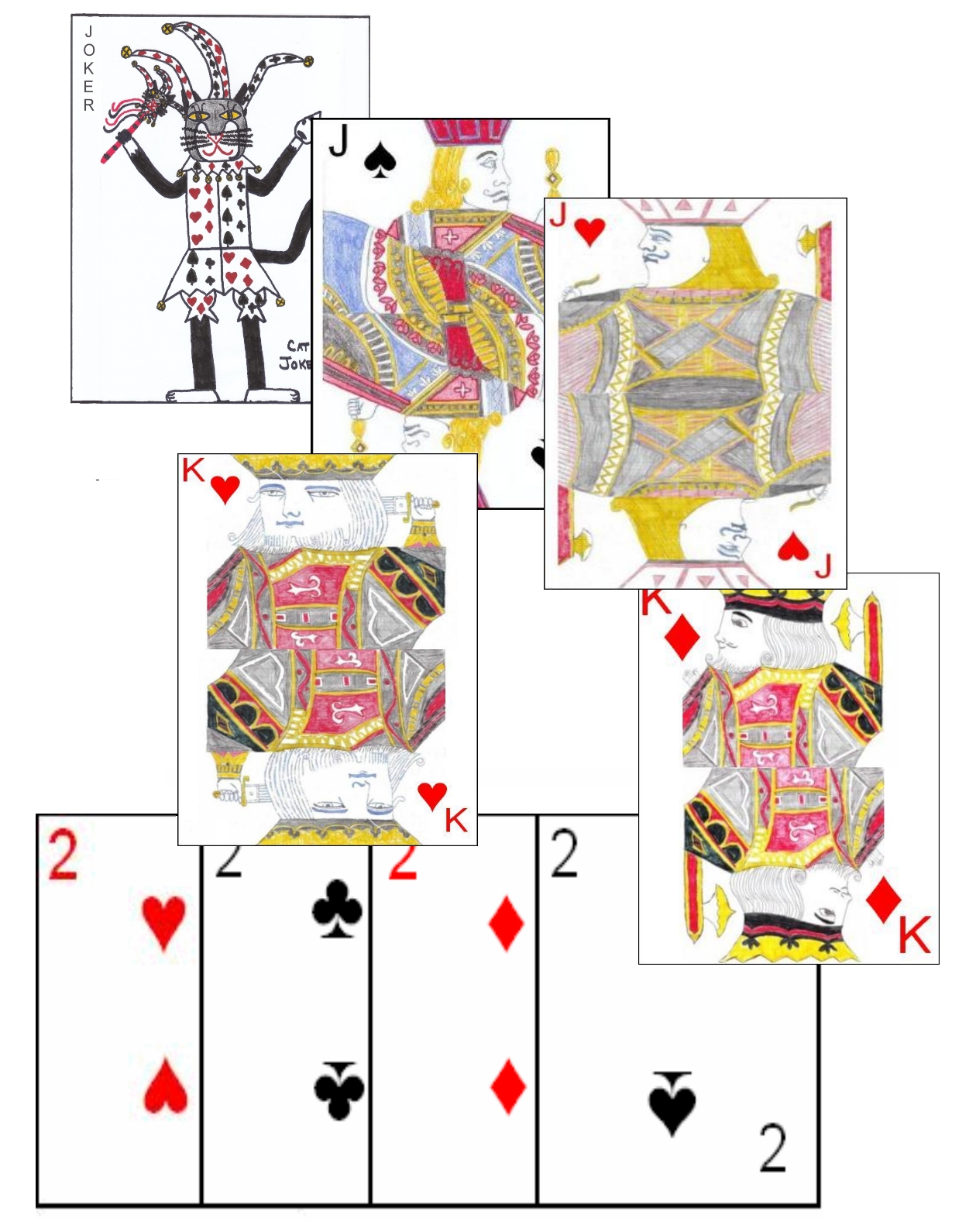 |
| A variety of wild cards are commonly used in a number of games which can be used to represent other cards of the holder's choice. |
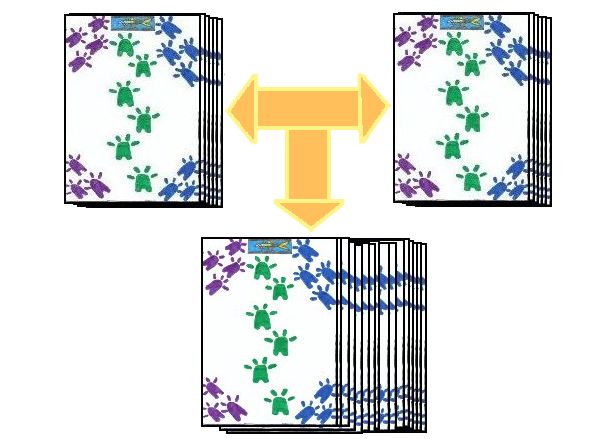 Multiple Decks: Many games, particularly those with a potentially larger number of players may require the use of multiple decks. This usually consists of two or more standard decks shuffled together and treated as one larger deck. In most cases these should be decks that have the same back design so as to keep all cards indistinguishable, although in some circumstances it is necessary to intentionally have the decks be of differing designs to distinguish and separate the decks throughout play of the game. Players must keep in mind the additional number of each denomination and suit of card when using such decks, as his can change their strategy considerably throughout the game. Also in these games, multiple Jokers may also be added to the combined deck to make an even larger stack.
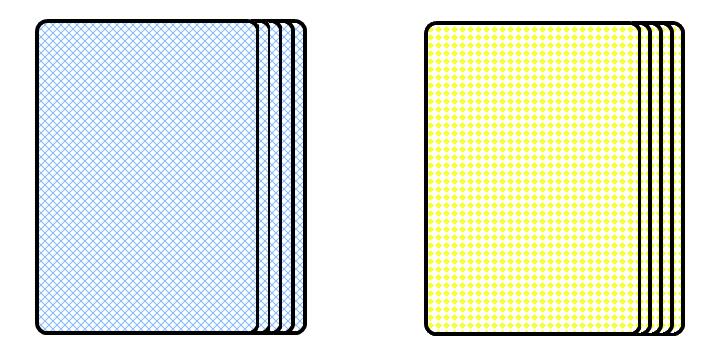 Secondary Deck: Even for some games in which one deck is sufficient for the game to be played, it is fairly common practice to make use of a second deck of cards. Although only one deck is used at any one time in the play, the additional deck is a secondary deck. This secondary deck is usually shuffled by another specific player and set aside before the current hand begins. Then, when ready for the next hand or game, this secondary deck already shuffled is then ready for immediate cutting and dealing. Then, when the secondary deck is used in a hand, the other deck can be shuffled and set aside for the next hand. This is done to decrease the time between deals as well as speed up the general proceedings. This is very common in tournament and partnership game settings, such as with Contract Bridge. In addition, this alternating of decks between hands also helps such that players may not remember the specific layout from a previous hand of a sloppily shuffled deck. The decks should have differing card backs from each other to ensure the cards from each deck do not become unintentionally intermingled. The second deck is usually being shuffled by another player while the current deck is being dealt. In partnership games, the secondary deck is usually shuffled by the current dealers partner and placed to his right such that the next dealer will have it immediately ready for the next deal. In non-partnership games, any other player can perform this shuffle.
Variations of the Standard Deck |
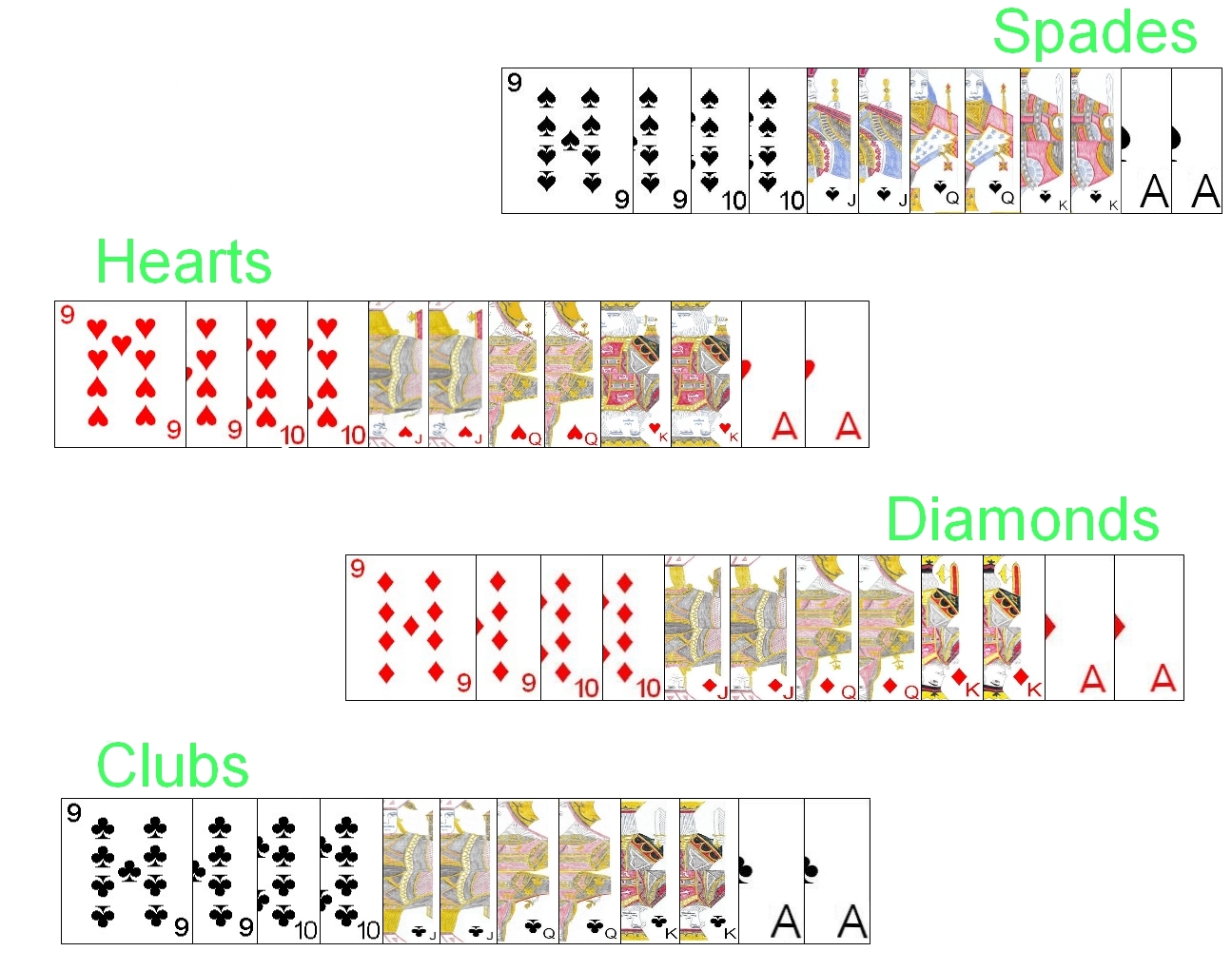 Pinochle Deck: The deck used for Pinochle and most of its variations is a sort of hybrid deck. It consists of TWO each of the following denominations in each of the four suits: Ace, King, Queen, Jack, 10, 9. The usual ordering of the Pinochle deck for Pinochle is, in ascending order: 9, J, Q, K, 10, A. Thus, there are a total of 8 cards of each denomination making a total deck consisting of 48 cards. Pinochle decks are usually widely available, however a Pinochle deck can also be made from two standard decks that have the same back design: From both decks remove all the 8's and lower and then shuffle the remaining cards in both decks together. These Pinochle decks can often be purchased alongside standard decks at retailers of playing cards.
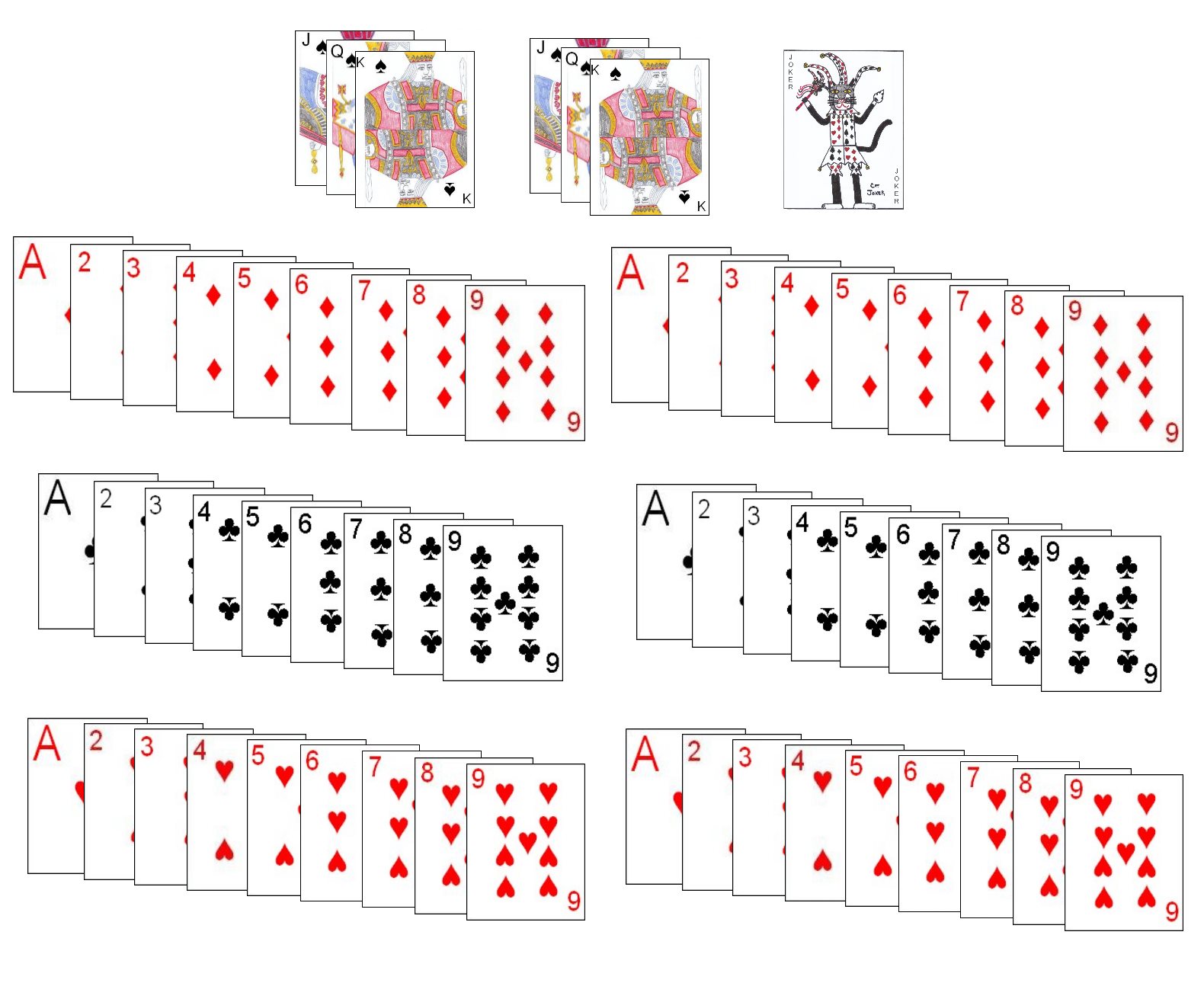 Khanhoo Deck: In 1891, Sir William Henry Wilkinson contracted cardmaker Charles Goodall to create a special pack of cards modeled after traditional Chinese Stick cards, also called gun pai or Chinese money cards (as many of the cards featured Chinese monetary symbols on the faces). These cards more closely resembled the French suited and European cards in size and style that Goodall and other Westerners were more familiar with. Goodall created this deck primarily to introduce the Chinese game of Khanhoo to Europe and the Western World. In addition to the Rummy like game of Khanhoo, this pack could also be used to play some of the other games commonly played with these Chinese stick cards.
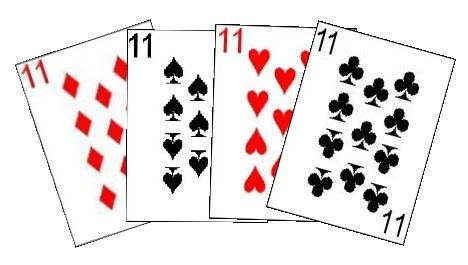 Augmented Deck: Although somewhat rare, another special deck sometimes seen is the augmented deck. This is a deck containing 62 cards. In addition to all the standard cards in the normal 52 card deck, this deck also includes an 11 in each suit, a 12 in each suit and a 13 in two suits (usually one red suit and one black suit). The usual ranking of the cards in such a deck are similar to that in a normal deck (from highest to lowest); Ace, King, Queen, Jack, 13 (in the two suits that contain it), 12, 11, 10, 9, 8, 7, 6, 5, 4, 3, 2. This deck is used for some special variations of Five Hundred, Cassino and several other card games. A Joker is also often added to this deck to create a 63 card deck.
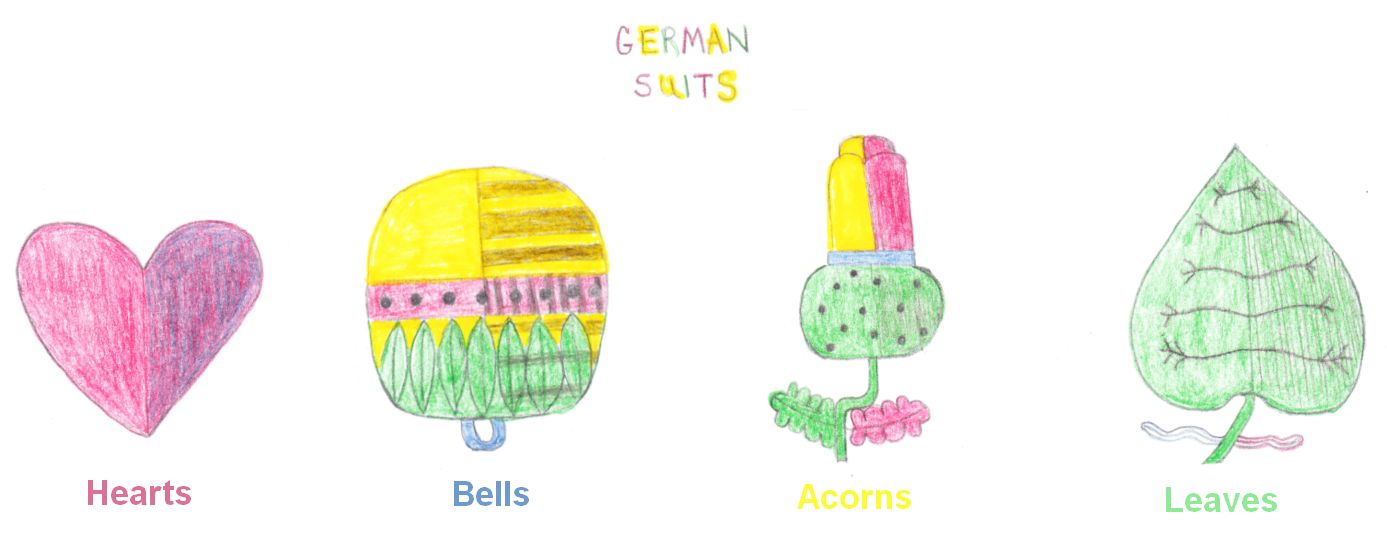 German Deck: The Germanic deck is a deck that is often used in Germany and other locations in central Europe. The German deck is similar to the French deck in that it contains four suits in various denominations. However, the standard German deck usually contains only 32 cards, and the suits, although somewhat similar, are of a different design. The fours suits in the German deck (in which the suit designs of the French deck were derived) are called Hearts, Bells, Acorns and Leaves. The denominations of the cards are also similar, however the Jacks and Queens are replaced by the Under Knave, called Unter
in German (roughly translated as sergeant), which sometimes is
designed to resemble a Knight and the Over Knave, called Ober, which
roughly translates to Officer. There is one card of each denomination in every suit. The usual ranking of the cards in the German deck is thus as follows (from highest to lowest): Ace, King, Over Knave, Under Knave, 10, 9, 8, 7. This deck is often used for games of originally Germanic origin, such as Schafkopf and International Skat.
German Deck: The Germanic deck is a deck that is often used in Germany and other locations in central Europe. The German deck is similar to the French deck in that it contains four suits in various denominations. However, the standard German deck usually contains only 32 cards, and the suits, although somewhat similar, are of a different design. The fours suits in the German deck (in which the suit designs of the French deck were derived) are called Hearts, Bells, Acorns and Leaves. The denominations of the cards are also similar, however the Jacks and Queens are replaced by the Under Knave, called Unter
in German (roughly translated as sergeant), which sometimes is
designed to resemble a Knight and the Over Knave, called Ober, which
roughly translates to Officer. There is one card of each denomination in every suit. The usual ranking of the cards in the German deck is thus as follows (from highest to lowest): Ace, King, Over Knave, Under Knave, 10, 9, 8, 7. This deck is often used for games of originally Germanic origin, such as Schafkopf and International Skat.