How To Play Bid Whist


Bid Whist is a major variant of Whist which is highly popular in many areas of the United States of America. The game described here, which is how the vast majority of devotees to Bid Whist play is the more modern variant of the game. Described in the variants sections is the classic game, from which it appears this game may have partly been developed from. Bid Whist is designed for play by four, participating in two partnerships of two players each.

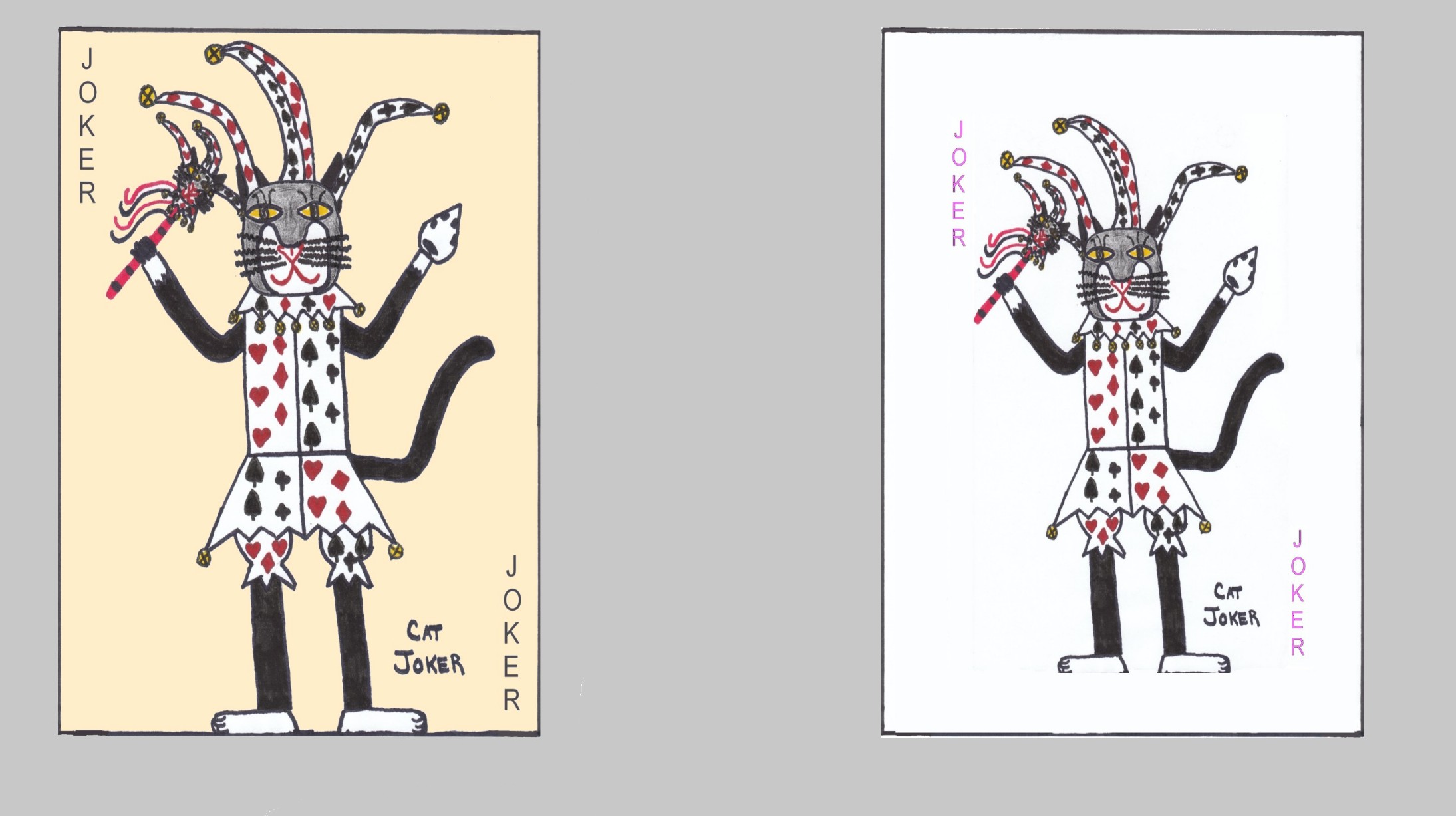
Big and Little Jokers in Bid Whist The game of is played using one standard 52 card deck with the addition of two Jokers. The Jokers should be distinct from each other in some way such that one is designated as the "Big Joker" and the other as the "Little Joker". Since most decks usually include one multi-color Joker and another Black and White Joker, the colored Joker is usually set as the Big Joker (Big Jo) and the Black and White Joker is set as the Small Joker (Little Jo). The specific rank of the cards will be directly dependent on the winning high bid during the auction phase of the game.

Determination of partnerships and first dealer can be performed using a variety of methods, with a cut for high card a method commonly performed. Using this method, each player cuts the deck and shows the card cut. The two players cutting the highest cards play as partners against the two player drawing the two lowest. Any players drawing equally ranked cards should draw again. The ranking of the cards for the purposes of this draw is as follows (from high to low): Big Joker, Little Joker, Ace, King, Queen, Jack, 10, 9, 8, 7, 6, 5, 4, 3, 2. The player who draws the first card in the suit of diamonds is usually set as the first dealer. This first dealer also has the first choice of seats at the table. Each player should directly across the table from his partner during the game. After each hand, the role of dealer rotates around the table in a clockwise direction.

After the determination of the partnerships and first dealer, the dealer deals 12 cards to each player, face down and one at a time. The remaining 6 cards of the deck are set, face down, in the center of the table to form the kitty.

After the dealer has distributed the cards, bidding for the hand can then begin:

Bidding - Each player, starting with the first player to the dealers left, is allowed exactly one bid. The bidding continues around the table in a clockwise rotation. On his one turn at bidding the player may either bid or pass. When bidding, a player names a number of odd tricks (tricks over 6) that they are bidding to win. These odd tricks are also called "books". If the first three players all "pass", the dealer must make a bid (with three being the minimum bid). When bidding a player must also declare either "Uptown", "Downtown" or "No Trump" along with his bid. Each of these additional declarations has a distinct meaning in regards to card ranking and trump suit (if any) that may be named for the hand.

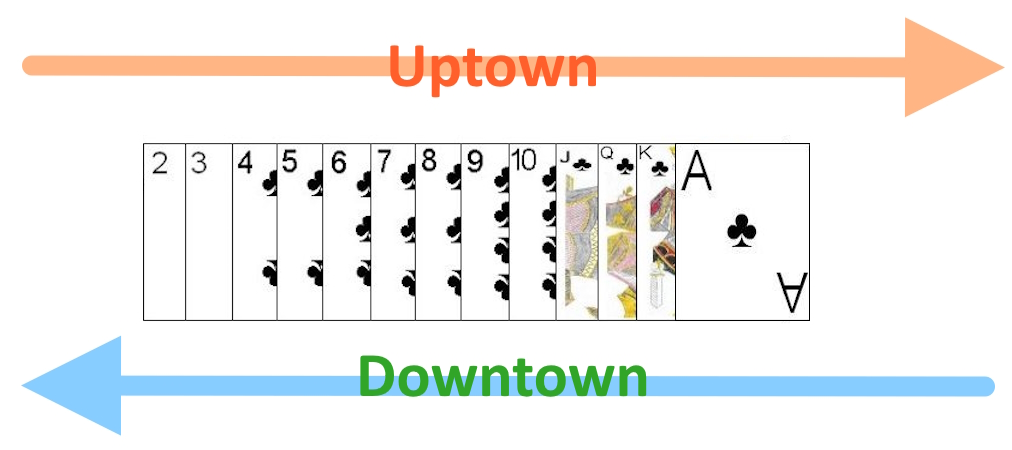
The declaration of uptown means that the bidder will, if he has the highest bid, declare the trump suit after the bidding is completed. In addition, when the winning bid contains "Uptown", the cards rank in the standard order, from high to low(Ace,King,Queen,Jack,10,9,8,7,6,5,4,3,2).

A declaration of downtown, on the other hand, means that the bidder, if he wins the bidding, will also declare a trump suit after the completion of the bidding. The call of "downtown" however, ranks the cards in the order from high to low (2,3,4,5,6,7,8,9,10,Jack,Queen,King,Ace).

The no trump declaration indicates that no trump suit will be named, thus the hand will be played with no designated trump suit. In addition, a player who's winning bid is declared with this "no trump" can decide which of the two (high or low) card rankings will be used for the hand.

As in other such bidding games, a bid of a higher number takes precedence over a bid of a lower number. Bids of uptown and downtown have equal rank when added to bids of the same number of odd tricks. However, a bid of no trump, outranks a bid of the same number using uptown or downtown.

Once each player has had their one opportunity to bid, the player making the highest bid is thus considered the high bidder and names the trump suit to be used for the hand (unless their bid also consisted of "No Trump"). If a no trump bid ends up being the highest bid, the player doing so would then name either uptown or downtown to indicate the relative ranking of the cards (high to low or low to high).

If the winning high bid was in one of the four trump suits, the winning bidder then picks up the face down six card kitty in the center of the table exposing such that all other players can see the faces of these cards. This is called "sporting the kitty". After the other players have had the opportunity to see these cards he then adds them to his hand. If the winning high bid was a "no trump" bid, the high bidder simply takes the kitty cards into his hand without exposing them for the other players to see. The high bidder then peruses his hand and discards any 6 cards from his hand, face down in front of him. These 6 cards count as one actual won trick for the high bidders partnership and count as the first trick towards the total needed to fulfill their bid.

If the winning bid was a "No Trump" bid, the Jokers have no value and can never win a trick. As such, it is customary (but not mandatory) for a player who was dealt a Joker to thus set the Joker aside and draw a random card from the six cards discarded by the high bidder.

The winning bidder then leads the first card to the first trick. The leader to a trick may lead any card of choice from his hand to the trick. Each other player, in a clockwise direction then adds one card to that same trick. If a player has a card of the same suit as led to that trick he must play it. If he has no such card, he may play any other card still remaining in his hand, including a card of the trump suit, if he has one.

After each player has played a card to the trick, it is determined who has won that trick (book). The player of the highest card in the trump suit to that trick wins the trick. If the trick contains no cards from the trump suit, it is won by the highest card in the suit originally led to that trick. The won trick is set aside and out of play. The winner of each trick leads the first card to the next trick.

As mentioned above, the ranking of the cards in the hand are dependent on specifics of the winning bidders declaration, as follows:

DeclarationTrump SuitCard Ranking (From high to low)
UptownSpades, Hearts, Diamonds or ClubsBig Joker, Little Joker, Ace, King, Queen, Jack, 10, 9, 8, 7, 6, 5, 4, 3, 2
DowntownSpades, Hearts, Diamonds or ClubsBig Joker, Little Joker, Ace, 2, 3, 4, 5, 6, 7, 8, 9, 10, Jack, Queen, King
UptownNo TrumpAce, King, Queen, Jack, 10, 9, 8, 7, 6, 5, 4, 3, 2
DowntownNo TrumpAce, 2, 3, 4, 5, 6, 7, 8, 9, 10, Jack, Queen, King
Ranking of the cards in Bid Whist

Note: If the winning bid is No Trump, the Big Joker and Little Joker have no value and can never win a trick. In these circumstances, if a joker is the first card led to a trick, the next player may play any card which, if not a joker, is considered the suit for which the trick is played in. In a "No Trump" hand a player may also play a joker to an existing trick if they do not have a card of the original suit led to the trick, but of course the Joker can never win that trick.

If the winning bid is in any trump suit, the Big Joker and Little Joker, respectively, are considered the two highest cards of the trump suit and act as members of this trump suit in all circumstances and would thus be played any time a card from the trump suit could or should be played.

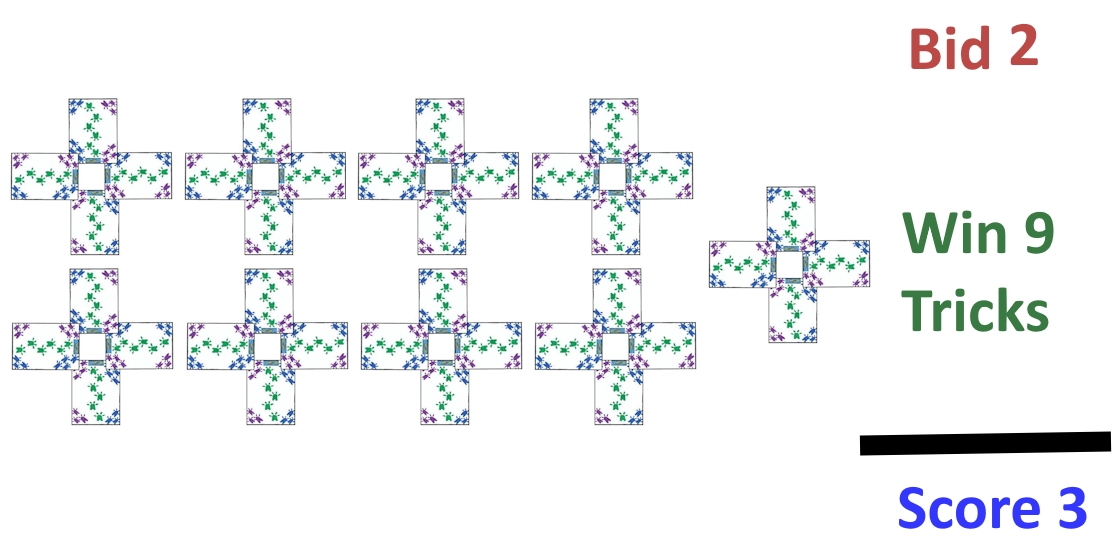
Scoring: Once each hand is completed, the partnership making the high bid will win or lose a certain number of points. If the bid making partnership wins at least as many tricks over 6 (counting the kitty trick) as their high bid, they win a number of points equal to the number of tricks over 6 (again, counting the kitty trick) they have won. However, if they do not win at least 6 plus the number of tricks they bid, a number of points equal to their bid (regardless of the number they actually did win) is subtracted from their current score. Negative scores are possible in this game. If the opposing partnership manages to win seven or more tricks they score one point per such odd trick (regardless of the bid type). If a side bids and wins a hand on a no trump declaration, they win double the normally earned points for the hand. If the bidding side manages to win every trick during the hand, all scores are quadrupled for this hand (called a Boston).

The first partnership to score 7 or more points at the end of a hand is declared the winner of the game. Alternatively, if a partnership reaches a score of negative 7 or lower at end of a hand, the opposing team is declared the winner of the game.


Bid Whist Variations and Optional Rules

Some of the more common variations of Bid Whist that are played are as follows:

Five Point Bid Whist: For a shorter game, some players prefer to set the target score 5. Thus, the first partnership to reach or exceed 5 points is declared the game winner. Similarly, in playing this variant, if one team ends a hand with a score of negative five, the opposing team is set as the game winner.

No Jokers: Some players play Bid Whist minus the Jokers, thus using just the standard 52 card deck. The ranking remains the same with the only difference being that there is no Big or Little Joker. In playing without the Jokers, the kitty is reduced to four cards, and the high bidder, after taking the kitty into their hand would discard four cards back to the table (face-down). In all other aspects the game is played identically to the standard version.

Minimum Bid: In the standard game, the minimum bid is three odd tricks. However, some players prefer to raise the minimum bid to four rather than three. Thus, the minimum bid (including for the dealer if the first three players pass) would be four. If the game is played without Jokers, however this optional rule should not be enacted and in this event sometimes the minimum bid is set as low as one trick.

Bid Ranking: A variant rule that is sometimes encountered regards the ranking of the bids. In the base game, Uptown and Downtown bids of the same number are equally ranked bids. However, some players prefer to use the rule that a downtown bid of the same number of tricks can beat an uptown bid of the same number. As in the standard game either of these would be beat by a no trump bid with the same number or by any bid calling for a higher number of tricks.

Successful bids earn points equal to the number of odd tricks won Classic Bid Whist: The game of Bid Whist as mostly played today, has significantly changed over time. The original or "Classic" version of the game was similar to standard Whist with the addition of bidding. As such, that version used one standard 52 card deck (no Jokers) and was played by four players in two partnerships. The ranking as used in the game was, regardless of the bid, the following (from high to low): Ace, King, Queen, Jack, 10, 9, 8, 7, 6, 5, 4, 3, 2.

Determination of partnerships and the first dealer can be performed using a variety of methods, such as drawing for high cards. Each player should sit directly across the table from their partner for this game. After each hand, the role of dealer should rotate around the table in a clockwise direction.

After a shuffle and cut, the dealer should distribute the entire deck such that each player receives 13 total cards. After the deal, the bidding occurs, starting with the player at the immediate left of the dealer and continuing around the table in a clockwise direction. Each player makes a bid as an estimate of the number of odd tricks (tricks over 6) that he believes his partnership can win during the hand, based on a trump suit of that player's choice. A player may also pass. Once a player passes, they may make no further bids during the auction on this hand. The bidding continues until a bid is followed by three consecutive passes, with the player making that last bid, considered the high bidder. If all four players initially pass with no bid, the cards are shuffled and dealt by the next dealer in rotation.

Once a high bidder is determined, that player then states which of the four suits is to be used as the trump suit for the hand. This player must announce one of the four suits as the trump suits for the hand, as "No trump" bids or not recognized in this variant. The player at his immediate left leads the first card to the first trick.

After all tricks have been played and won, scoring can occur for the hand. If the high bidders managed to win at least as many tricks as bid, they earn a number of points equal to the number of tricks won. However, if they do not win at least as many tricks as won, they must subtract the amount of their bid from their current score and the opponents are entitled to score one point per odd trick they were able to win during that hand.

The first team to score 7 (sometimes 5, for a shorter game) points is declared the winner. However, if a team reaches a negative score of 7 (or again sometimes 5) the opponents are declared the game winner.

Individual Play Bid Whist: Bid Whist is sometimes played as a non-partnership game, with each player playing individually (sometimes called "Cutthroat Bid Whist"). This variant can be played by from 2 to 5 players. During the bidding, the bidder is announcing the total number of tricks he expects to take during the hand. He does not need to specify in this bid whether the bid will be played uptown or downtown, although if a bid is to played at no-trump this should be announced (as a no-trump bid is considered higher than any trump suit bid of that same number). After first dealing a six card kitty, the entire deck should then be distributed to the players. In order to ensure that the deck can be divided evenly, in the five player variant, the kitty should be reduced to 4 cards.

Gameplay is similar to Standard Bid Whist, with the high bidder attempting to win at least as many total tricks as bid. If the high bidder does manage to win at least as many total tricks as bid, that player earns a number of points equal to the number of tricks won during that hand. If he fails to win at least as many total tricks as bid, he must subtract from his current score the amount of his bid. Each opponent of the high bidder earns one point for each trick won during the hand. The first player to reach or exceed 30 points is declared the game winner.

Copyright © 2015 CatsAtCards.com. All rights reserved.
[Main][Site Map][Glossary][Copyright Page]