Bing Rummy is a Rummy card game which was developed in the U.S. state of Alaska in the early 1900's. As the game was most popular in the mining towns of the state, it is believed the name of the game was derived from the ore piles that were harvested in these towns, known as bing ore.
Bing Rummy can be played by 2 to 8 participants using two standard International decks shuffled together
(for a total of 104 cards). The ranking of the cards used in this deck (in particular for use in creating sequence melds) for this game are as follows from highest to lowest: Ace, King, Queen, Jack, 10, 9, 8, 7, 6, 5, 4, 3. All twos are considered wild cards, and thus, for the purpose of sequence melds, the three is considered the highest card, although, if preferred by the player, a two in a sequence meld could be considered the natural card of it's denomination preceding a three in a sequence meld.
Determination of seating positions and first dealer in Bing Rummy can be performed using any methods, with the a draw for high cards the most commonly used. Using that method, each player would draw one card from the shuffled deck, with the players thus take seats in order of preference from highest card drawn to lowest. If multiple players draw a card of the same denomination, those players would each set that card aside and draw a new card, continuing until each player draws a distinctly ranking card. The player drawing the highest ranked card of all is set as the first dealer. After each hand, the role of dealer rotates around the table in a clockwise direction.
Once the players are seated the dealer then thoroughly shuffles the deck and offers it to the player at his right. This player then pulls a section off the top of the deck and looks at the face of the bottom card in the section removed. If this card is any two he may keep that card. This player then replaces the stack on the top of the deck, and as such the deck is never actually cut, and the dealer then begins dealing. The dealer then begins distributing the cards in a clockwise direction around the table, face-down and one-by-one, starting with the player at his immediate left. He continues dealing until each player has a total of 14 cards. If the player at his right had exposed a two and kept it, this player would receive one fewer cards during the deal such that each player has the requisite total of 14 cards.
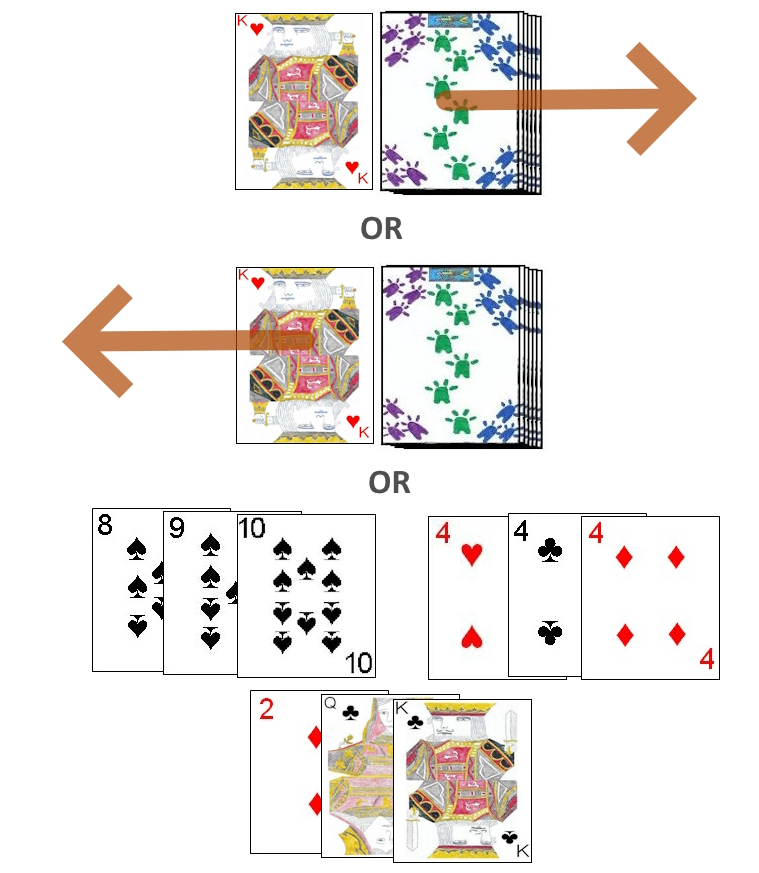 The dealer then places the remainder of the deck near the center of the table in a face-down pile and then takes the top card of the draw pile and placing it face-up beside the draw pile to start the discard pile. The player to the immediate left of the dealer has the first play, and the turns proceed in a clockwise direction around the table.
On a players turn, he may take exactly one of three specific actions:
- Draw the top card from the draw pile and discard any card from his hand to the discard pile.
- Draw the top, face-up card from the discard pile and discard a card from his hand as a replacement. A player drawing from the discard pile may never discard the same card as drawn.
- Meld cards from their hand. If a player has any melds in the hand that they can legally play to the table, these may be played. It should be noted that a player may never draw a card and meld on the same turn. There is a specific melding requirement for a player's first meld of a hand. Once a player fulfills this initial melding requirement, they can then, on that turn or later turns (on which they do not draw), create additional melds or add cards to other player's existing melds already found on the table. The following are the legal melds allowable in Bing Rummy:
- Sequence:
A sequence is a meld consisting of three or more cards in direct sequential order and all of the same suit. The meld may contain one or more twos as replacements for other cards.
- Group:
A group is three or more cards all of the same rank (regardless of suit). Group melds may contain one or more twos as replacements for other missing cards in the meld.
As mentioned, the first meld a player makes on a new hand must fulfill a certain criteria. On this first meld, the player must meld at least three different sets (any combination of three or more sequences or groups). Once a player makes this initial melding requirement, they may then, on that same or subsequent turns, layoff cards to their own or other player's melds. Thus, once a player has made their initial meld, they may not create completely new melds, but may lay off as many cards able, to other melds on the table (either those made by that player or by other players). Another important rule is that, after a player makes a meld to the table (either his initial meld or a subsequent meld), he may never end his turn with a number of cards points still in hand that would cause his current accumulated score, if added to this total in card points, to exceed 75 points. In that event, he must wait until a further turn on which he can make melds of sufficient cards to ensure his total in card points and accumulated score are under 76 points. In addition, on subsequent turns, that player must never end a turn with the total in his unmelded cards in hand, added to his current ongoing score, exceeds 75 points.
Once a player has played his last card to a meld, the hand ends and scoring occurs. Each player then adds to their ongoing, cumulative score a number of points based on the cards remaining in their hands (regardless of whether or not they form valid melds). The following shows the value of each card that a player still have in hand once any players plays his last card:
| Card Denomination | Point Value |
|---|
| 2 | 2 Points Each |
| 3, 4, 5, 6, 7, 8, 9, 10 | Value marked on card |
| Jack, Queen, King | 10 Each |
| Ace | 15 Each |
Any player that, upon the calculation of scores at the end of a hand, finds that their current score has reached or exceeded 76 total accumulated points must drop from the game. The game continues over several hands until there is only one player remaining with a score of 75 or fewer, after which that player is then declared the game winner. If the stock becomes exhausted during the course of play, all but the top card of the discard pile should be turned over (no shuffle) to start a new draw pile.
Copyright © 2015 CatsAtCards.com. All rights reserved.