Call Bridge: Call Bridge is a card game which is played very
similarly to Call Break, and is played in many of the same locales. Call
Bridge is also designed for four players, each playing independently and
uses one standard 52 card deck. The ranking of the cards in that deck is
as follows (from highest to lowest); Ace, King, Queen, Jack, 10, 9, 8, 7,
6, 5, 4, 3, 2. Similarly to Call Break, the suit of spades is always considered the trump suit during every hand.
Determination of the first dealer and seating positions can be performed similarly to Call Break, with a draw of cards from the shuffled deck a common method used. The players would thus take their selection of seats at the table in order of cards drawn, from lowest to highest. The player drawing the lowest card of all would also be set as the first dealer. The role of dealer rotates in a counter-clockwise direction around the table after each hand.
Once the players are seated, the designated dealer begins dealing the cards, starting with the player at his immediate right and continuing in a counter-clockwise direction. He deals the cards one-by-one and face down until he has dealt out the entire deck, which should result in each player receiving a hand of 13 cards.
Once the cards have been dealt, the players then pick up their hands for examination, after which a round of bidding occurs. The player to the immediate right of the dealer has the first opportunity to bid, which continues in a counter-clockwise rotation around the table. Each player has exactly one opportunity to so bid. The minimum bid a player must make is 2 and the maximum bid 12, with each player bidding the number of tricks (also called calls) he expects to win during this hand. These bids should be recorded somewhere for use in scoring at the end of the hand.
After each player has make their bid, play of the hand begins. The player to the immediate right of the dealer leads the first card to the first trick, with each player, in a counter-clockwise direction around the table contributing one card to that same trick.
The leader to a trick can lead any card of choice from his hand to the trick. There are a few stipulations, however on what the subsequent players can play to that same trick. If a player has a card of the suit originally led to the trick he must play it, but may choose which such card in that suit to play from his hand. If a player has no cards in the suit originally led to that trick (and the led suit was not spades), but does have a card in the suit of spades which could currently win the trick, he must play that card. If he does not have a card in the suit led, and does not have a card in the trump suit which could win that trick, he may play any card remaining in his hand.
After each player has played a card to the trick in turn, it is determined who has won the trick. The player of the highest card in the suit of spades wins the trick. If the trick contains no cards in the suit of spades, the highest card in the suit originally led to the trick wins it. The cards won in a trick are set aside, out of play, and face down, near the player who won them. The winner of each trick leads the first card to the next trick.
After all tricks have been played and won, scoring for the hand (round) occurs. In order to score positive points for the hand, a player must win either the exact number of tricks bid on that hand or one more than their bid (i.e. for a bid of 4, the player would score if winning 4 or 5 tricks). If a player does manage to thus win his bid (or one higher) he earns a number of points equal to his bid. If, however, the player wins fewer tricks than bid, or wins two or more tricks than he had bid, that player must subtract from his current score a number equal to his bid. If a player made a bid of 8 or more, these are called bonus bids and if a player manages to fulfill his bid (win the number or one more than his bid) he is entitled to add 13 points to his current score. If he is not able to fulfill his bid, he subtracts from his current score the amount of his bid.

There is usually no specific required score or number of hands indicating a full game, so the game usually continues for some set amount of time. At the end of that time, whichever player has the highest
accumulated positive score is declared the game winner.
Batak Ihaleli: Batak is a Turkish trick-taking game which has a
number of similarities to Call Break and the probable parent of that
game. With Turkey this game is also sometimes played under the base name "Spades" but should not be confused with the popular name by that name commonly played in the United States. Batak is designed for play by four players, each playing independently, and is played using one standard 52 card deck. The ranking of the cards in the deck, as used for this game, is as follows (from high to low): Ace, King, Queen, Jack, 10, 9, 8, 7, 6, 5, 4, 3, 2.
Determination of seating positions and first dealer can be performed using a variety of methods, with draw for high cards a common method. Using that method each player randomly draws a card from the shuffled deck, with any players drawing cards of equal rank discarding and drawing again. The players then each take their preferred seat at the table in the order of rank of card drawn, from highest to lowest. The player drawing the highest ranked card of all is set as the first dealer. After each hand, the role of dealer rotates to the next player in a counter-clockwise direction.
The dealer begins each hand by thoroughly dealing the deck and offering it to the player at his left to cut. After the cut, the dealer then begins dealing the cards around the table, one-at-a-time in a counter-clockwise direction around the table, starting with the player at his right. He continues dealing until the entire deck has been dealt out, with each player receiving a total of 13 cards.
After the deal, there is a round of bidding. The bidding starts with the player to the immediate left of the dealer and continues in a counter-clockwise direction around the table. A bid is that player's
estimate of how many tricks he expects to take during this hand. The
minimum allowable bid is 5 and the highest bid is 13. Alternatively to a
number bid, a player may instead elect to "pass". In order to be
considered a legal bid (if the player does not opt to pass), each bid must be higher than any previous bid on
this hand. If the first three players all pass, the dealer must make a minimum bid of 4 and is set as the
High Bidder for that round. Once a player passes, they are no longer entitled to make further bids during that hand.
The bidding proceeds around the table in a counter-clockwise direction
around the table. Once a high bid is followed by three consecutive passes, the round of bidding ends, with the player making the highest bid set as the
Bidder for the hand. The player making the high bid then announces one of the four suits to be used as the trump suit for this hand.
Once the bidding has concluded play of the hand begins, with the high bidder leading the first card to the first trick.
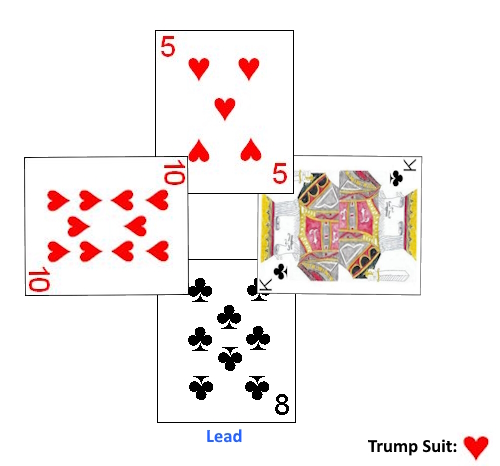
The leader to a trick may play any card of choice remaining in his hand to start the trick. However, if a card in the trump suit has not yet been played in any trick, a card from the trump suit may not yet be led to a trick (unless the only cards the player has remaining are those from the trump suit). After the lead, each other player, in a counter-clockwise direction around the table then plays one card to that same trick. If the player has a card of the suit originally led to the trick he must play it, and he must attempt to win the trick if possible by playing a higher card in that suit than any other card in that suit in the trick if such a card would currently win the trick. If he has no such card
in the initially led suit, if he has any cards in the trump suit, he must play
then a card from the trump suit, again playing a card in that trump suit higher than any other such
trump card previously played to the trick, if he has one. If he has no cards in the suit originally led to the trick, and no cards in the trump suit, he may play any other card remaining in his hand.
After all four players have played one card to the trick, it is determined who has thus won the trick. The trick is won by the highest card of the trump suit within that trick. If the trick contains no cards from the announced trump suit, the trick is won by the highest card in the suit originally led to the trick. Cards won in tricks are set aside, out of play and winner of the trick leads the first card to the next trick.
After every trick in the hand has been played and won, scoring occurs for that hand. For the High Bidder, if he manages to win at least as many tricks as bid, he earns a number of points equal to his high bid. If he wins fewer tricks than his bid, the amount of his bid is instead subtracted from his current ongoing score. For all the other players, they must win at least one trick during the hand, or the amount of the high bidder's bid is subtracted from their score. If these players
thus manage to win at least one trick during the hand, the earn a number of points equal to the number of tricks they won during that hand.
After ten hands have been completed whichever player has the highest total accumulated score is declared the game winner.
Batak Koz Maca: In addition to Batak Ihaleli as described above a variant of that game is also played in which each player makes a specific bid as to the number of tricks they believe they can win during that hand. This variant is also usually played by four players and uses the standard 52 card deck. In fact the game is played similarly to Balak Ihaleli, with the following differences:
- The suit of spades is always set as the trump suit for every hand.
- Players may not pass during the round of bidding, and each player has exactly one opportunity to bid. The minimum bid is one and the highest is 13. A player's bid is a declaration of the number of tricks that player believes he can win during that hand. Bids do not have to be higher than previous bids by other players
but simply an estimate of the number of tricks the player believes he can
win based on the cards in his hand.
- If a player wins at least as many tricks as bid he earns a number of points equal to the amount of his bid. If he fails to win at least as many tricks as bid, the amount of his bid is subtracted from his current score instead.
Other than these differences Batak Koz Maca is played identically to Batak Ihaleli, as described above.

 Snarples:
 Snarples is a fun trick taking game that is widely played
by professional major and minor league hockey players in North America
(in particular within Canada and the United States). It is often played
during road trips by the team members while traveling in the team bus
from one venue to another. The game is also sometimes known under the
names Schnarples, Schnarpes or Schnarps.
The game is played using one standard 52 card deck. The ranking of the
cards in this deck are as follows (from highest to lowest): Ace, King,
Queen, Jack, 10, 9, 8, 7, 6, 5, 4, 3, 2. Although most commonly played by four players, Snarples can easily be played by 3 to 8 players, with each playing independently.
Determination of seating positions and first dealer can be performed using a variety of methods, with a draw for high cards a common such method. Using this method, each player draws a card from the shuffled deck, with any players drawing cards of equal rank discarding those cards and drawing another. The players would then take their seat of choice at the table in order of card rank drawn, from highest to lowest. The player drawing the highest card of all is set as the first dealer. After each hand, the role of dealer rotates in a clockwise direction around the table.
Each player begins the game with a total of 16 points and through gameplay attempts to reduce this score to a total of zero or less. The first such player to do this is the game winner.
The designated dealer of the hand thoroughly shuffles the deck and offers it to the player at his right to cut. After the cut, the dealer then begins dealing the cards in a clockwise direction around the table, starting with the player at his immediate left. He deals the cards one-at-a-time and face down, continuing until each player has a total of five such cards. He then sets the remainder of the deck aside, and out of play.
After the deal, there is then a single round of bidding, with the player to the immediate left of the dealer making the first bid and the bids continuing in a clockwise direction around the table. A player may either pass, or make a bid from one to five. In order to be considered a legal bid, each bid must be higher than any previous bid. If all players pass, the cards are thrown in and the same dealer shuffles and deals again. After the round of bidding, the high bidder than announces his choice of trump suit. After the announcement of the trump suit, each player other than the bidder may then announce whether they intend to play or sit out the hand. The high bidder may never sit out the hand. If the winning bid was 1 trick, or the announced trump suit is Spades, players must play (no players may sit out the hand). Additionally, no player may sit out more than two hands in a row.
If every other player except the high bidder sits out the hand, the high bidder may either subtract five points from his current score, or may instead force each other player to add five points to their current score. If a player elects to sit out the hand, and their current ongoing score is three points or less, they must immediately add one point to their current score.
The high bidder leads the first card to the first trick. After the lead, each other player in a clockwise rotation then plays a card from their hand to the trick.
The first card led to a trick may be any card remaining in the leading player's hand. Each other player must then play a card to the trick of the suit originally led to that trick. If they have no cards in the suit led to the trick, they may play any card from their hand, including a card from the trump suit.
After each player has played a card to the trick, it is determine who won the trick. The trick is thusly won by the highest card in the trump suit played to the trick. If the trick contains no cards from the designated trump suit for the hand, the trick is won by the highest card in the suit originally led to that trick. Cards won in tricks are set aside, in a face-down pile near the player who has won that trick. The winner of each trick leads the first card to the next trick.
If the high bidder wins at least as many tricks as bid, he earns a number of points equal to the tricks he managed to win during the hand. Each opponent who elected to play the hand earns one point for each trick they managed to win.
If the high bidder fails to win at least as many tricks as bid (called punted), he must add five points to his score. Each other player must win at least one trick during the hand, or that player must add five points to his ongoing score.
If any player finds, at the end of a hand, that his score has reached or exceeded 33 points, that player must
immediately drop from the game, taking no further part in that game. If, at the end of a hand one or more players manage to reduce their score to 0 or less, the game ends with the player with the lowest total score declared the game winner. An alternative way to win is for a player, who manages to win all five tricks during the hand, in which the suit of spades is set as the trump suit, immediately wins the entire game,
regardless of that player's score (called a Spade Out).
Donut: Donut is another fun and fast-moving game which plays similar to Call Break and it's variants. Donut is played by four to six players and uses one standard 52 card deck. The normal ranking of the cards in this deck is as follows, from highest to lowest: Ace, King, Queen, Jack, 10, 9, 8, 7, 6, 5, 4, 3, 2.
At the start of a new game, each player is given a score of 15. During the course of the game, players will attempt to reduce this score, with the first player managing to get their score to zero or less declared the winner.
The dealer should thoroughly shuffle the deck and offer it to the player at his right for the cut. After the cut, the dealer then deals out five cards to each player. He deals these cards one at-a-time and face-down, starting with the player at his left and continuing in a clockwise direction.
The fifth and last card which is to be dealt by the dealer to himself is temporarily dealt face-up such that all players can see this card. The rank of this card dealt will have a specific affect on how the hand is to be played, as follows:
| Card | Rules for Play of the Hand |
|---|
| 4, 5, 7, 8, Jack, Queen, King, Ace | The suit of the dealt card is set as the trump suit for this hand. Players may opt to drop from the hand, before play, if they do not believe they can win at least one trick. |
| 2 | The dealer may select his choice of suits to use for the trump suit for that hand, after looking at his cards dealt. Every player must play this hand, with no player allowed to drop. |
| 3 | The current player with the highest total score is entitled to select the trump suit for this hand after looking at his hand. No player may drop from this hand. However, if there is a tie for the highest score, the suit of the
last card as dealt to the dealer sets the trump suit for the hand, and players may drop from that hand if they prefer. |
| 6 | The hand is played without the use of a trump suit. All players must participate (no player may drop), and the ranking of the cards in the deck is reversed for this hand. The ranking of the cards during this hand is as follows (from highest to lowest): 2, 3, 4, 5, 6, 7, 8, 9, 10, Jack, Queen, King, Ace. |
| 9 | The hand is played without the use of a trump suit, using the normal ranking of the cards. No player may drop from the hand that round. |
| 10 | The suit of the turned up card is set as the trump suit for the hand. Every player must play in that hand (no player may drop during that round). |
After this card is shown, each player, starting with the player to the left of the dealer, and continuing in a clockwise rotation around the table then states if they intend to play that hand or drop (not participate in that hand). If 2, 3, 6, 9, or 10 was the rank of card dealt face-up, however, players may not elect to drop on that hand. If a player elects to drop, they place their cards aside, and out of play. The current dealer of the hand must always play a hand on which he deals. If every player except the dealer decides to drop from the hand, the dealer subtracts three points from his current score.
Once the bids have been recorded, play of the hand begins. The player to the immediate left of the dealer leads the first card to the first trick, and each player in turn, in a clockwise direction, contributes one card to that same trick.
The leader to a trick may play any card of choice remaining in their hand to start the trick. Each other player to the trick, must play card of
the same suit as led to that trick if they have such a card. If they have no such card, they may play any card remaining in their hand, including a card from the trump suit for that hand.

After each player has played one card to the trick, it is determined who has won the trick. The player of the highest card in the trump suit wins the trick. If the trick contains no cards of the trump suit, it is instead won by the player of the highest card in the suit originally led to that trick. Cards won in tricks should be set aside in a face-down pile, near the player who won the trick. The winner of each trick leads the first card to the next trick.
After all five tricks have been played and won, scoring for the hand occurs. Each player is entitled to subtract one point from their ongoing score for each trick they manages to win during that hand. However, if a player wins zero tricks during that hand, he must instead add three points to his current ongoing score. In addition he puts a circle (or donut) around his current score as recorded on the
score sheet.
The first player to manage to reduce his ongoing score to 0 or less is declared the winner. If, at the end of a hand, multiple players have scores of zero or less, the player with the lowest score is declared the winner. If there is a tie for lowest overall score, the game is considered a draw amongst the
tying players.
Horsethief: Horsethief is another game that plays similarly to most
of the other games on this page. It appears to be played in some of the
mid to eastern states in the USA. The game is commonly played by three to five participants, using one standard 52 card deck. The ranking of the cards in the deck as used for the game is as follows, from high to low: Ace, King, Queen, Jack, 10, 9, 8, 7, 6, 5, 4, 3, 2.
The object of the game is to be the first player to reach or exceed the target score of 15 points, with each player starting the game with a score of zero, and working to increase their
ongoing point total through a series of hands.
The dealer should thoroughly shuffle the deck and offer it to the player at his right for the cut. After the cut, the dealer then deals out five cards to each player. He deals these cards face-down and one at-a-time, starting with the player at his left and continuing in a clockwise direction around the table. After each player has received the requisite five cards, the dealer then places the remainder of the deck in a face-down pile near the center of the table and turns the top card from this deck face-up near the center of the table. The suit of this card determines the suit which will be set as the trump suit for the hand.
After this, each player, starting with the player to the left of the dealer and continuing in a clockwise direction around the table indicates if they intend to play, "in", or not play, "out",
for this hand. A player that stays "in" for the hand, must win at least
one trick during the hand or will suffer a penalty score. Players that
select not to play the hand, simply discard their hands, face-down to
the side, with those cards thus out of play for the remainder of the hand. If the exposed card to indicate the trump suit is in the suit of clubs, all players must remain in for that hand.

If every player except one has elected not to play the hand ("out"), that player automatically wins that hand, being awarded five points with the hand not being played. Thus, if all the player prior to the dealer elect not to play the hand, the dealer immediately wins the hand, with five points added to his score.
Each player that elected to stay "in" for the hand, starting with the player to the immediate left of the dealer, then has the opportunity to exchange from zero to five cards from his hand for new cards from the stock. The player does this by discarding any number of cards from his hand, with the dealer dealing that player the same number from the top of the deck. This continues in a clockwise rotation around the table until each "in" player has
had the opportunity to exchange cards from his hand.
After these card exchanges have been completed, play of the hand begins. The first active player in a clockwise direction around the table from the dealer leads the first card to the first trick. Each other active player, in a clockwise direction around the table then also plays a card to that same trick.
The leader to a trick may play any card of choice from his hand to start the first trick. Each other player, in playing to the trick, must play a card of the suit originally led to the trick if they have one. If they have no such cards, they may play any card from their hand, including one from the trump suit.
After each active player has played one card to the trick, it is determined who has won that trick. The player to that trick, of the highest card in the trump suit thus wins that trick. If the trick contains no cards in the trump suit of that hand, the player of the highest card of the suit originally led to that trick wins it. Cards won in tricks should be set aside, face-down and out of play, near the player winning the trick. The winner of each trick leads the first card to the next trick.
After all five tricks have been played during that hand, scoring for the hand occurs. If any player who elected to play that hand fails to win at least one trick, that player must subtract five points from his current ongoing score. Negative scores are possible. Each player that managed to win at least one trick during that hand earns one point per trick earned during that hand.
The first player who, over the course of multiple hands, had earned an accumulated total of 15 or more points at the end of a hand, is declared the game winner.
Muushig (Myyшиг): Muushig (also called "Myyшиг", "Мощиг" or "Moshik") is a card game from Mongolia which shares many of the
common features of other games on this page.
The game is designed for play by two to five players, each playing independently and using one 32 card deck which can be formed by removing all cards
lower than rank seven from one standard 52 card deck. The ranking of the cards as used in this deck is as follows (from highest to lowest): Ace, King, Queen, Jack, 10, 9, 8, 7.
Each player starts the game with a score of 15 and the winner is the first player to decrease that score to zero or less over the course of multiple hands.
Determination of the first dealer and seating positions can be performed
using a variety of methods, with a draw for high cards a method often
used. Once the players are seated and this first dealer determined, the
dealer should thoroughly shuffle the cards and offer it to the player at his right to cut. After the cut, the dealer then begins distributing the cards, one-by-one and face down, starting with the player at his immediate left. He deals in a clockwise direction continuing until each player (including himself) has a total of 5 cards. He then deals one more card face-up near the center of the table, and places the remainder of the deck in a face down pile partially covering this trump card
as the stock. The suit of the card dealt to the table sets the trump suit for this hand.
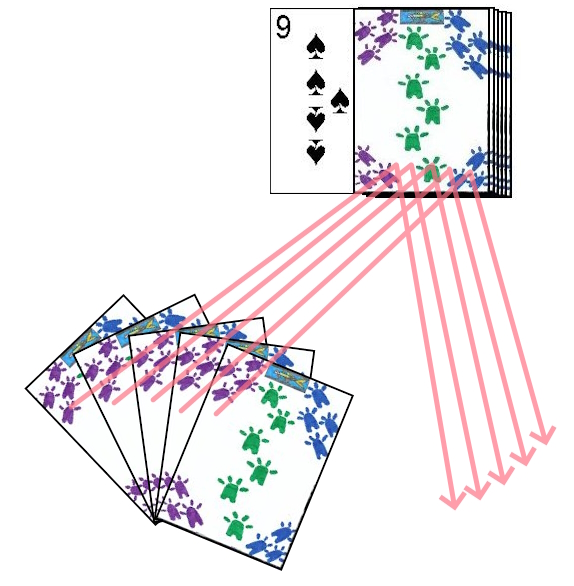
Each player, starting with the player at the dealer's immediate left has the option to discard up to five cards from their hand, and be dealt a similar number from the top of the stock by the dealer. A player can never discard and request more cards than are left remaining, thus once the stock cards have been used, subsequent players may not discard
or request replacements. The card used to designate the trump suit may never be exchanged and
thus remains face-up on the table throughout the hand.
Before the first card to the first trick is played, any player who did not request new cards from the stock may elect to resign. Starting with the player to the immediate right of the dealer and continuing in a clockwise direction, each player thus has one opportunity to thus resign from this hand. The player simply states this and places their hand face-down on the table, not participating further in that hand. If all players except one drop during a hand, the only remaining player automatically wins the hand, subtracting five points from their current score. A player who currently stands at
exactly one point, however, may never drop or resign from the hand.
The hand is then played out in a series of tricks (called "gers") in which each active player contributes one card. The player to the immediate left of the dealer plays the first card to the first trick and each other active player then plays a card to the same trick
in a clockwise order.
The leader to a trick may play any card of choice remaining in their hand to start the trick. Each other player must then play a card of the suit initially led to the trick or a card of the trump suit. If the player does not have a card of the originally led suit or
a card from the trump suit, they may play any card from their hand to the trick.
After each active player has played one card to the trick, it is determine who then won the trick. The player of the highest card in the trump suit to the trick wins it, or, if the trick contains no cards in the designated trump suit for that hand, the highest card of the suit originally led to the trick wins it.
Cards won in tricks should be set aside and out of play and the winner of each trick leads the first card to the next trick. After all five tricks have been played and won, the players determine how many tricks they have managed to win.
Each player is entitled to subtract one point from their current ongoing score for each trick that player managed to win during the hand. However, if a player wins no tricks during the hand (and did not drop
from this hand, if allowed), that player must add five points to their current ongoing score.
The first player, over the course of multiple hands, who manages to reduce their score to zero or fewer is declared the winner. If multiple players so manage to do this at the end of the same hand, the player who did this first during that hand (by order of tricks taken during the hand) is declared the game winner.
Copyright © 2015 CatsAtCards.com. All rights reserved.
 After all cards have been dealt, each player looks at their hand to determine their individual bid. If any player finds that his hand consists of no cards in the suit of spades or his hand contains no cards in the rank of Ace, King, Queen or Jack,
in any suit, he may (but is not required
to) show his hand, announcing this. In this event, all the cards are thrown in, reshuffled and the same dealer deals a new hand. If no player thus announces having no cards in the trump suit (spades)
or any high cards, a round of bidding then occurs.
After all cards have been dealt, each player looks at their hand to determine their individual bid. If any player finds that his hand consists of no cards in the suit of spades or his hand contains no cards in the rank of Ace, King, Queen or Jack,
in any suit, he may (but is not required
to) show his hand, announcing this. In this event, all the cards are thrown in, reshuffled and the same dealer deals a new hand. If no player thus announces having no cards in the trump suit (spades)
or any high cards, a round of bidding then occurs.