 Capture the Commander is a unique tabletop, layout type card game designed by Danny and Isabella Bruggeling. The game is designed for 2 to 4 players using one standard 52 card deck. Each card has a relative ranking value for comparison purposes which will be important during play of the game. The following are these relative rankings of the cards (from highest to lowest): Ace, King, Queen, Jack, 10, 9, 8, 7, 6, 5, 4, 3, 2.
Determination of the dealer can be determined using any method with a random draw of cards from a shuffled deck a common practice. Using that method, whichever player draws the highest ranked card would be set as the first dealer. If subsequent hands are to be played, the identity of the dealer should rotate around the table in a clockwise direction around the table after each game.
The dealer should then thoroughly shuffle the deck and offer it to the player at his right to cut. After the cut, the dealer then distributes 13 cards to each player, one at a time and face-down, starting with the player at his left and continuing in a clockwise direction. Any remaining cards should be set aside, out of play during that game. All cards should be dealt in a pile to each player, and the recipient of the cards should not look at the cards he has been dealt. Although the player may not look at his dealt cards, he may reshuffle his stack, if preferred.
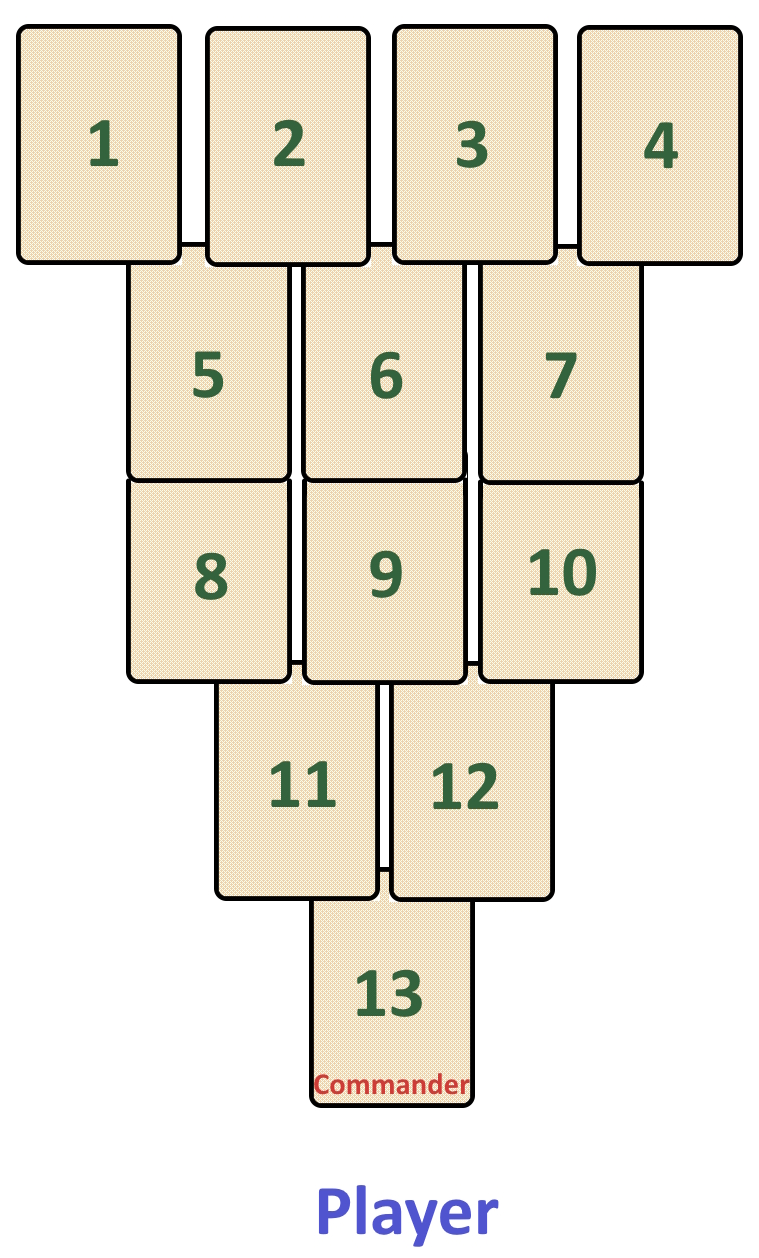
Each player should then arrange his dealt cards into a specific face-down layout of cards (still without looking at his cards). This layout should be in a somewhat triangular format, with the first row (as nearest to the player) consisting of a single card, the next row, two such cards, the third and fourth rows each consisting of three cards and the last row consisting of four cards. Each row should partially overlap the cards in the previously dealt row.
The first, single row card, placed closest to each player, is considered that player's Commander, and the object of the game is to thus defend that card, while at the same time attempting to capture the Commander card of the other players.
During play, a card that has no other cards overlapping it is considered "fully uncovered", a card that has exactly one card overlapping one side of the card is considered "partially covered" and a card that is overlapped by two cards or one card directly on top of it is considered to be "fully covered". There are certain restrictions on the player of cards based on the amount of coverage that card has at any specific time during play. Thus, in the diagram showing the game's initial layout, cards 1, 2, 3 and 4 would be considered completely uncovered. Card 5 is considered fully covered (by cards 1 and 2), card 6 is considered fully covered (by cards 2 and 3), card 10 is considered fully covered by card 10, card 12 is considered fully covered by cards 9 and 10, and the commander card is considered fully covered by cards 11 and 12.
The player to the immediate left of the dealer has the first turn, and the turn to play then rotates in a clockwise direction around the table.
A player on his turn then selects any "fully uncovered" card from his personal layout to attack a card from an opponent's layout. This card can elect to attack any "partially covered" or "fully uncovered" card on any opponent's layout. Both cards are then temporarily exposed to show the values on that card. The lower ranked of the two cards in this "battle" is then removed from the player's layout from which it was found. These removed cards thus set aside out of play. The higher ranked card is then replaced, face-down back in it's original location. If both cards are of the same rank, both players involved in this "battle" select any card adjacent to their card involved in the battle, and the higher of these cards then wins the battle. If they are again equal, another such adjacent card is exposed, until non-equal cards are turned by both players. A card is considered adjacent to another card if that card is partially of fully covered by the other card, or directly next to, and in the same row, as the other card. If a player has no more adjacent cards in the event of such a tie in card ranking and the other player still has remaining cards, the player with the fewer cards must drop from the game, his Commander card thus having been captured. If both players have the same number of cards, and the last card exposed is a tie, both players are eliminated (in a two player game, the entire game is then considered a tie).
Similarly, if a player's commander is beaten by another card during a battle, that player is eliminated. Play continues until there is only one player remaining who still has his Commander card, with that player declared the winner.