Cau Robat is a Spanish card game from the fishing family of card games and is most commonly played in the Catalonia area of Spain. The game is usually played by from 3 to 5 participants and is a relatively complex variant of the normal fishing type card game.
The game is traditionally played using the 40 card Spanish suited deck. This deck contains 10 cards each in the four Spanish suits of coins, glasses, swords and batons. Each of these suits would thus contain one card in each of the denominations of 1, 2, 3, 4, 5, 6, 7, Sota, Horse and Rei. If a Spanish deck is not at hand for play, a standard 52 card deck can be used, removing from play all cards of rank 8, 9, 10. The ranking of the cards in these decks would be as follows (from lowest to highest): 1 (Ace), 2, 3, 4, 5, 6, 7, Sota (Jack), Cavalla or Horse (Queen), Rei (King). Since sequences of cards are valid captures in the game, it should be noted that the Sota (Jack) is considered next in sequence directly after the 7. In addition, the 1 (Ace) can be considered in sequence after the Rei (King) to allow sequences to be extended, such as Cavalla (Queen), Rei (King), 1 (Ace), 2.It should also be noted that each card in this deck has a capture value, which will also facilitate another method of capturing cards in the game:
Determination of seating positions and first dealer can be performed using any method, with a draw for high cards common. Using this method, each player would thus draw one card from the shuffled, face-down deck. Any players drawing cards of the same rank would discard the duplicated cards and draw another. After each player has drawn a uniquely ranked card, the players would then compare cards drawn and take their choice of seats in order from highest drawn card to lowest. The player drawing the highest ranked card of all is set as the first dealer. After each hand, the role of dealer rotates around the table in a counter-clockwise direction.
The dealer for the hand, then shuffles the deck and offers it to the player at his left for the cut. After the cut, the dealer then deals a number of cards from the top of the deck, face-up in a row in the middle of the table. For a game consisting of 2, 3 or 4 players, he would deal four such cards. For a 5 player game, he would deal five of these cards to the center of the table. If there are multiple cards of the same rank, the duplicates should be shuffled back into the deck and a replacement card dealt, ensuring that the cards dealt to the center of the table are all of different denominations. The dealer then deals the remainder of the deck out to the players, starting with the player at his right and continuing in a counter-clockwise direction. The cards are dealt in face-down packets of three cards. Note that in the five player game, after each player has received two packets of three cards, the dealer should then deal one final card to each of the players.
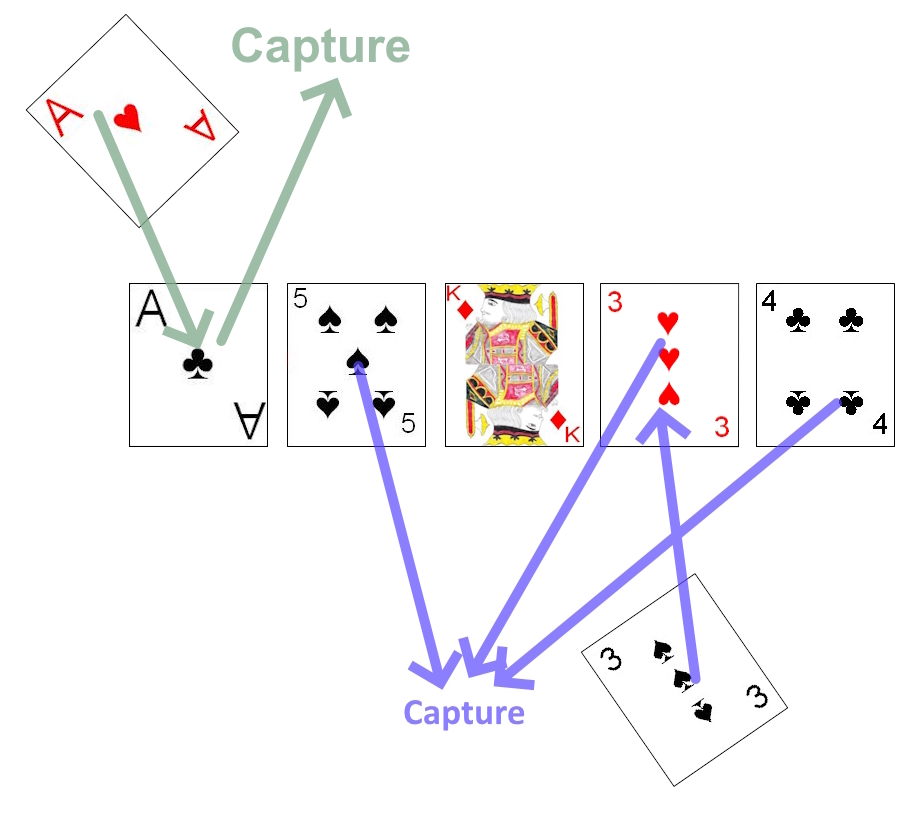 The player to the right of the dealer has the first turn, and the turns then continue in a counter-clockwise direction around the table. On each turn, a player must play one of his cards face-up to the center of the table. Since the
ultimate goal of the game is to capture the most cards during play, a player will usually strive to capture one or more cards based on the card thus played.
The player to the right of the dealer has the first turn, and the turns then continue in a counter-clockwise direction around the table. On each turn, a player must play one of his cards face-up to the center of the table. Since the
ultimate goal of the game is to capture the most cards during play, a player will usually strive to capture one or more cards based on the card thus played.
There are two primary methods in which cards can thus be captured from the table on a player's turn, which are as follows:
- If the card played is of the exact same denomination as another card on the table, the player of that card may thus capture that card, placing both the capturing and captured card in their capture pile.
- If there is an ascending sequence of two or more cards on the table (regardless of suit) and the card played is equal to the first card in that sequence, the player may thus capture the entire sequence. The capturing card and the cards captured are thus added to that player's capture pile.
When adding captured cards to a player's capture pile, they should be placed in a specific order. In placing a sequence, the sequence should be added to the pile in descending order from highest to lowest card, with the capturing card placed on the top. For a matching card, the captured card should be placed first with the capturing card placed on top. The capture pile is always retained face-up in front of the player to whom it belongs to.
The top card from opponents' capture piles can also be considered part of the table cards for purposes of sequences. If this card can be formed as part of a sequence from the table, that the player could legally capture, they would thus capture the cards from the table which are part of the sequence as well as the entire capture pile that contained the card which could be used as part of that same sequence. The opponent's pile should be added to a player's capture pile in the location of which it's top card would reside in the sequence. As an example, if the table contained the cards 3, 5, and an opponent's capture pile was headed by a 4, a player on his turn could play a three, and capture the 3 and 5 from the table (for the sequence of 3, 4, 5) as well as the entire pile which was topped by the 4. The cards would be placed on this player's capture pile in this order. Start with the 5, then the entirety of the capture pile that was topped by the 4 (including the four), next the captured 3, and lastly the three used to capture these cards. In order for a player to capture an opponent's capture pile in this way, the top card of that opponent's play pile may not represented on the table.
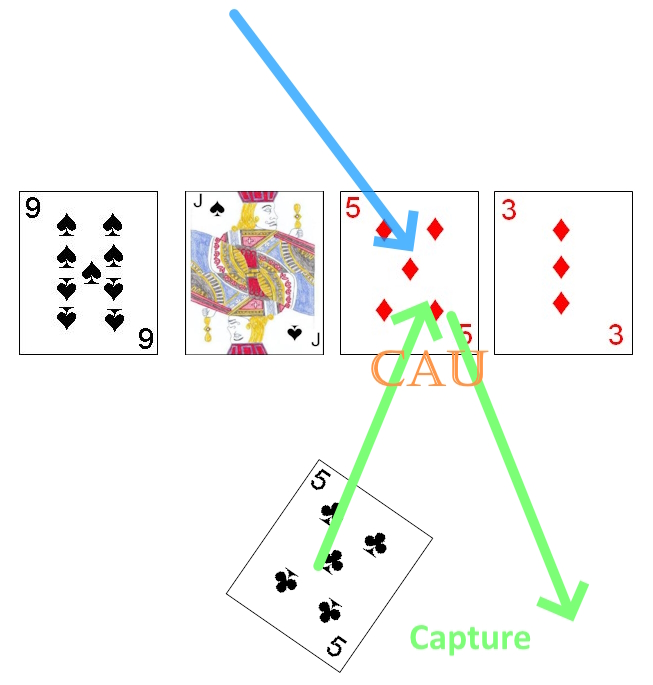 There are also a few other situations during the game in which a player
can win or capture cards from other players. If the immediately preceding
player plays a card, and the next player in turn plays a card of the same
denomination (thus capturing this card), the player making that capture
may announce "cau". This forces the player who played the previous card
to give you the top card from his capture pile. This card is played on
the top of the capturing players capture pile after he captures the
appropriate card from the table. However, if the third player in sequence
can play a third card of that same denomination, he may immediately
announce "recau". This player then captures the matching cards, and the
previous player must give him the top two cards of his capture pile and
the player playing the first card of that rank in sequence must give that
player one card from the top of their capture pile. Lastly, if the fourth
player in turn has the fourth (and last) card of that same denomination,
he may announce "contracau". This player then captures all the cards of this denomination played, while each of the previous players playing cards of that same denomination must give that player cards from their capture pile. The player of the first card of that denomination must give the player the top card from their play pile, the player of the second card of that rank must give the player two cards from their play pile, and the player of the third card must give the player of that fourth card the top three cards from the top of their capture pile. If the played card is also the beginning card of a sequence on the table, the final player to make this capture may also capture the cards comprising the sequence as well.
There are also a few other situations during the game in which a player
can win or capture cards from other players. If the immediately preceding
player plays a card, and the next player in turn plays a card of the same
denomination (thus capturing this card), the player making that capture
may announce "cau". This forces the player who played the previous card
to give you the top card from his capture pile. This card is played on
the top of the capturing players capture pile after he captures the
appropriate card from the table. However, if the third player in sequence
can play a third card of that same denomination, he may immediately
announce "recau". This player then captures the matching cards, and the
previous player must give him the top two cards of his capture pile and
the player playing the first card of that rank in sequence must give that
player one card from the top of their capture pile. Lastly, if the fourth
player in turn has the fourth (and last) card of that same denomination,
he may announce "contracau". This player then captures all the cards of this denomination played, while each of the previous players playing cards of that same denomination must give that player cards from their capture pile. The player of the first card of that denomination must give the player the top card from their play pile, the player of the second card of that rank must give the player two cards from their play pile, and the player of the third card must give the player of that fourth card the top three cards from the top of their capture pile. If the played card is also the beginning card of a sequence on the table, the final player to make this capture may also capture the cards comprising the sequence as well.
If one player manages to capture every card currently found on the table, each other player must give the player who so makes that capture the top card of their capture piles. The cards are given (and added to that player's capture pile), in order of turn after the player who cleared the table. If a player does not have enough cards in their capture pile to give to a player who earned the cards, the player would give these additional cards as soon as able (once capturing enough cards to give to that player).
After the player's have all played their last cards, the hand ends (any cards remaining in the center of the table are not awarded to any of the players) and each players makes a count of the total number of cards currently in their capture piles. The player with the highest count of cards is thus declared the winner of the hand. Usually, a number of hands are so played and the player who managed to win the most hands is declared the overall game winner.
Variations and Optional Rules
Three Card Hands: Some players prefer to play the game with three card hands. In other words, the dealer initially deals out three cards to each player, as well as four cards to the center of the table (or five cards if five players are participating) leaving the remainder of the deck for use later in the hand. After each player plays the three cards forming their hands, the dealer then deals three more cards to each player, continuing in this manner until the last of the deck has been dealt and the players play out the last three cards in their hand, ending the hand.
No Sequences in Caus: Another optional rule that is sometimes adopted is that, in a call of a Cau, Recau or Contracau, the player may not consider for capture any cards from a sequence but only cards that are of the exact same rank.
Cau: In the variant of this game which is played under the name "Cau", each player keeps his capture pile face-down. This thus prevents the capturing of an opponents capture pile, as each player's capture pile is always retained face-down. Other than this change (which can significantly simplify the game), the game is played the same as the parent game.
No Sequences in Caus: Another optional rule that is sometimes adopted is that, in a call of a Cau, Recau or Contracau, the player may not consider for capture any cards from a sequence but only cards that are of the exact same rank.
Cau: In the variant of this game which is played under the name "Cau", each player keeps his capture pile face-down. This thus prevents the capturing of an opponents capture pile, as each player's capture pile is always retained face-down. Other than this change (which can significantly simplify the game), the game is played the same as the parent game.