 Czech Rummy has been the most popular Rummy type card game in the Czech Republic (now known as the country of Czechia) since at least the 1960's. In that country, this game is often known simply as Rummy. Czech Rummy is designed for 2 to 5 players and uses two standard 52 card decks shuffled together with the addition of four total Jokers. The ranking of the cards as found in this deck (mainly for purposes of sequence melds) is as follows (from highest to lowest): King, Queen, Jack, 10, 9, 8, 7, 6, 5, 4, 3, 2, Ace. The four Jokers are considered wild cards and can be used to replace any other missing card in a meld.
Determination of seating positions and the identify of the first dealer can be performed using a variety of methods. One common such method is for each player draw one card randomly from a shuffled deck. The player drawing the highest ranked card of all is set as the first dealer for the game and thereafter, the role of dealer rotates in a clockwise direction around the table after each hand.
The designated dealer should thoroughly shuffle the cards and offer the cards to the player at his right for the cut. After the cut, the dealer then begins distributing the cards, starting with player at his immediate left and continuing in a clockwise rotation around the table, until each player has twelve total face-down cards. The dealer then places the remainder of the deck face-down as the stock pile near the middle of the table, and turns the top card from the stock, placing it face-up next to the stock pile to start the discard pile. If the turned-up card is a Joker, it is usual to simply shuffle the Joker back into the stock, and replace it with the next card from the top of the stock.
The player to the immediate left of the dealer has the first turn, and the turns then proceed in a clockwise direction around the table. Each turn consists of a number of actions for which a player will take:
Draw: To start his turn, each player will have the opportunity to draw one card. The player may either draw the top, exposed card from the stock pile, adding it into their hand. Alternatively, the player may instead take the top face-down card from the stock, also adding it to his hand.
Melding: After the draw, a player on his turn may then meld cards, if willing and able. A meld consists of various legal combinations of cards. The following are the legal meld types allowable in Czech Rummy:
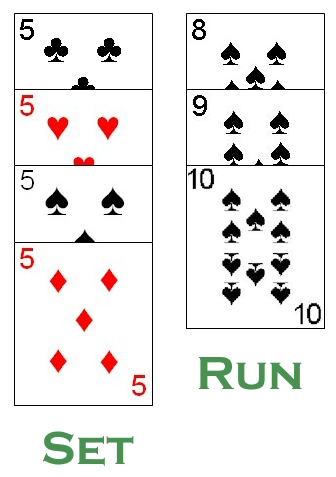
- Set: A set is a collection of three or more cards all of the same rank (i.e. four fives).
- Run: A Run is a collection of three or more cards all in direct sequential order and all of the same suit (for example the 8, 9 and 10 of spades).
| Card | Point Value |
|---|---|
| Ace | 1 |
| King | 13 |
| Queen | 12 |
| Jack | 11 |
| 2, 3, 4, 5, 6, 7, 8, 9, 10 | Point value as marked on card |
A Joker is considered to have the same value, for purposes of this initial meld, equal to the point value of the card it is replacing in the meld.
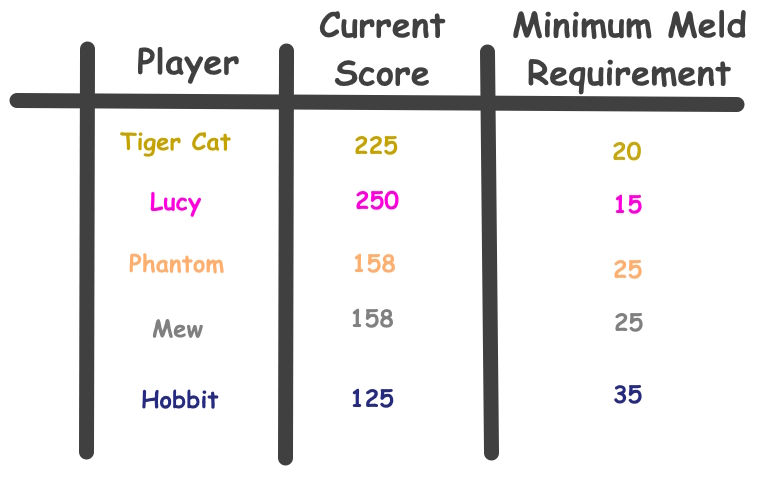 After the first round, the required minimum number of points for a player's initial meld of the hand is based on their particular point total as compared to the other active players:
- For the player who currently has the most total accumulated points, the minimum points required for the initial meld is 15.
- For a player with exactly one other player having a higher score, that player's initial meld requirement is 20.
- In the situation of a player having exactly two other players with a higher score, that player's initial meld requirement is 25.
- For a player having exactly three other players with a higher total score, this player's initial meld requirement for the hand is set at 30.
- For a player with four other players having a higher accumulated score, this player's initial meld requirement is 35.
Once a player has made their initial meld, they may then make any additional legal melds on the same or later turns or lay-off cards to their own melds that they have previously played to the table. If a player has the proper replacement natural card for a Joker used in any meld on the table (from melds they themselves have made or a meld played by another player), they may replace that card with the Joker, taking the Joker into their hand. However, this can only be done once a player has made their initial, required meld.
Discard: Each player then ends the turn by discarding any card from his hand face-up to the top of the discard pile. A player may never discard the same card they drew from the discard pile.
The hand continues in this manner until any player manages to "go out" by either melding all of his cards (over one or more turns) to the table, or by melding all but one card and then, discarding his last card as his normal discard to end the turn. Once any player manages this, the game immediately ends. The player who managed to deplete their hand scores nothing, however each other play must add to their current, ongoing score a number of points based on the cards remaining in their hand, regardless of whether these cards could be melded or not. The value of each card is the same as shown in the chart above. The point value for a Joker remaining in the hand is 15 points.
The hand can also come to an end if the stock pile is exhausted, and a player, on their turn to draw, would want to draw from this empty stock. At this time, the hand immediately ends and each player must add to their ongoing score a number of points equal to the card point value for each card remaining in the hand (regardless of whether that card could be legally melded to the table).
If a player reaches or exceed 300 points, that player must drop from the game. The last player remaining with a score lower than 300 is declared the game winner. If, on a hand, all the remaining players reach or exceed 300, the game winner is the player with the lowest such score.