Fipsen is the name of several trick-taking card games from Germany, which appear to have a number of elements from both Skat and Napoleon (Nap). The variant of Fipsen which appears to be the most widely still played is the Prisdorf variant, which will thus be described first. However, other variants of the game are described in the "Variations" section below.
Prisdorf Fipsen is designed for play by four players (each playing independently) and uses a somewhat unusual pack consisting of 25 total cards. This deck would consist of all cards from denomination seven to Ace in the suits of hearts, clubs and spades. To these 24 cards, one card from the suit of diamonds, the seven, is also included. The ranking of the cards in the suits of hearts, clubs and diamonds is as follows (from highest to lowest): Ace, King, Queen, Jack, 10, 9, 8, 7. The suit of diamonds, of course, only has one card, so this card is both the highest and lowest in that suit.
Determination of seating positions and first dealer can be performed using a variety of methods, with a draw for high cards commonly used. Each player would thus draw a card from the shuffled deck, and any players drawing cards of the same rank as another player would draw again until drawing a card of a unique denomination. The players would then take their choice of seats at the table in ranking order of cards drawn from highest to lowest. The player drawing the highest ranked card of all is set as the first dealer. After each hand, the role of dealer rotates around the table in a clockwise direction for the next hand.
The dealer then shuffles the deck to be used for the game and offers it to the player at his right to cut. This player may either cut the cards or decline, which indicates no cut. Next, the dealer begins distributing the cards. He begins by dealing each card, in a clockwise direction, a packet of two face-down cards. He then deals two cards face-down to the center of the table as the skat. He then deals each player an
additional packet of three face-down cards, such that each player receives five total cards, and there is a skat of two cards in the center of the table. The remaining three cards from the deck are set aside, usually out of play.
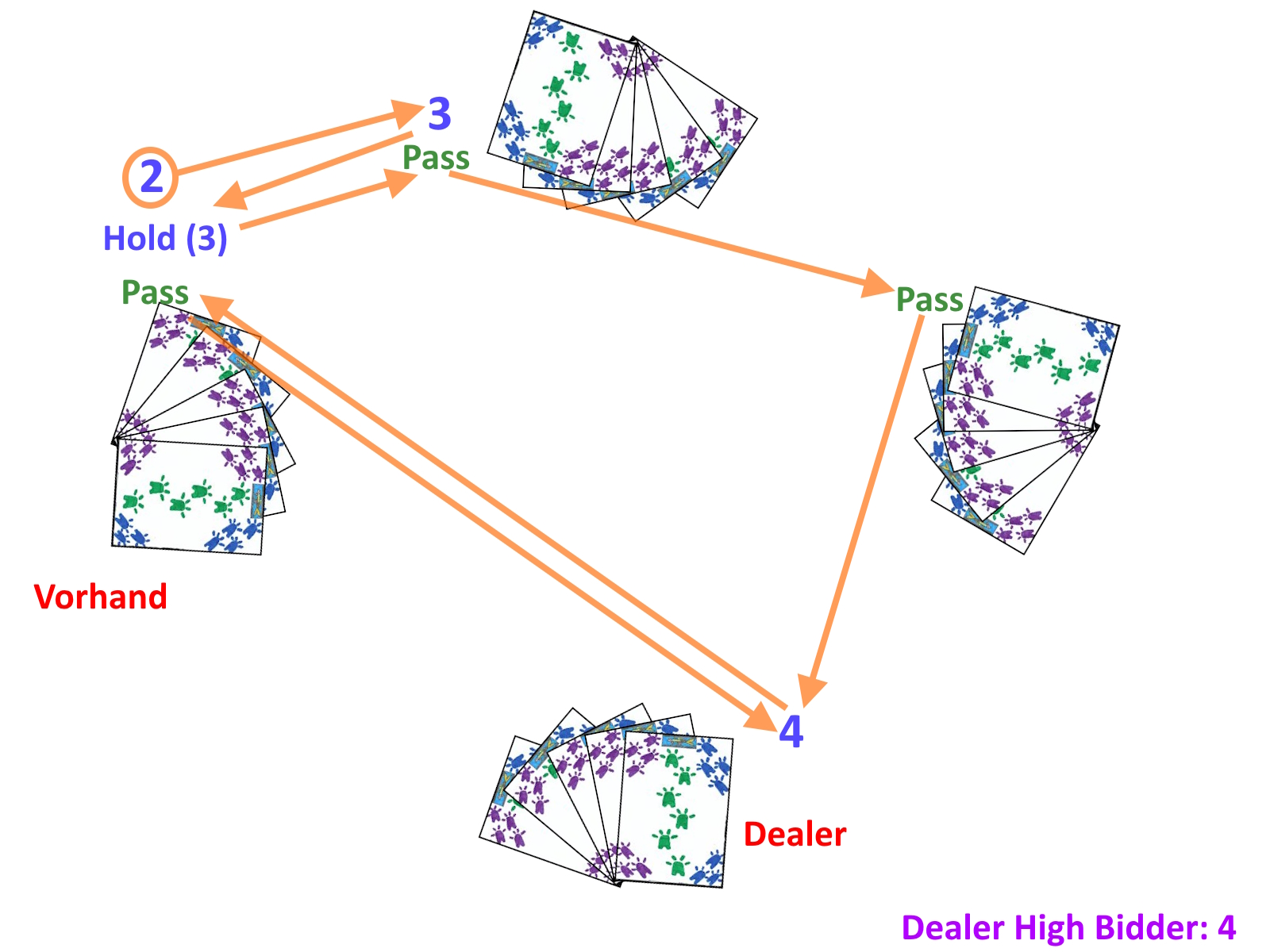
After the cards have been dealt, the players then bid in a format reminiscent to the game Skat. The bidding thus starts with the player to the immediate left of the dealer (called Vorhand). This player may make any legal bid or pass. If he passes the opportunity to bid rotates in a clockwise direction around the table until a player makes a bid. If all four players pass, the cards are shuffled together and redealt by the same dealer. Once a player passes, he may not, in the same hand, make any further bids.
Once a player makes a legal bid, the player at the right of that player (if he has not already passed), may then opt to make a higher bid than this players bid or pass. If he makes a higher bid, the current high bidder may then
hold this higher bid (indicating he matches that bid), make a higher bid or pass. If the player does not pass, he must then either make a higher bid himself or pass. Once one of these players passes, whichever player is the highest bidder is then considered the high bidder, and the player at that players right may then opt to higher. If that player does bid higher, the previous high bid holder may either hold that bid, make a higher bid or pass. The bidding continues in this manner around the table, until all players have passed except one, which is declared the high bidder.
In bidding, a player declares a number from two to five, which is a declaration of the number of tricks the player expects to win during the hand. A higher numbered bid overcalls a lower numbered bid. In addition, there are certain
modifiers that can be added to the bid that will increase the value of that bid (and also increase the scoring for that hand). The following are allowable modifiers to a bid:
- Hand:
The bidder indicates he will play the hand without taking the cards from the two card
skat to assist him during the hand. This call, if ending up being the highest bid, will also double the score for that hand.
- Ruten:
The bidder adding "Ruten" to his bid, indicates he will be setting the trump suit to diamonds for the hand. Since there is only one card in the suit of
diamonds in play, there is only one card of the trump suit, which can make it more difficult for the declarer to obtain their bid. Thus, this also doubles the score for the hand.
Thus, in bidding, a player announces a number and then, optionally can add the modifiers Hand or Ruten. A bid of the same number but with one modifier is considered higher than a bid of that same number with no modifiers and a bid of the same number with two modifiers is considered higher than a bid of that same number with only one modifier. In addition to the standard bids, there is also the special bid of "Kieker" available to a player. This bid has a value higher than a bid of four (with any number of modifiers) but lower than any bid of five. This bid is only allowed (but not required) for a player who finds that his hand contains no royalty cards (cards in the rank of Jack, King or Queen). A bid of Kieker requires that bidder to win five tricks to make a successful bid. A player bidding Kieker may also add the modifier of Ruten to their bid.
Once the high bid is determine, play of the hand can begin. If the ultimate high bid was not Kieker and did not include the modifier "Hand", the high bidder may take the two cards from the face-down skat into their hand and then discards any two cards face-down to the side, out of play. The player may also opt not, even if they did not bid hand, to not take these cards, which will also double the scoring value for this hand. If the bid included the Ruten modifier, the suit of diamonds must be set as the trump suit for the hand. Otherwise the high bidder may declare any suit as the trump suit. If they select the suit of diamonds, this retroactively sets the bid to Ruten, and will double scoring on this hand.
If the high bid was a Kieker, the player must briefly show any other player his current five card hand (to verify he did not have any royalty cards). He then picks up not only the skat, but the three leftover cards from the initial deal. He then discards any five cards from the hand to reduce his hand back to five total cards. If, after this draw, the Kieker bidder does not believe he can win all five tricks, he may resign the hand without play and subtract 5 points from his current accumulated score.
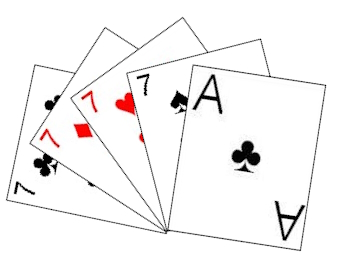
Before actual play begins, any player finds that he has in hand, all four sevens and any Ace, he announces this by stating "Siebener Fips" and immediately wins the hand, adding 30 points to his current score. The hand need not be played and no other scores for any other players are calculated on that hand.
The player to the immediate left of the dealer (Vorhand) leads the first card to the first trick, and each other player, in a clockwise direction, in turn, plays a card to that same trick.
The leader to a trick may play any card of choice to lead to a trick. Each other player must then play a card of the same suit as originally led to the trick if they have such a card. If they have no such card, they may play any other card from their hand, including a card from the designated trump suit, if they have one.
After each player has played one card to the trick, it is determined who has thus won the trick. The player of the highest card in the designated trump suit wins the trick. If the trick contains no cards in the designated trump suit, the player of the highest card in the suit originally led to the trick wins it. Cards won in tricks are set aside and out of play, the winner of the previous trick leads the first card to the next trick.
Once the declarer, during the hand wins, the required number of tricks as per his bid, he can stop play of that hand. However, if he has not yet lost a trick, he can opt to continue playing, in an attempt to win all five tricks (called "Durch"). If he manages to so win every trick in that hand, his score for the hand is doubled. However, if he fails to win all five, after attempting to continue for the durch, he must instead subtract from his current score double the amount of his bid.
If the declarer thus manages to earn his bid, he earns a score equal to the amount of his bid (1 to 5). A Kieker bid requires the player to win all five tricks. Although it has a base value of 5 points, because it includes the double for durch, the bidder will win 10 points for achieving this bid. If the declarer fails to win all five tricks in a Kieker bid, however he must subtract 20 points from his score. A kieker bid may also include the ruten modifier which would then double these scoring values.
There are also several situations which can be applied to double this score, as follows:
- If the high bid was Ruten, or the declarer selected diamonds as the trump suit, the hand score is doubled.
- If the declarer manages to win all five tricks (durch) his score is doubled.
- If the declarer announced the "hand" modifier (play the hand without the aid of the skat), the score for the hand is doubled.
- If the declarer failed to win at least as many tricks as bid, or attempts to continue for the durch and does not win all five tricks, the score is doubled.
Each applicable situation for the hand can be applied, which can thus cause the final score for the hand to be doubled multiple times.
It should be decided before hand the number of total deals which are to be played. In a standard Fipsen tournament, for example, 100 total deals are played. Once the requisite number of deals have been played, the player with the highest total accumulated score is declared the overall game winner.
Three Player Prisdorf Fipsen: A three player variant of Prisdorf Fipsen is also occasionally played. This variant is played identically to the game as described above, with the following few differences:
- Each player still receives 5 total cards, and a skat of two cards is dealt to the middle of the table. This leaves eight cards,
however, which are set aside and out of play.
- If a kieker bid is the ultimate high bid for the hand, that bidder then discards his five cards and takes both the skat the eight extra cards to for a new hand. That player then discards five of these ten cards to form his new hand.
- In a three player Fipsen tournament setting, 120 deals is usually played.
In all other aspect the Three Player variant is played the same as the standard, more common, four player version.
Großenaspe Fipsen: In the Großenaspe
municipality of Germany a somewhat different variant of Fipsen is also
played. This game is also for four participants each playing independently. It uses the full 32 card Skat deck, with the cards ranked, in every suit as follows (from highest to lowest): Ace, King, Queen, Jack, 10, 9, 8, 7.
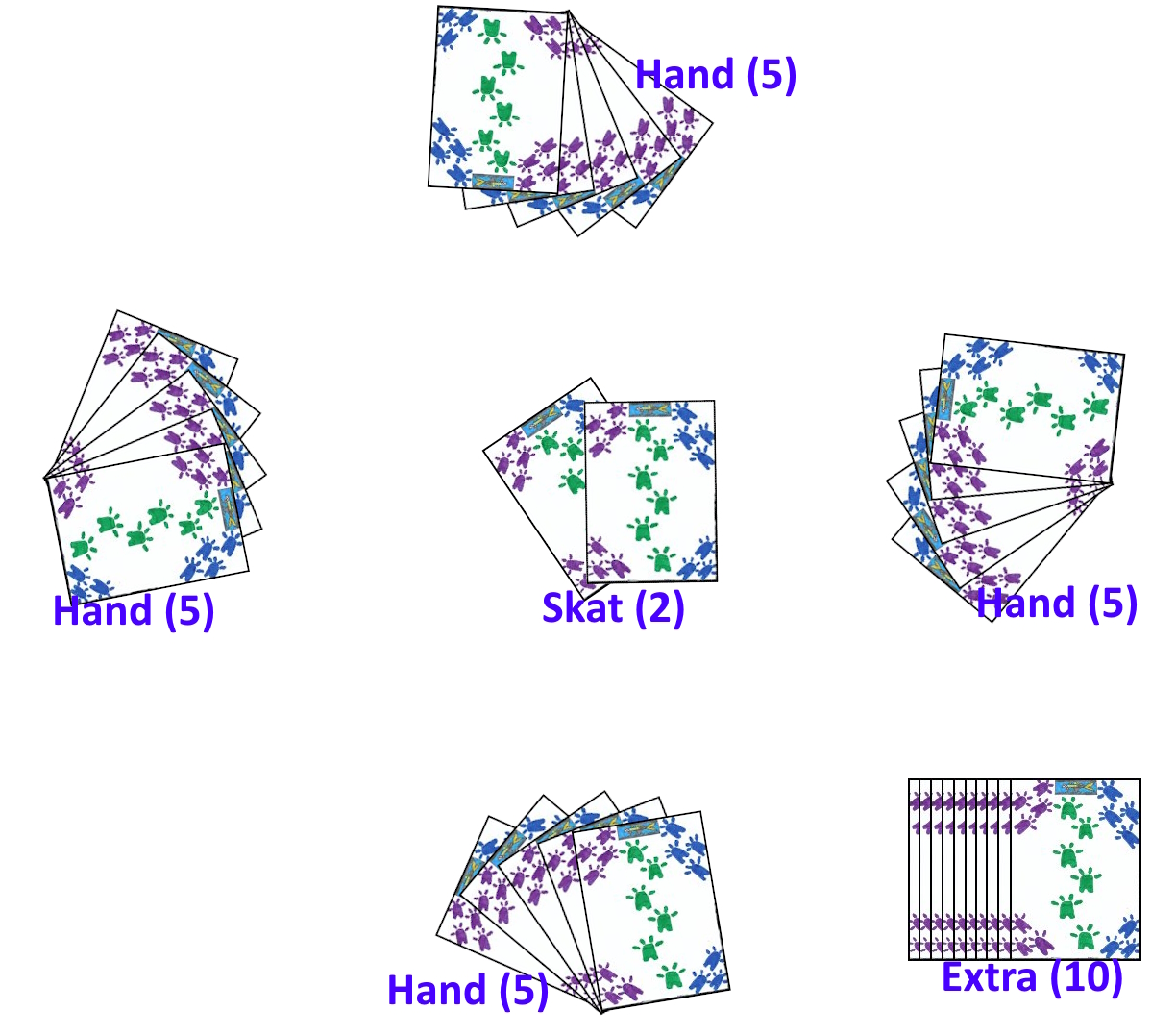
In this variant, the cards are usually not cut after the shuffle. The dealer then deals each player a packet of two-face-down cards, then two face-down cards to the center of the table as the skat. He then deals each player a packet of three face-down cards. He places the remaining 10 cards in a face-down pile to the side.
There is then a round of bidding, which starts with the player to the immediate left of the dealer and proceeds in a clockwise direction around the table. The minimum bid is one and each player must either pass (by announcing "weg") or make a bid higher than the previous high bid. Once a player passes, they may not make further bids on this hand. If all four players initially pass, the cards are gathered together, shuffled and redealt by the same dealer.
A player may also add the special modifier "Gute" to his bid, which indicates that he will play the hand using the suit of clubs as the trump suit for the hand. A bid with the "gute" modifier is considered higher than a bid of the same number without this modifier included.
In addition to the normal bids as mentioned there are two special bids that a player can announce:
- Kieker (also known as Gucker)
: This bid, which has a bidding value higher than "4 Gute" but lower than a bid of 5, is a bid to win all five tricks after discarding and replacing the bidder's hand. This bid can only be made by a player with no court cards (Jack, Queen, King) in their initially dealt hand. If the Kieker bid ends up being the highest bid, it's bidder discards their entire hand, picks up the skat and the 10 extra cards which were not dealt from the pack during the deal. He then discards any seven of the cards from his hand leaving him with a hand of five cards.
- Fips
: Fips is a bid to win all five tricks during the hand, playing only with the five cards they have originally been dealt (they may not pick up the skat). This bid is considered the highest bid of all, and the modifier "Gute" can also be added to the bid, which sets the suit of clubs as the trump suit for the hand.
Once the high bidder has been determined, this player then picks up the two skat cards, adding these cards to their hand (except in a bid of Fips). The player then discards any two cards from their hand and sets them aside, out of play. The player then announces the trump suit to be used for the hand, unless the modifier "Gute" was added to the bid which requires that clubs be the trump suit for this hand.
The player to the immediate left of the dealer leads the first card to the first trick, and each other player, in turn, then plays a card from their hand to that trick. The leader to each trick can play any card of choice to that trick. Each other player must play a card of the same suit as originally led to the trick if having such a card. If the player does not have a card in this suit, they may play a card of any other suit, including from the trump suit.
After each player has played one card to the trick, it is determined who has thus won it. If the trick contains any cards from the designated trump suit, the player of that card wins the trick. If the trick contains no such cards, the player of the highest card in the same suit as the first card played to that trick wins it. Cards won in tricks should be set aside and out of play. The winner of each trick then leads the first card to the next trick.
Once the declarer wins enough tricks to fulfill his bid, he can immediately stop play. However, if the player has not yet lost a trick during this hand, he may instead opt to attempt to continue playing to win all five tricks. In this event, that player's bid is immediately considered to be five.
If the declarer manages to win at least the number of tricks as per his bid, he scores that amount, adding it to his ongoing accumulated score. This value is doubles if the hand was played in the suit of clubs. However, if he does not win at least as many tricks as bid, he must subtract a number of points from his score. If he won at least one trick, but less than his bid, each opponent instead earns the amount of that bid, or double the amount of the trump suit used for the hand was clubs. If the declarer fails to win at least one trick, each opponent scores 5 points, or double this amount if clubs was set as the trump suit for the hand.
In a bid of kieker, the declarer must attempt to win all five tricks. If he succeeds, he earns a total of 10 points, or 20 points if clubs was used as the trump suit for the hand. If he fails, this value is scored by each opponent instead. In a kieker bid, if, after drawing the new hand, the player does not believe they can fulfill the bid, the player may resign the hand, with each opponent earning a score of 5 points, and no play on that hand. A successful Fips bid (winning all five tricks) earns the player 20 points
or 40 points if clubs was set as the trump suit. In a failed Fips bid, this amount is awarded to each opponent instead.
After a predetermined number of hands, whichever player has the highest total score is declared the overall session winner.
Thedinghausen Fipsen: Yet another variant of Fipsen is played in the village of Thedinghausen. Despite carrying the name of Fipsen, it has some significant differences from some of the other variants of Fipsen played in Germany.
Thedinghausen Fipsen is designed for play by five players, each playing independently. The standard 32 card skat pack is used, with the ranking of the cards being (from high to low) as follows: Ace, King, Queen, Jack, 10, 9, 8, 7.
The designated dealer first deals a packet of three face-down cards to each player. He next deals one card, face-up to the center of the table. The suit of this dealt card sets the trump suit for the hand. The dealer next deals a packet of two face-down cards to each player. The last six cards from the deck are then set aside, and out of play.
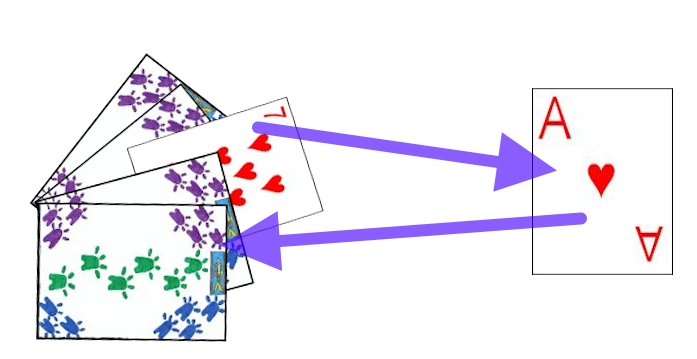
If any player has the seven of the designated trump suit and the turned up trump designated card was an Ace of that same suit, the player dealt that card may exchange the seven for the turned up trump Ace.
The player to the immediate left of the dealer plays the first card to the first trick. Each other player then plays one card to the trick, in a clockwise direction around the table. The leader to a trick may play any card of choice from their hand. Each other
player, if having a card of the same suit as initially led to the trick they must play that card. If they have no cards in that suit, they may play any card to the trick, including a card from the turned trump suit.
After each player has played a card to the trick in turn, it is determined who has thus won the trick. If the trick contains any cards from the turned trump suit, the highest card in that suit wins the trick. If the trick contains no cards in that trump suit, the highest card in the suit originally led to that trick wins it.
The cards won in the trick are set aside and out of play, and the winner of each trick leads the first card to the next trick.
Each player earns a score equal to the number of tricks won during that hand, and the first player to win ten tricks over any number of hands is the game winner.
Copyright © 2015
CatsAtCards.com. All rights reserved.