Fünfzehnern is a four player German trick taking game. It is known to have been commonly played at least before 1811. The name of this game translates from German to English as "Fifteen" or "Fifteening", which are also alternate names sometimes given for this game.
The game is traditionally played using the 32 card German deck, which consists of 32 cards in the suits of bells, leaves, hearts and acorns, with one card of the following denomination in each suit; Ace, King, Ober, Unter, 10 , 9, 8, 7. If such a traditional German suited deck is not available, a suitable deck can be created by removing all cards from below seven in a standard 52 card International deck. The ranking of the cards in this deck would thus be as follows (from high to low); Ace, King, Queen (Ober), Jack (Unter), 10, 9, 8, 7. As mentioned, the game is designed to be played by four players with each playing independently.
Determination of seating positions and the first dealer can be performed in a variety of ways, with cutting for high card a common method. Using that method, each player would thus randomly cut one card from the shuffled, face down deck. The players should then take their set of preference at the table, starting with the player drawing the highest ranked card and continuing from highest to lowest card cut. The player drawing the highest card of all is set as the first dealer, and thereafter the deal of each hand proceeds in a clockwise direction around the table.
|
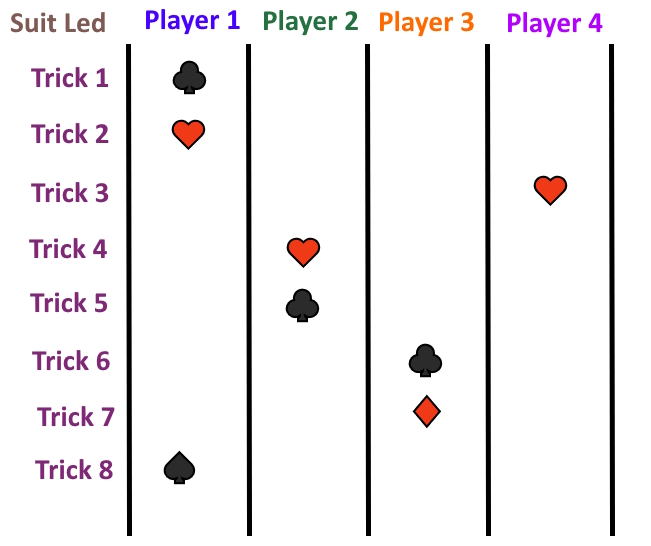
| Example of each player's leads, based on the very strict lead requirements in a hand of Funfzehnern. |
The player to the immediate left of the dealer leads the first card to the first trick, with each player contributing one card to the same trick in a clockwise direction around the table. On this first trick of the hand this player may lead using any card from his hand. And as long as this player retains the lead for each trick, that player may continue to lead to each trick using any card of choice remaining in his hand. However, once a player captures the lead from any other player (by winning a trick), their are restrictions on the lead card to a trick.
Thus, once a player wins the privilege to lead to a trick, with a different player having had the lead on the previous trick, a player must lead to the next trick a card of the same suit as that which the player was able to capture the lead. For example, if the player won the previous trick (and thus the lead) by playing the highest card in the suit of diamonds to the trick, he must then lead to the next trick with a card in the suit of diamonds. This second player to win the lead, if not having any cards in the suit led by the previous player, must then play a card in the suit that was led previous to the current winning suit. In thus playing a card of the required suit, the player must also play an unbeatable card in this suit (if he has such a card). An unbeatable card would be having any of the highest unplayed card (or cards) in that suit. If a player has exhausted all the suits that the former players had won tricks in, they may then play a card of any suit still remaining in their hand.
In playing a card to a trick led by another player, a player must play a card of the suit originally led to that trick (but need not play his highest if he elects not to). If a player has no cards in the suit originally led to the trick, the player may play a card from any suit to that trick.
After all four players have played one card to the trick, it is identified who has won the trick, with the trick won by the highest card played to it in the suit originally led to that trick. Cards won in tricks should be set aside in a face-down pile near the player who those cards, for later use in calculating points won during that hand. The winner of each trick then leads the first card to the next trick, and must follow any lead restrictions as described above.
Zwang Rule: If a player, having both the King and Queen of the same suit, and is legally able to lead that suit, may lead the Queen and announce "Zwang" upon leading that card. The player who has the Ace of that same suit must play it when it is their turn to play to that same trick. This allows the player to later attempt to win the King in that same suit on a later trick.
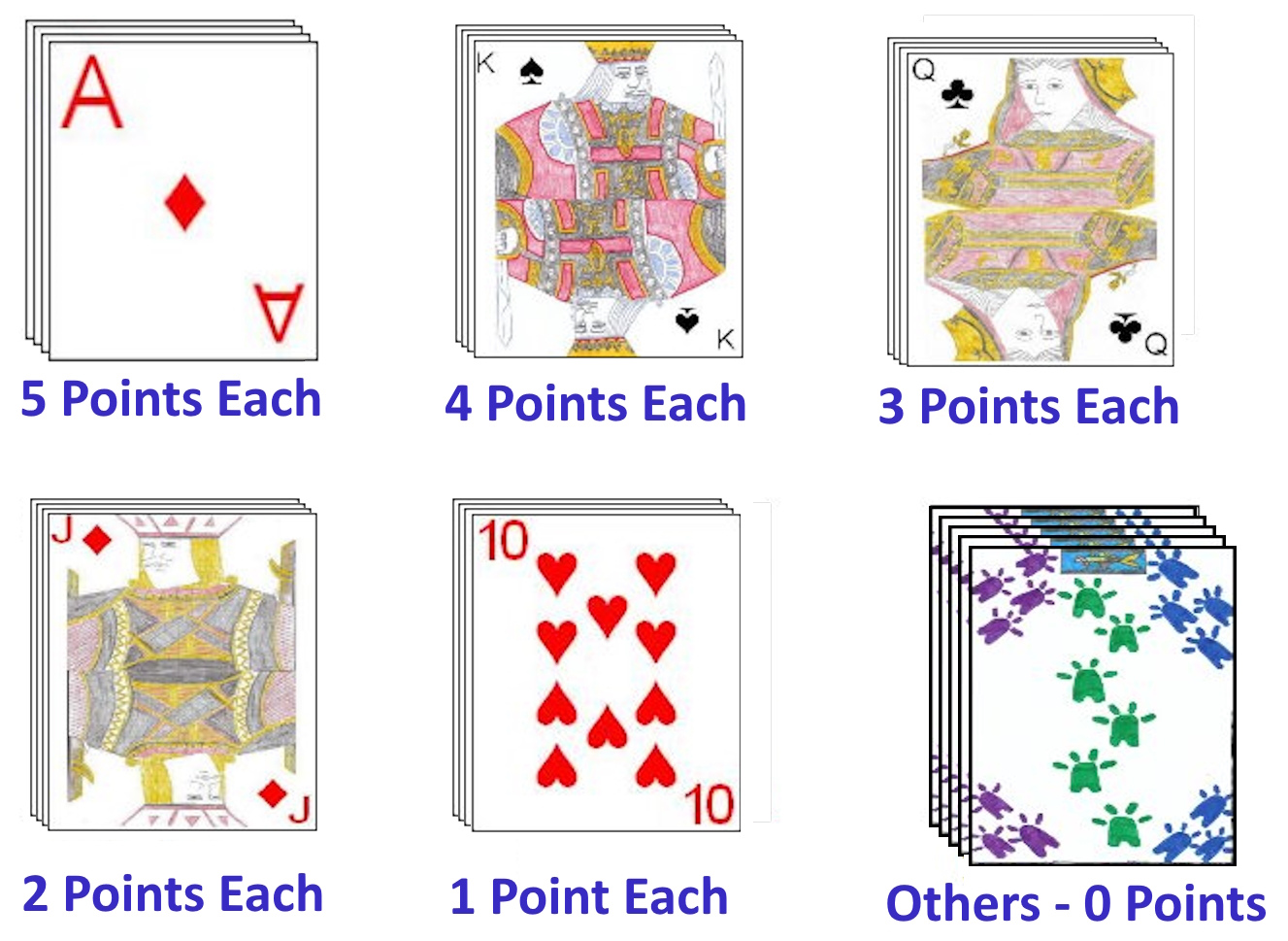
After all eight tricks have been played and won, the players then review their cards won in tricks to determine the number of cards points they managed to win during play of that hand. The following chart shows the card point value of each card as found in the deck:
|
|
Each player then earns or loses a number of Game Points based on their final card point count for that hand. For each card point a player managed to capture over 15 (the average each player might be expected to win during a hand), that player earns one game point. For each card point under 15 a player managed to capture in tricks during that hand, the player loses one Game Point. A player capturing exactly 15 card points neither loses or earns any Game Points on that hand.
After playing some pre-determined set number of hands, the player with the highest grand total in Game Points is declared the entire session winner.