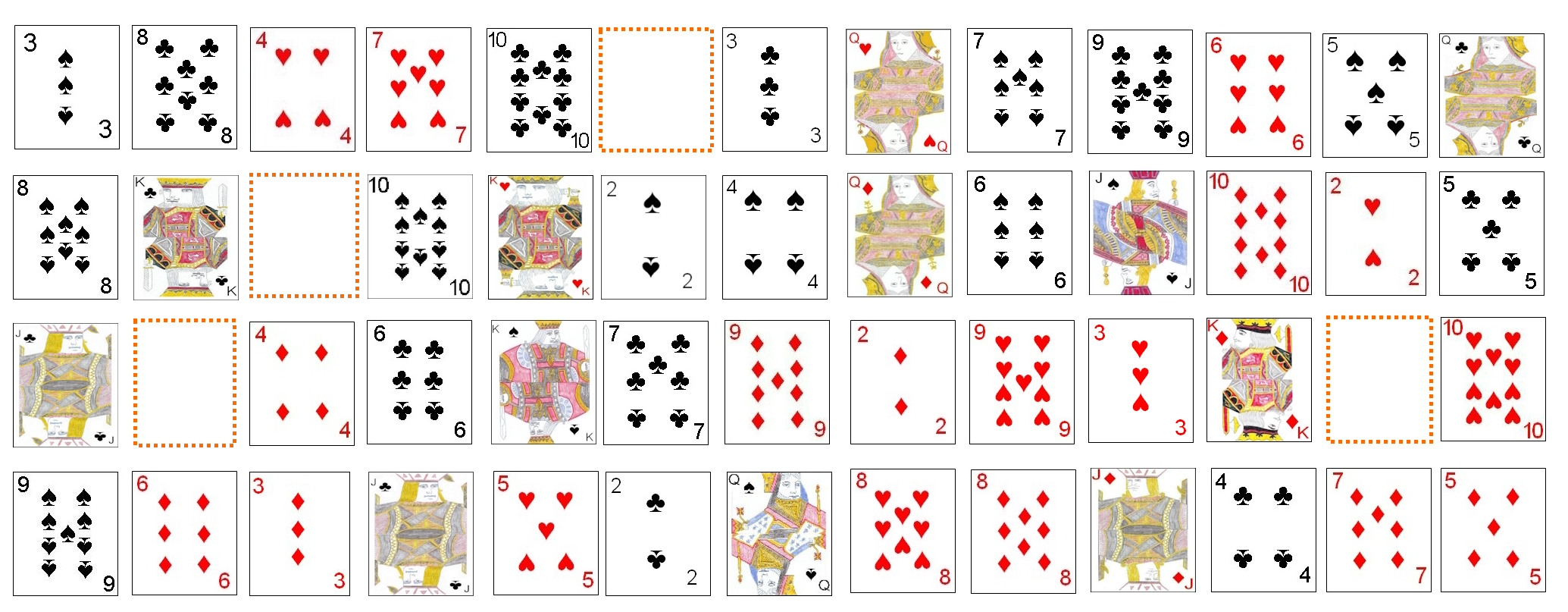
 Before play, the deck should be thoroughly shuffled. Once shuffled the player then deals four horizontal rows of 13 cards each from left to right with each card dealt face-up. After all the cards have been dealt, the four aces should be located in the layout and removed, set aside out of play. These are the gaps in the layout in which the player will use to help re-arrange the cards. The ultimate goal of the game is to thus arrange the cards in four rows with the cards going in an ascending sequence from two to King, in each suit. Thus, the ending result should be four rows of cards in sequence from two to King, with each suit represented, with the gap found at the far right of each row. It does not matter the ordering of the suits, from top to bottom in the layout, as long as each of the four rows contains one full suit, from two to King.
In an effort to thus arrange the layout into this final configuration, the player makes a series of moves. A move consists of a player filling in the four gaps in the layout by replacing this card with another card from somewhere else in the layout. The card can be in the same row or be in a different row. The one stipulation is that a gap can only be filled with a card that is of the same suit and next highest in ascending sequence as the card immediately to the left of the gap. For example, a nine of clubs could be placed in a empty gap that was immediately to the left of the eight of clubs.
If a gap is at the far left of a row (with no cards to it's left), this gap can be filled with any two. A gap to the immediate right of a King cannot be filled, as King is considered the highest card in every suit.
If the player manages to thus form the arrangement of four rows of cards, from two to King, one in each suit, the player has won the game. However, if the player gets into the situation in which there are no more available moves, they may gather all the cards from the layout that are not in proper sequence (starting from the card of rank "two" at the far left), shuffle them and reform the layout with the shuffled remainder of the cards. The space immediately to the left of the last card in correct sequence in each row should be left as an open gap which can then be filled by the next series of moves. The player is allowed two total redeals in this way. If the player, after two such redeals and finding he has no available moves, ends the game, not having won.
The average player should manage to win approximately 5% of all games using these rules.
Variations and Optional Rules
Redeals: Some players prefer to make the game either more or less difficult, by adjusting the number of redeals allows. The standard version, as described above, allows two total redeals, but some variant allow three or more redeals. The variant which allows three such redeals is sometimes played under the name "Addiction Solitaire". Each additional redeal increases the odds of arranging the layout correctly.
No Shuffle in the Redeal: Under the basic rules of the game the cards are shuffled after being gathered from the layout for redeal. If the cards are not shuffled, this actually makes the game somewhat easier, as the cards may already be somewhat arranged in helpful ordering by suit. This can increase the win percentage to closer to 15%.
Double Montana: Double Montana is a variant of this game designed for use with two decks. Two full 52 card decks are used for this variant, which is also sometimes called Paganini and Big Paganini.
After the shuffle the deck is then dealt in eight rows of thirteen cards. The eight Aces are then removed and placed at the far left of each row. The specific placement of which Ace goes on which row is decided by the player, but once placed, these Aces cannot be moved. The spots vacated by the Aces can then be filled, with the game continuing as the standard version, only with additional rows. The game is won if the player manages to arrange the layout such that there are eight rows of 13 cards each, with each row containing one complete sequence from Ace to King, with all the cards in that row being of the same suit.
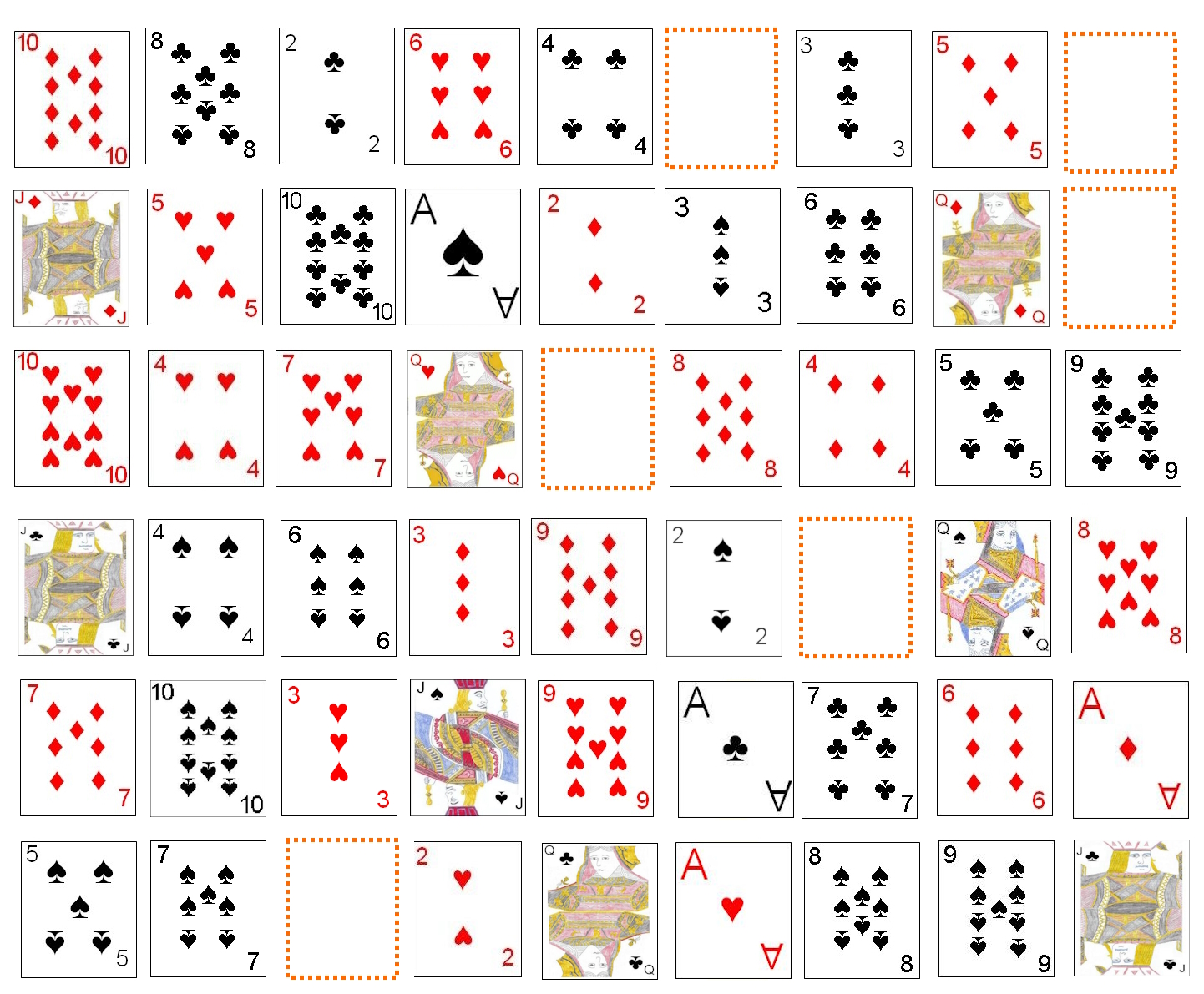 Maze: Maze is another solitaire game with a somewhat similar layout and end goal to Gaps. Maze uses one 52 card deck which has been thoroughly shuffled. The player then deals out the cards in 6 rows of cards. The top two rows each contain 8 cards, and the bottom
four rows contain nine cards each. The four Kings are then removed from the layout and discarded to the side, out of play.
Maze: Maze is another solitaire game with a somewhat similar layout and end goal to Gaps. Maze uses one 52 card deck which has been thoroughly shuffled. The player then deals out the cards in 6 rows of cards. The top two rows each contain 8 cards, and the bottom
four rows contain nine cards each. The four Kings are then removed from the layout and discarded to the side, out of play.
The four spaces left after the Kings have been removed, and the two that are at the far right of the top two rows then form a gap in which a player can move another card from.
Any gap can be filled by one of two cards. It can be filled with the card which is of the same suit, but one rank higher than the card immediately to the left of the gap. Alternatively, the gap can be filled with a card that is one rank lower and of the same suit, as the card to the immediate right of the gap. A gap that is immediately to the left of a Queen can be filled with any Ace or a card one rank lower and of the same suit, as the card immediately to the right of the gap. A gap to the immediate left of an Ace can not be filled with any other card.
The rows should be considered one continuous string of cards, thus the end of one row continues down to the first card in the next row. Similarly, the last card on the last row is considered to be contiguous with the first card in the first row. Thus, a gap at the far left or right of a row can be filled as appropriate also based on cards from the previous row.
The game is considered won if the player can, starting with an Ace in the first card in the first row, form a layout that consists of four sequences of Ace to Queen, with the cards in each sequence all of the same suit. Thus, immediately to the right of a Queen in one suit, would be the Ace of another.
Pas a Deux: Pas a Deux is another form of solitaire that bears some resemblance to Gaps. The game is played using two standard 52 card decks, each with a different back design. Both decks should first be thoroughly shuffled independently, but the two individual decks should not be mingled. The player then selects one of the decks as the foundation deck. He thus deals out this entire deck into four rows of thirteen cards (columns) each, with each card dealt face-up in it's row.
The other shuffled deck is then set down as the talon. The player then turns over the cards from the talon, one at a time, revealing this card. The player then locates this same card in the layout. The player is then permitted to swap the identified card, as found in the layout, with any card immediately above or below it, either horizontally or vertically. The player is not, of course, required to swap two cards if the player believes that doing the swap would not be helpful in winning the game.
The ultimate goal of the player is to arrange the layout in four rows of cards, arranged from Ace to King. The top row should be in the suit of clubs, the second row in the suit of spades, the third row in the suit of diamonds and the bottom row the suit of hearts. If the player manages to arrange the layout into this configuration they have thus won the game. Once the player has gone completely through the talon, they player is then entitled to turn that pile over and go through the talon a second time. If unable to form the entire necessary arrangement after this second redeal, the player must then shuffle both decks and start a new game.
Copyright © 2015 CatsAtCards.com. All rights reserved.