Gnällknekt is a unique card game that is somewhat well known in Sweden but rarely encountered outside this area. The game is designed for play by 3 to 5 participants and uses a 104 card deck which is formed by shuffling two standard 52 card decks together.
The ranking of the cards is fairly normal, with respect to the ranking in other card games, except for that of the Ace and Jack. For the Ace, it is considered the highest card in the deck for attacking, but in defense it is considered the lowest card in the deck (see below). The ranking of the remaining cards in the deck are as follows: 2, 3, 4, 5, 6, 7, 8, 9, 10, Queen, King. The Jacks are another special card, as these are considered special "trump" cards. Their use will be explained below.
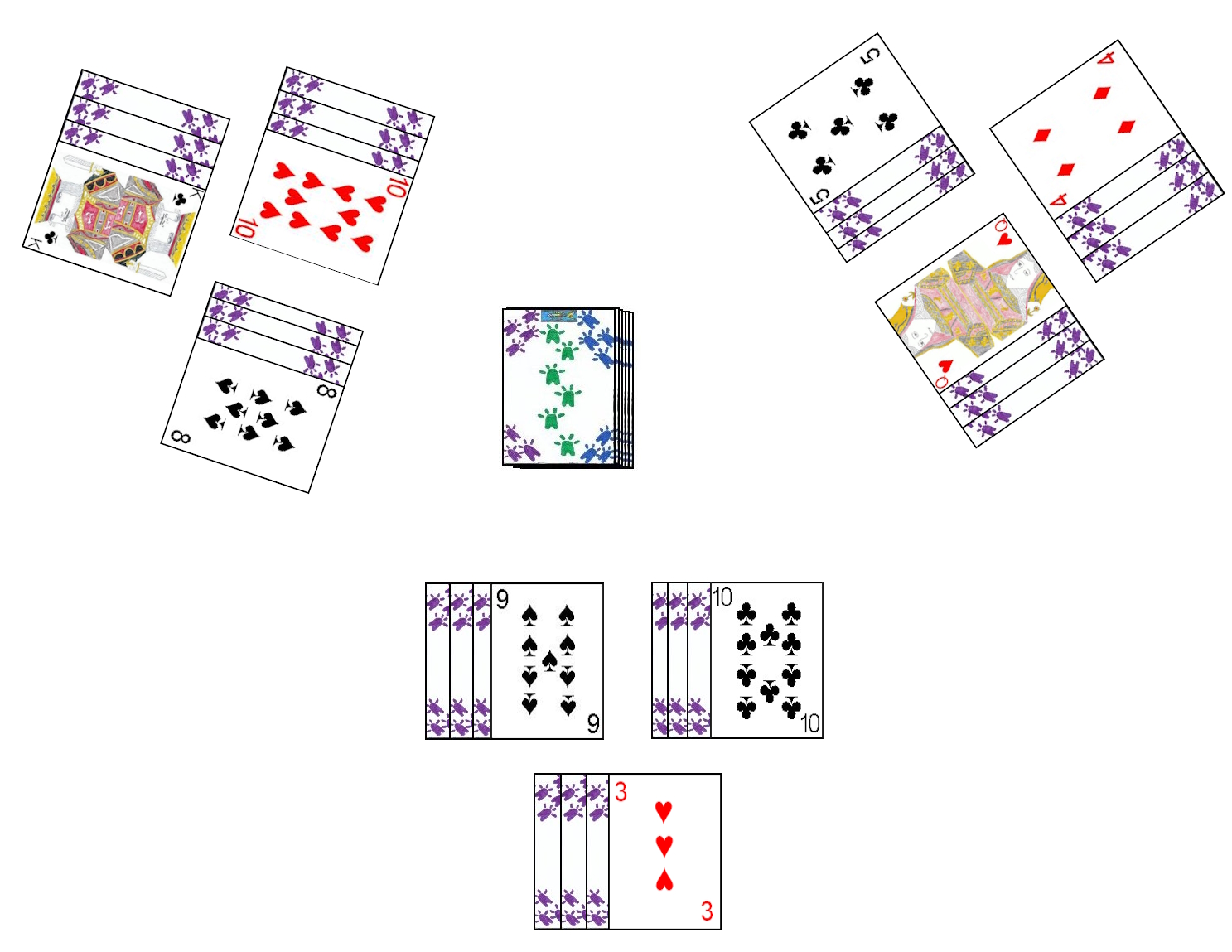 Determination of seating positions and first dealer can be performed using any method, with a deal for high card being a common such method. Using this method, each player would draw one card from the shuffled, face-down deck. Any players drawing cards of the same rank would discard the duplicated cards and draw another. After each player has drawn a card of a unique rank, the players would then take their choice of seats in order from highest drawn card to lowest. The player drawing the highest ranked card of all is set as the first dealer, with the role of dealer than rotating around the table in a clockwise direction after each hand.
The dealer for the hand then thoroughly shuffles the deck and offers it to the player at his right to cut. After the cut, the dealer then deals a special layout in front of each player. Three piles of cards should be dealt in front of each player. These piles should consist of three face-down cards, with one face-up card on top of each pile. These cards should be dealt slightly offset, such that it can clearly be seen how many cards are in each pile. These three piles represent that players "lives" during the game. The remainder of the cards are then placed in a face-down pile near the center of the table, as the stock. Once a player's three piles are completely eliminated that player must drop from the game.
The player to the left of the dealer has the first turn, and the turns continue in a clockwise direction around the table. To start each turn, a player draws a number of cards into their hand equal to one plus the number of "lives" that player has remaining. For example, on a player's first turn that player would thus draw four cards from the stock into their hand. The player may draw these cards from any combination from the discard pile and the draw pile. On the first player's first turn, there will not yet be a discard pile, so they must draw their cards (four) from the draw pile.
After the draw, the player can make two moves during his turn, which can consist of 2 attack moves, 2 defense moves or one of each:
- Defense: A defense move consists of the player adding any one card from their hand, onto the top of any of their "lives" piles. The card should be played face-up and any pile can never contain more than three face-up cards. If a player has two cards of the same denomination, he may play both of these, as a pair, onto the pile, but must still abide by the rule that none of these piles may ever have more than three face-up cards on them. As noted previously, an Ace found on a pile is considered the lowest card in the deck.
- Attack: An attack move consists of attempting to eliminate the top face-up card of one of any other player's piles. In order to be played, and thus be able to eliminate this card, the card played must either be of the exact same rank, or must be of higher rank but of the same suit. In used as an Attack card, the Ace is considered the highest card, and can thus beat any card of it's same suit (except a Jack). In an attack play, the attacking and defending cards are then set aside in a used cards pile. In attacking, a player may use both cards from their hand, as well as card from the top of his "lives" piles.
If, in eliminating a card from the top of a lives pile, this exposes a face-down card as the top of that pile, this card should immediately be turned over as the top card of that pile. If the last card is eliminated from a pile, that pile may not be rebuilt. Once the last card has been removed from a player's last pile, that player must drop from the game.
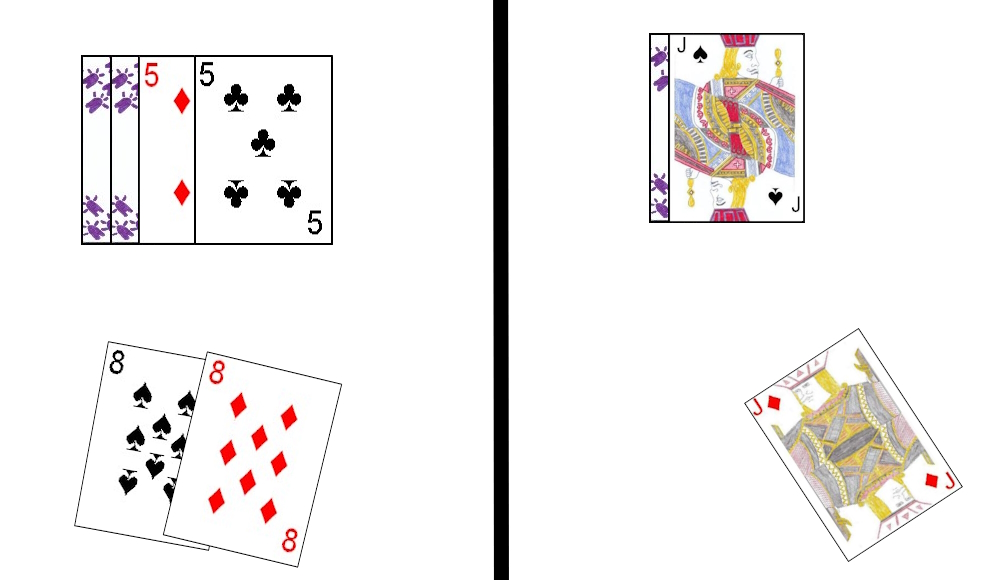 Jacks and Pairs: Beating a Jack or a pair of equally ranked cards can only be done in certain ways. If the top card in a pile is a Jack, this card can only be eliminated by another Jack. If the top two cards of a player's pile is a pair of cards of the same denomination, this pair of cards can only be removed by a pair of cards of equal rank or higher. Although, a normal attack move consists of one card, playing a pair is also a legal play. All cards involved in the attack and defense are discarded to an out-of-play discard pile. If a player has a pair of Jacks, each Jack can be removed individually by play of an attack card Jack. In addition, a pair can be used to beat any single card on the top of another players pile, except a Jack, while a Jack can be used to remove any other single card or a pair of equally ranked cards found at the top of such a pile. In attacking using a pair, the pair may only come directly from the hand, or be the top two cards from the same "lives" pile.
After a player has thus completed his turn, if he has one or more cards left in hand, discards one card to a face-up discard pile which is set near the stock pile. If the stock pile runs out of cards, the pile of previously played cards should be shuffled together to form a new draw pile which is set near the center of the table.
End Game: The game ends once there is only one player remaining with any lives piles remaining, with that player declared the winner. However, there are situations in which the game could end in a tie. This could occur when one player, having only one pile, continuously defends, adding his two drawn cards to his pile and the other player continuously attacks these cards, but with no progress ever made to complete the game. This is called "Whining" mode. While in some circumstances this can not be avoided, the game includes certain rules to help reduce this situation to make a clear winner in every hand:
Once the game has been reduced to two players, the game continues using the normal rules for five rounds (each player receiving five more turns). After five rounds, the draw rule changes, with each player drawing only a number of cards equal to the number of piles that player has remaining. In addition, during these last rounds, any pair can be used to remove one Jack at the top of a player's lives pile if it would that completely remove that player's last pile. If, after five rounds using these different rules, there is still no winner, the game is declared a draw amongst these two players.