Iceberg Rummy is a newer member of the Rummy family of games. It is a unique variant of Rummy which was created by Gordon Bower of Alaska in 1997. Each player plays independently and strives to score as many points as possible, through melds, on each hand.
Iceberg Rummy is designed for play by 2 to 5 players using either one or two decks of cards. For two or three players, one standard 52 card deck should be used and for four or five players two such decks should be shuffled together to make one larger 104 card deck. For purposes of sequence melds, the ranking of the cards in the deck are as follows (from highest to lowest): King, Queen, Jack, 10, 9, 8, 7, 6, 5, 4, 3, 2. Aces have a special role in this game, and are not normally used as part of melds by any player.
Any standard method can be used to determine the identity of the first dealer, such as a draw for high cards. Using this method each participant should draw one card from the face down deck. The player whom draws the highest card of all those drawn is set as the first dealer. For purposes of this draw the ace is considered the highest card of all. For each subsequent hand the deal rotates clockwise from player to player around the table.
Once the dealer is selected this player then shuffles the deck and the player to the dealer's immediate left cuts. The dealer begins by dealing one face-down card to each player, starting at the player to his left and continuing in a clockwise direction until each player (including himself) has a total of seven cards. Once these hands are dealt, the dealer places the remainder of the deck in the center of the table face down as the stock pile.
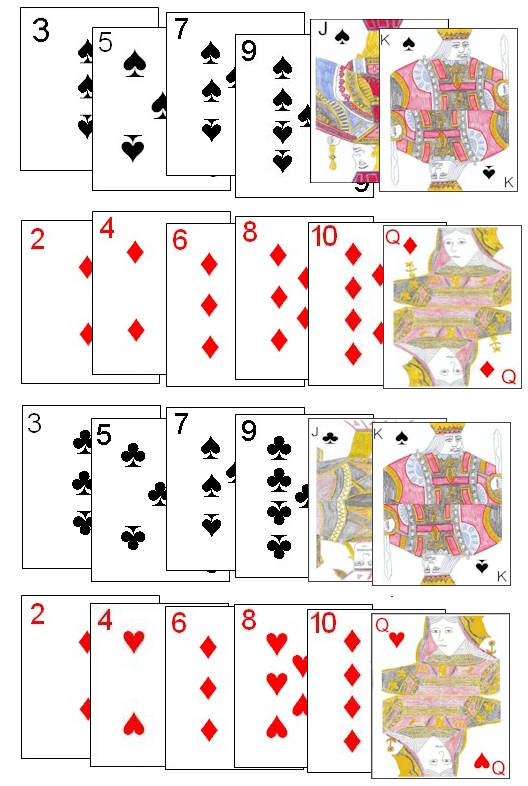 Iceberg Rummy adds some additional meld types that are not traditionally seen in most Rummy games. The following are all the possible legal melds in this game:
- Pair: This is two cards of the exact same rank, but of different suits. If a player later adds additional cards to this meld it then becomes a set.
- Sets: This is three or more cards all of the same exact rank. If the set consists of three or four cards each card must be of a different suit. If the set contains five or more cards, there must be at least one card of each suit in the set.
- Runs: A set is three or more cards of the same suit which are in direct sequential order.
- Odds in One Suit: This is the combination of cards consisting of 3, 5, 7, 9, Jack, King, all of the same suit.
- Evens in One Suit: This special meld consists of the cards 2, 4, 6, 8, 10, Queen, all in the same suit.
- Odds in One Color This meld consists of the cards, 3, 5, 7, 9, Jack, King, not all of the same suit, but all of the same color (red or black).
- Evens in One Color: This meld is the cards 2, 4, 6, 8, 10, Queen, not all in the same suit, but all of the same color.
The player to the immediate left of the dealer has the first turn, and the turns proceed in a clockwise direction around the table. Each turn consists of several steps, as follows:
- Pick up the card that was passed from that player's right-hand opponent. On most of the player's first turn of the hand, there will be no such card, so the player does not take this step on the first turn.
- Draw one card from the top of the stock pile, adding it to their hand.
- If the player has any Aces in their hand, they place these face-up on the table in front of themselves. These cards will earn that player bonus points at the end of the hand.
- Next, the player may make any legal melds to the table if able and willing. This can be any of the melds listed above. The player may also add cards to other player's existing melds on the table.
- Discard one card, placing it face-down next to his left-hand opponent.
|
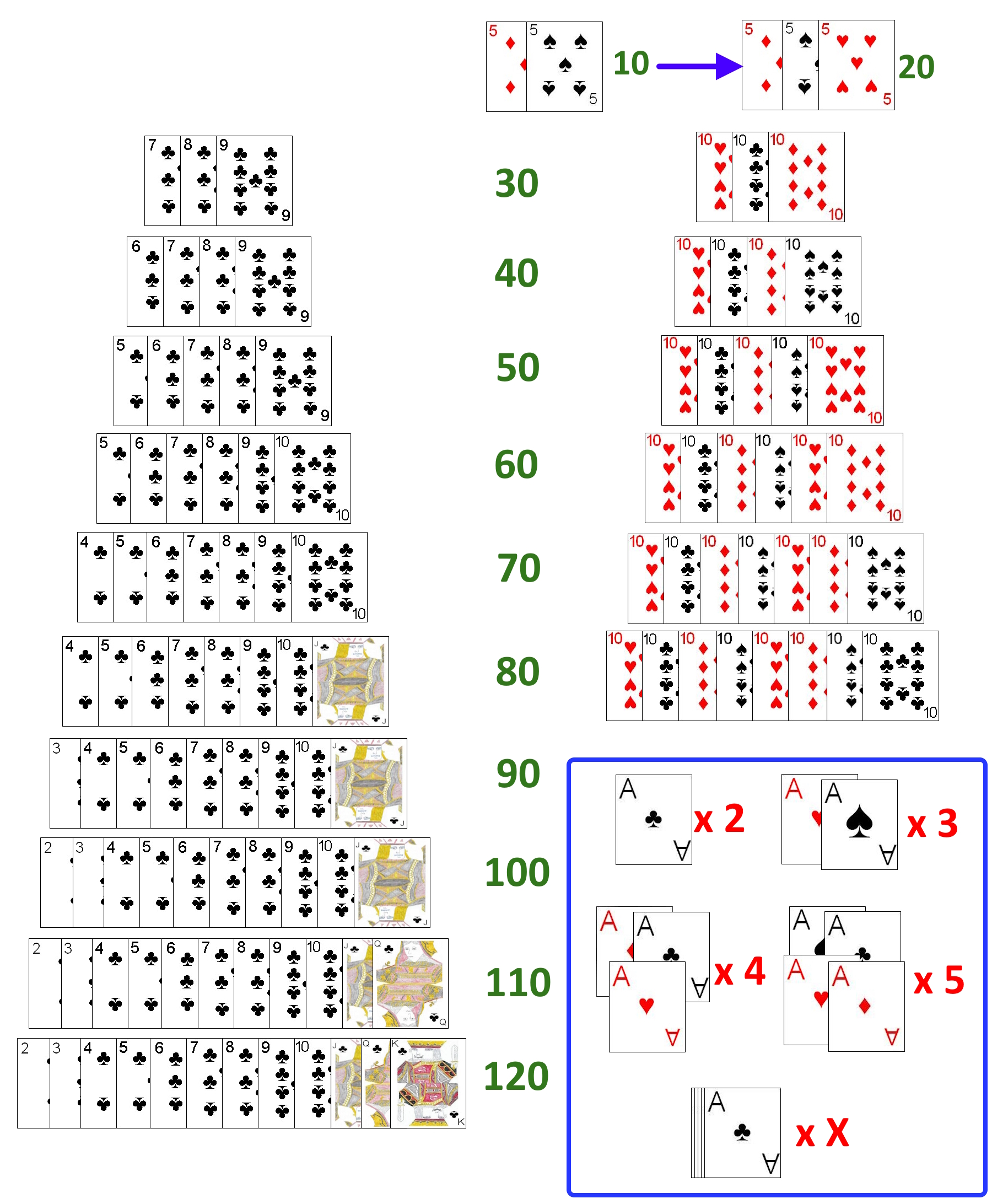 |
The hand can end in one of two ways. The first way a hand can end is if a player goes Rummy by playing (or discarding) the last card from his hand, which instantly ends that hand. The second method to end a hand is through the play of all of the Aces from the deck. One the last Ace has been played, the hand also immediately ends.
All scoring for melds should be recorded immediately upon making (or adding to the meld) to ensure all scores are calculated correctly. Once the hand ends, players with cards remaining in hand, must subtract from their current score a number of points based on those cards, as follows:
- Any card in a player's hand which could have been legally played to the table, with the current state of the melds on the table, score a negative point value based on the positive score playing that meld would have earned for that player.
- Any cards in a player's hand which could not be formed into valid new melds or added to existing melds on the table score a negative point value equal to 10 points for each such card.
Each Ace that a player managed to play during the hand acts as a score multiplier (to both positive and negative scores earned by that player during the hand). Each Ace that player managed to play acts as a x2 multiplier to that players score. For example one Ace would allow that player to multiply their final score for the hand by two (x2), two would provide a three times multiplier (x3) and three Aces would serve to give that player a (x4) multiplier.
If, at the end of any hand, any player has managed to accumulate a total score of 5000 or more points, that player is declared the game winner. If multiple players have reached or exceeded 5000 total points, the player with the highest such total is declared the overall game winner.