Jut Patti is a fun and easy card game that is very popular in South Asia, in particular the nations of Nepal and India. The game is sometimes written as Jute Patti or Jutpatti. The game is usually played by two, three or four players and uses one standard international deck of 52 cards.
Determination of the first dealer and seating positions can be determined using a variety of methods, with a draw for high cards a common method. Using that method, each player should draw a card from the shuffled, face-down deck. Players would then take their choice of seats in order from highest to lowest. Any players drawing cards of the same denomination would draw new cards, continuing this until drawing a card of a unique denomination. The player drawing the highest ranked card of all is set as the first dealer. After each hand, the winner of the last hand is set as the dealer for the next hand.
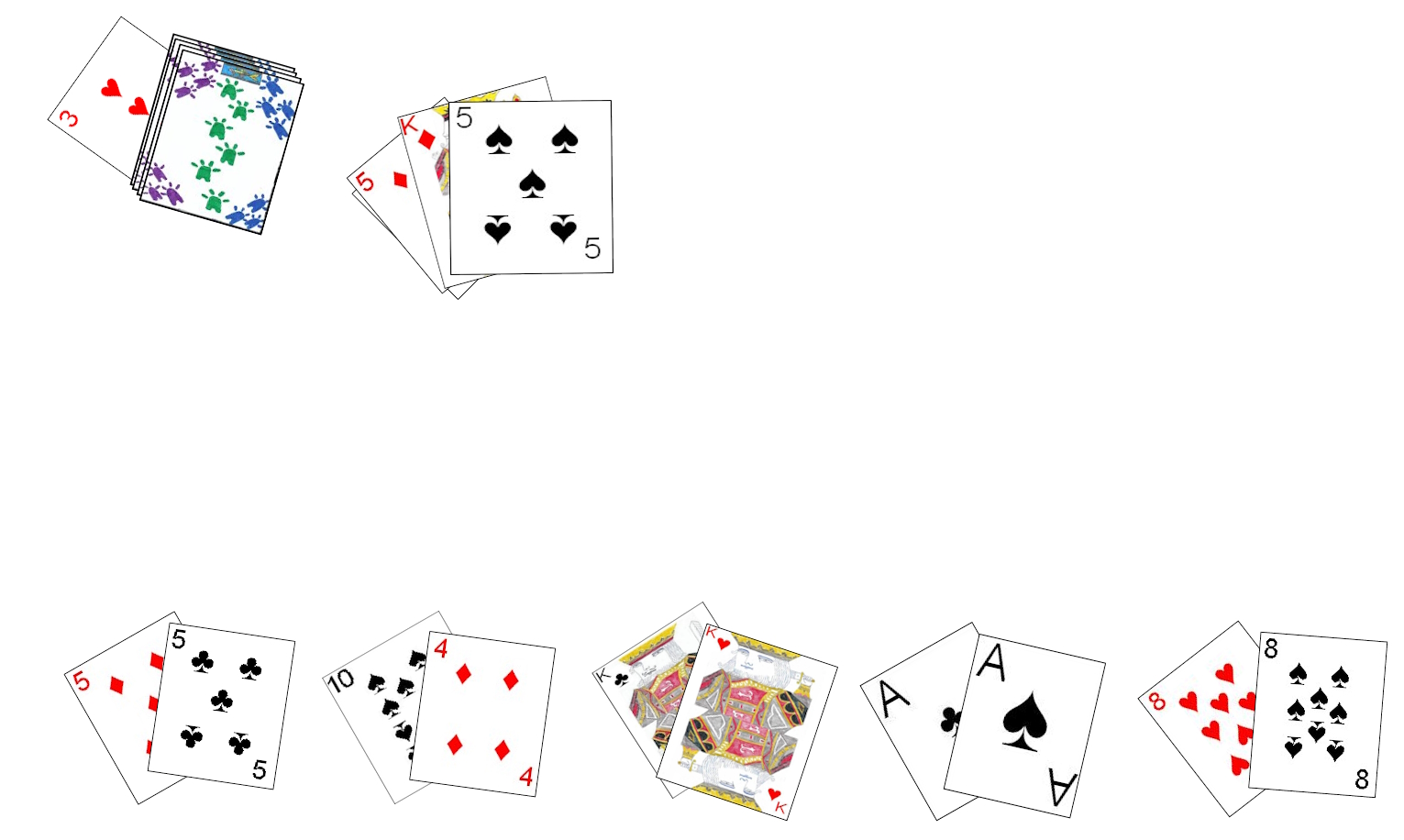 The designated dealer for that hand should then thoroughly shuffle the deck and offer it to the player at his left to cut. After the cut, the dealer then deals the cards, one-by-one and face down in a counter-clockwise direction around the table, starting with the player at his right. He continues dealing until each player has a total of nine face-down cards. The player then places the remainder of the deck in a face-down pile in the center of the table as the stock. The top card of the deck is then turned face-up and place partially under the stock. Every card exactly one rank higher than the rank of the card shown is considered a wild card or Joker. The ranking sequence of the cards is as follows (from low to high): Ace, 2, 3, 4, 5, 6, 7, 8, 9, 10, Jack, Queen, King. For example if a nine was the exposed card, all tens would be considered wild cards. If the exposed card is a King, all Aces would then be considered Jokers. As the object of the game is to form pairs of cards in the hand, a Joker can be used to pair with any other card, regardless of that other cards rank.
Each player starts his turn by drawing a card, either the top card from the face-down stock, or the top face-up card from the discard pile (which would thus the be headed by the last player's discard). On the very first turn of the game, there is no discard pile, so the first player, on his first turn, must draw from the top of the stock pile.
After the player draws his card, he then examines his hand for any pairs that might be formed. If the player can form his hand, after the draw, into exactly five pairs of cards, he announces this, shows his hand and immediately wins the hand. It must be remembered, of course, that a Joker can be paired with any other card to form a legal pair.
If the player does not have, after his draw, exactly five pairs in hand, the player then selects any card from his hand and adds it face-up to the top of the discard pile. Generally, this discard pile is not kept neatly squared up, and thus one or more cards directly below the discard are often partially visible.
If the draw pile becomes exhausted (the face-up card used to designated the denomination for the Joker is never drawn), all cards (except the top card) from the discard pile are shuffled and turned over to start a new face-down draw pile, which is again placed partially covering the Joker designator card.
Although each hand can be considered to be a complete game, it is also common to award each player one point for each game won, and after a game session, compare the total of all players, with the player having won the most such games declared the overall session winner.