How To Play the Card Game Kop
Kop is a Polish card game of the Schafkopf family. Despite the fact that the game only uses 16 total cards, it has many opportunities for skillful play and strategy. The variant of the game first describes is also sometimes known as "As - Dycha (Ace - Ten) Kop".
Kop is a trick-taking game played by four players using one standard deck which has been stripped down to 16 cards. This deck consists of one of each of the card denominations 10, Queen, Jack, Ace in each of the four suits. Despite being of a probable Germanic origin for the game, it is usually played with a deck using the standard French suit markings.
As in other games of the Schafkopf family, Kop features a permanent trump suit. This suit consists of 12 of the 16 cards used in play. The following is the full ranking of all the cards in this trump suit (shown from
highest to lowest):
- Permanent Trump Suit: Ace of hearts, Ten of hearts, Queen of clubs, Queen of spades, Queen of hearts, Queen of diamonds, Jack of clubs, Jack of spades, Jack of hearts, Jack of diamonds, Ace of diamonds, Ten of diamonds
It should be noted that all of these cards are thus considered to be of the same suit, regardless of the actual suit markings on the card.
In addition to this trump suit there are two additional suits, which each consist of two cards each. The cards comprising these two additional suits and the ranking of the cards within these suits are as follows:
- Clubs: Ace of clubs, Ten of clubs
- Spades: Ace of spades, Ten of spades
Although most hands consist of play by two players in partnership against the other two players (in an opposing partnership), due to the nature of the game, these partnerships will usually change on every hand, with the precise identity of the players forming each partnership unknown until it becomes obvious during play of the hand.
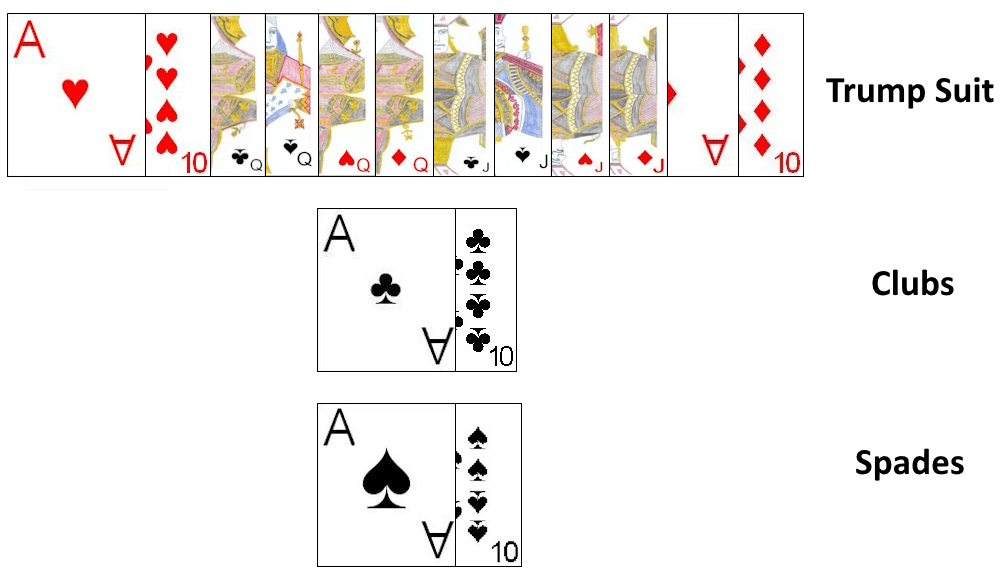 |
| The three complete suits as used in the card game Kop |
The first dealer can be determined in any number of ways, with cutting for high card a method commonly used. Once the initial dealer is determined this player then shuffles the deck and offers it to the player at his right for a cut. After the cut, the deals the cards in a clockwise direction around the table, starting with the player at his immediate left. He deals the cards one-at-a-time and face down, continuing around the table until each player has a total of four cards. After each hand the identity of the dealer rotates in a clockwise direction around the table. After the cards have been dealt the player then pick up their cards for examination.
Following the deal, there is then an opportunity for players to make a bid or announcement. The player at the immediate left of the dealer has the first option to so bid and this passes in a clockwise direction around the table. The following are the applicable bids that can so be made, from the lowest ranked to the highest:
- Kontra (Double):
This is not an actual bid, but rather an announcement that the player is doubling the current potential score of the current hand by calling "kontra".
This bid can thus be only bid after another player has made a legal bid. A player who has made one of the following bids may not initially double his own bid (or the bid of his partner, if the partnerships are known),
But if a member of the opposing partnership has already doubled, either member of the high bidding partnership may double again (by
announcing "re"). After an announcement of "re", the opponents can then call "bok" to double yet again, and a last redouble can be performed by the high bidders with a call of "słup". It should be noted, since the initial partnerships may not yet be known, any consecutive doubles by the same team are only considered one double (and the number of doubles adjusted accordingly).
- Wesele (Wedding):
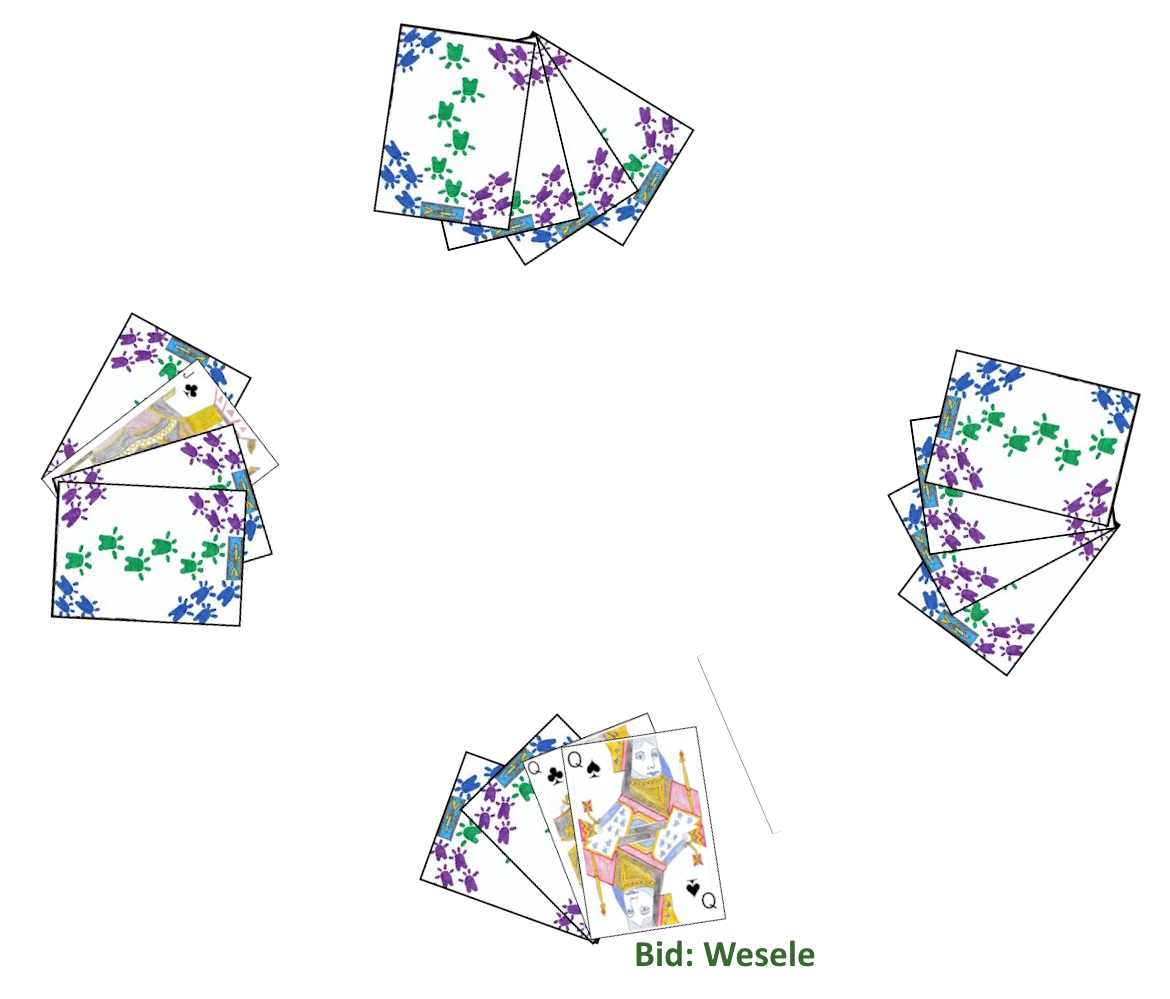
Wesele is a bid made by a player during his opportunity to bid. This bid may only be made by a player who has both Black Queens in hand (Queen of spades and the Queen of clubs). This will allow that player to obtain a partner for play during the hand and obligates that player and his currently unknown partner to win a majority of the card points during the hand. The player who has the highest Jack from the trump suit that the player does not have in hand will end up being the partner of this player, although a player who thinks they have this highest Jack should not announce this in any way.
- Zolo:
Zolo is a bid that can be made by any player. This is a bid to play alone (Solo) against the other three players, contracting to win a majority of the card points in tricks during play.
- Zolo Du:
Zolu Du is similar to a bid of Zolo. Any player can make this bid and is offering to play alone against the other three players, and is also contracting to win all four tricks during that hand.
If no players make an announcement of Wesele, Zolo or Zolo Du, the hand is played at a "normal" game (sometimes called a "simple" game). In this event the player who has the Queen of clubs plays in partnership along with the player having the Queen of spades. The two players having these cards (called "Starzy" or the "Old Ones"), should not make any mention of this fact, thus the identity of the partnerships will be initially unknown. If the same player has both of the black Queens, and that player did not make a bid of "Wesele", "Zolo" or "Zolu Du", that player will silently be playing alone against the other three. This is called cicha.
If, after a double, any player has legally made a higher bid, any previous doubles are no longer valid, however the doubling process may then begin again from player to player.
The bidding and announcements continue until all players pass, with the player making the highest bid (if any) set as the high bid for that hand. The player to the immediate left of the dealer then leads the first card to the first trick, and each other player in a clockwise direction around the table then plays one card to the trick.
The leader to a trick may play any card from his hand to lead to a trick, including a card from the permanent trump suit. Each other player in turn must play a card of the same suit as led to the trick if they have such a card. If they have no card of the suit led, they must then play a card of the trump suit if they have any. If they have neither a card of the suit led or a card of the trump suit, they may play any other card. If playing a card of the trump suit to the trick, they must play a card higher than any other card
previously played to that same trick, if able.
The highest card of the trump suit played to the trick thus wins the trick. In the rare case in which the trick contains all non-trump suited cards, the highest card in the suit originally led to the trick wins it. The won cards in that trick should be set aside, in a face-down pile near the player winning it. The winner of each trick then leads the first card to the next trick.
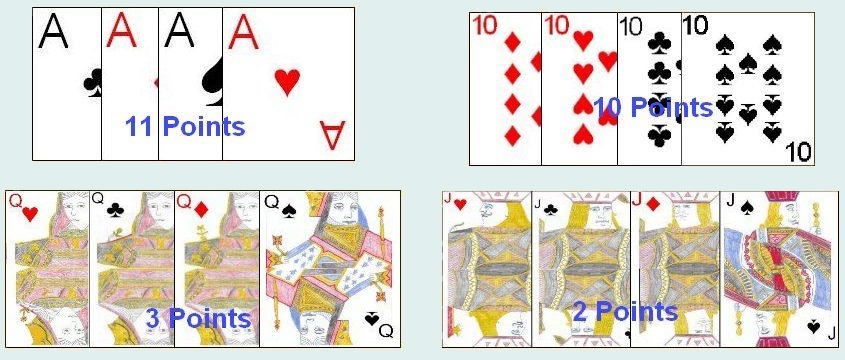
After all four tricks have been played and won, each team then gathers all the cards won by that partnership (or the lone player) to determine how many card points won during that hand. Each card in the deck has a card point scoring value as per the following chart:
| Card Denomination | Point Value |
|---|
| Each Ace | 11 |
| Each 10 | 10 |
| Each Queen | 3 |
| Each Jack | 2 |
The normal goal of each hand is for one team to earn a majority (53 or more) of the available card points during the hand, with that team thus winning the hand if managing this. See below for the special situation in which each team earns exactly 52 points. However, for a player who announced "Zolo Du" that player must win every trick in order to be declared the winner of that hand. The winner of each hand will win a number of Game Points, as follows:
- For an announcement of "Zolo Du" and successfully winning every trick, that player earns ten Game Points for each opponent. If that player instead does not win every trick, each opponent scores four points instead.
- For an announcement of "Zolo" and that player successfully winning 53 or more card points, the player earns five Game Points for each opponent. However, if the player fails to earn 53 or more points, each opponent wins five points instead.
- For a player who had both Black Queens but did not announce this (cicha) and captured 53 or more card points during the hand, that player earns four Game Points for each opponent. However if the solo player fails to earn at least 53 card points, each opponent earns four Game Points instead.
- For a "standard" game, a team managing to win 53 or more card points, both members of that team earn 1 Game Point.
If both teams captured exactly 26 points (called boki), the losing team is the side which made the last double. If no doubling was announced on that hand, the team that had the Queens (or the solo player) is considered the losing player, with each member of the opposing each earning one point.
In addition to the normal scoring, there are a number of situations which can thus double the Game Points thus earned during the hand:
- Each Kontra, Re, Bok and Słup will double the number of points awarded to the winning team on that hand.
- If the losing team captured fewer than 25 card points, but won at least one trick, the Game Points awarded to the winning team are doubled.
- If the losing team won no tricks during the hand, the Game Point scores earned by the winning team are tripled.
After a set number of hands, the player with the highest total in Game Points is declared the overall session winner.
Variations and Optional Rules
As - Trzy Dychy Kop:
Although in the traditional version of the card game Kop, the ranking as given above is used, some players have started using a different ranking and arrangement of the suits, with the trump suit extended even longer, and the two off-suits each containing only one card each. The following shows the three suits and rankings within those suits as used in this variant of the game:
- Permanent Trump Suit: Ace of hearts, Ten of clubs, Ten of spades, Ten of hearts, Queen of clubs, Queen of spades, Queen of hearts, Queen of diamonds, Jack of clubs, Jack of spades, Jack of hearts, Jack of diamonds, Ace of diamonds, Ten of diamonds
- Clubs: Ace of clubs
- Spades: Ace of spades
Other than the differences in the composition of the suits, this variant is played identically to the standard variant of Kop as described above.
Baśka:
Baśka is another game from Poland which players very similarly to Kop, however it has a number of number of differences that make it a distinct game. Baśka uses the same 16 card deck as does Kop and has the same permanent trump suit and card ranking as does that game as well as the same card point valuation for each card. However, there are a few bids which may alter the ranking of these cards. Like Kop, Baśka is also played by four players and the specific arrangement of the partnerships is usually unknown until revealed through play of the hand.
Determination of first dealer, the cut and the deal are performed in the same manner as in Kop. After the deal, there is a round of announcements/bidding. The following are the announcements or bids which can be made, in order from lowest to highest in precedence:
- Kontra (Double):
Doubling calls are not an actual bid, but rather an announcement that the player is doubling the current potential score of the current hand by calling "kontra". A player who has made one of the following bids may not initially double his own bid (or the bid of his partner, if the partnerships are known), but if a member of the opposing partnership has already doubled, either member of the high bidding partnership may re-double by announcing "rekontra". After an announcement of "rekontra", the opponents can then call "bok" to double yet again, and a last redouble can be performed by the high bidders with a call of "hirsh". It should be noted, since the initial partnerships may not yet be known, any consecutive doubles by the same team are only considered one double (and the number of doubles adjusted accordingly).
- Wesele (Wedding):
Wesele is a bid made by a player during an opportunity to bid. This bid may only be made by a player who has both Black Queens in hand (Queen of spades and the Queen of clubs). This will allow that player to obtain a partner for play during the hand and obligates that player and his currently unknown partner to win a majority of the card points during the hand. The player who has the highest Jack from the trump suit that the player does not have in hand will end up being the partner of this player, although a player who thinks they have this highest Jack should not announce this in any way.
- Gran:
A Gran is a bid of a player offering to play the hand solo
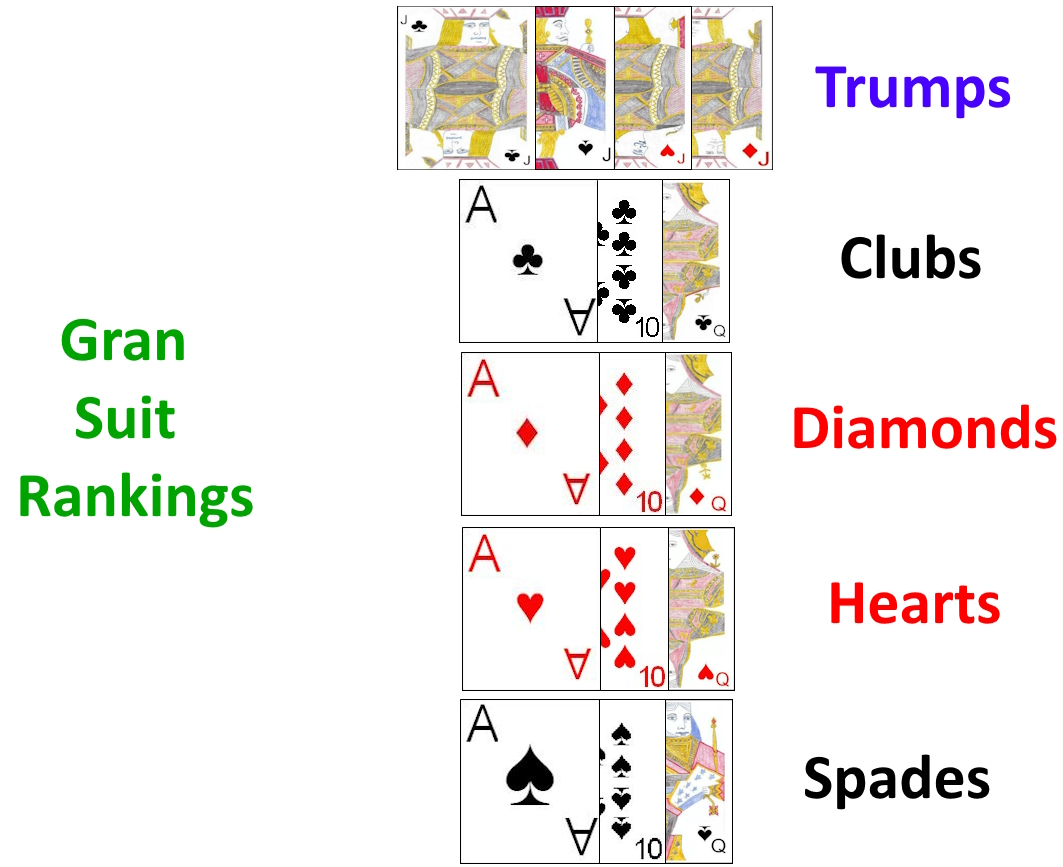
(without the aid of a partner). It is similar to a bid of Zolo, however the ranking of the cards in the deck is significantly modified during play. Thus, there would be five suits, a trump suit and four non-trump suits. The following shows the ranking of the cards in each of these suits (shown from highest to lowest):
- Permanent Trump Suit:
Jack of clubs, Jack of spades, Jack of
hearts, Jack of diamonds.
- Clubs: Ace of clubs, 10 of clubs, Queen of clubs
- Diamonds: Ace of diamonds, 10 of diamonds, Queen of diamonds
- Hearts: Ace of hearts, 10 of hearts, Queen of hearts
- Spades: Ace of spades, 10 of spades, Queen of spades
The player is contracting to win 53 or more card points during play of the hand.
- Zolo:
Zolo is a bid that can be made by any player. This is a bid to play alone (Solo) against the other three players, contracting to win a majority of the card points in tricks during play.
- Gran Du:
This is a bid by any player to play solo, and offering to win every trick during the hand. The ranking of the cards for play of this bid would be the same as for a Gran as listed above.
- Zolo Du:
Zolu Du is similar to a bid of Zolo. Any player can make this bid and is offering to play alone against the other three players, and is also contracting to win all four tricks during that hand.
- Baśka:
In order to make this bid a player must have all four Queens in hand. A player making this bid instantly wins the entire hand, with no play needed.
The bidding continues in a clockwise direction around the table until every player passes. A higher bid than a previous bid will nullify any doubles that were made previous to that bid, but players can of course then start the doubling process again. If no players actually made a bid, a "simple" or "normal" game will be played,
with the same rules as described for Kop. Once each player has passed after a high bid (or there are no bids made), play of the hand begins. The player to the immediate left of the dealer leads the first card to the first trick and each other player in a clockwise direction then plays one card to that trick.
The leader to a trick may play any card from his hand to start the trick, including a card from the trump suit. Each other player in turn must play a card of the same suit as led to the trick if they have a card in that suit. If they have no card of the suit led, they must then play a card of the trump suit if they have any. If they have neither a card of the suit led or a card of the trump suit, they may play any other card. If playing a card of the trump suit to the trick, they must play a card higher than any other card
previously played to that same trick, if able.
The highest card of the trump suit played to the trick thus wins the trick. The won cards in that trick should be set aside, in a face-down pile near the player winning it. The winner of each trick then leads the first card to start the next trick.
The following shows the possible base scores that can earned during a hand:
- Simple Game:
In a simple game, if no one bid, the team winning the majority (53 or more) card points earns one Game Point. The score for this is raised to 2 Game Points if the losing side earned fewer than 25 card points but won at least one trick, and is raised to 3 if the losing side won no tricks.
- Wesele:
If the highest bid was a bid of Wesele, and his team managed to win 53 or more card points, each member of his team earns one Game Point. If the player fails to earn at least 53 card points, each opponent earns one Game Point. The score for the bid of wesele is raised to 2 Game Points if the losing side earned fewer than 25 card points but won at least one trick, and is raised to 3 if the losing side won no tricks.
- Cicha:
If, during a "simple game" one player, having both black
suited Queens manages to win 53 or more card points, that player wins 4 Game Points for each opposing player. However, if that player fails to capture at least 53 card points, the opponents each earn 4 Game Points.
- Gran:
If Gran was the high bid, and the solo bidder of Gran manages to capture at least 53 or more card points, that player earns 5 Game Points per opponent. If he fails to capture at least 53 card points during the hand, each opposing player earns 5 Game Points instead.
- Zolo:
In a high bid of Zolo, if the high bidder manages to capture 53 or more card points, that player earns 5 Game Points per opposing player. If he is unable to so capture that many card points, his opponent's score 5 Game Points each.
- Gran Du:
A high bid of Gran Du requires that the bidder capture all 4 tricks played during the hand. If the bidder manages this, he earns 10 Game Points per each opposing player. However, if he wins one or more tricks, each opponent scores 10 Game Points.
- Zolo Du:
A player bidding Zolo Du must win every trick during the hand. If they are able to thus win all four tricks, that player earns 10 Game Points for each other player in the game. However, if that player fails to win one or more tricks during that hand, each opponent scores 10 Game Points.
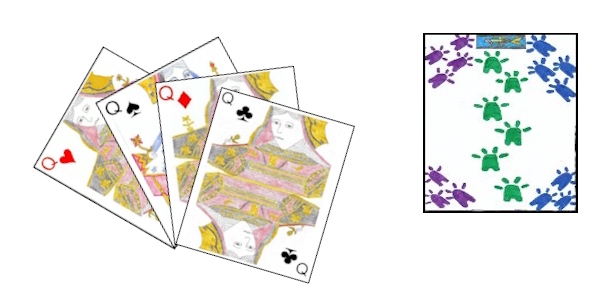
- Baśka:
A player who bid "Baśka:" simply shows his hand (which must contain the four Queens), after
which he immediately wins the hand and 10 Game Points for each opponent in the game.
If both teams captured exactly 26 points, the losing team is the side which made the last double. If no doubling was announced on that hand, the team that had the Queens (or the solo player) is considered the losing player, with each member of the opposing each earning one Game Point.
There are a number of situations which might cause the ending number of Game Points won to be increased, which includes the following:
- Each legal double that was declared (Kontra, Rekontra, Bok and Hirsh) will double the number of points awarded to the winning team on that hand.
- In a Simple Game if the team consisting of the players with both black Queens loses the hand, the Game Points awarded to the opposing team are doubled.
After some set number of games, the player or players with the highest total in Game Points are declared the overall game winners.
Copyright © 2015 CatsAtCards.com. All rights reserved.