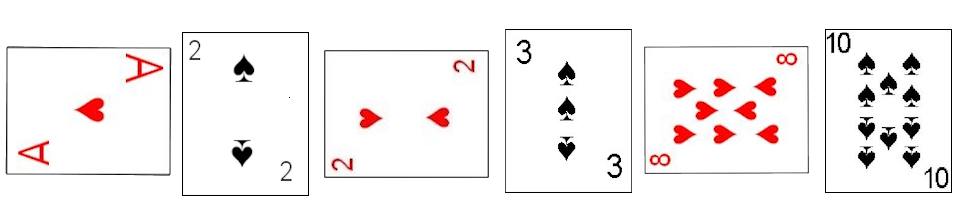
 "Logic - the Card Game" is a card game of logical deduction that is known to be played in the San Francisco bay area of California. It is also sometimes known simply as "Logic". This game is designed for play by four players in two partnerships consisting of two players each.
The game is played with a reduced 24 card deck. This deck can be formed from a standard 52 card deck, by including the cards in the ranks Ace, 2, 3, 4, 5, 6, 7, 8, 9, 10, Jack and Queen in the suit of hearts (♥), and the same denominations of cards in the suit of spades (♠).
Determination of partnerships and seating positions can be performed using a variety of methods, with a draw of cards a commonly used method. Using that method, each player would draw a card from the face-down shuffled deck. The players drawing the two highest cards would play as partners opposing the players drawing the two lowest. Any players drawing cards of equal rank would discard those cards and draw new cards, continuing until drawing cards not drawn by any other player. The player drawing the highest card of all has the first choice of seats at the table. The partner of this player should be seated directly across the table from his partner for the hand.
Determination of the first dealer in this game uses a somewhat unusual procedure. Any player draws a random card from the shuffled deck. If the drawn card is an Ace, 5 or 9, the player drawing the card is set as the first dealer. If the drawn card is instead a 2, 6 or 10, the dealer to the immediate right of the drawing player is set as the first dealer. If the drawn card is a 3, 7 or Jack, the player across the table from this player (this player's partner for the hand) will be set as the first dealer. Or lastly, if the card drawn is a 4, 8 or Queen, the player to the immediate left of the drawing player is set as the first dealer. After each hand the role of dealer rotates in a counter-clockwise direction around the table.
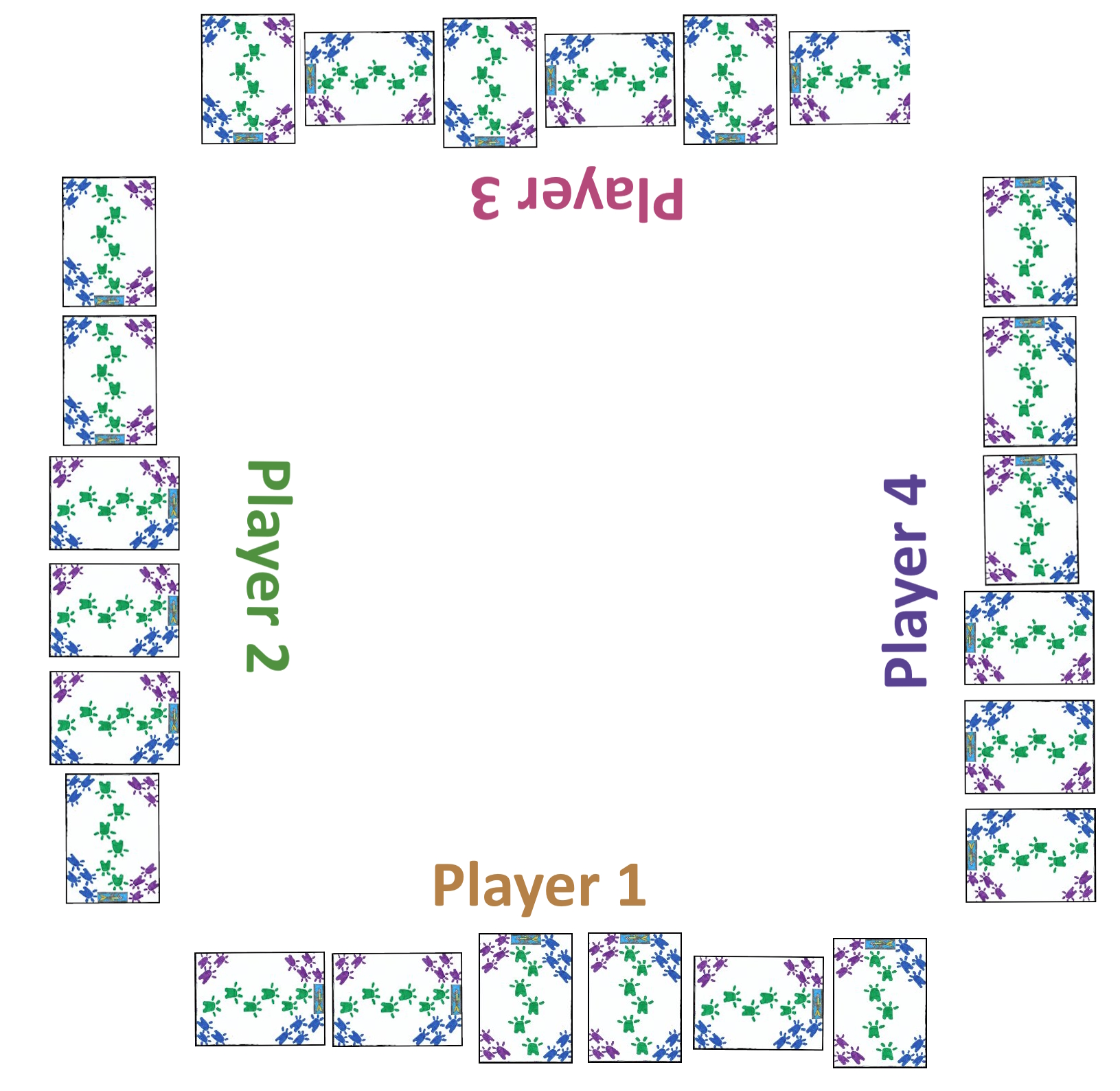
After the dealer has been thusly determined, this player then shuffled the 24 card deck to be used for the hand, and deals 6 face-down cards to each player. Each player then looks at the cards deals and arranges them in a row in front of themselves. The cards should thus be arranged from left to right in front of each player in sequential order, from highest to lowest. If a player has two cards of the same rank, they may select which of the two cards to put before the other. After all the players have thus arranged their cards in this manner, the players then turn each of the cards that red in color (cards in the suit of hearts) at a 90 degree angle. Thus, it is evident which cards are black (spades suit) and which are red (hearts suit).
The player to the immediate right of the dealer has the first turn, and the turns rotate in a counter-clockwise direction around the table. Each turn consists of two distinct parts, which must be performed in the following order:
- The Show: The first part of each player's turn consists of what is called The Show. This consists of the partner of the player who's current turn it is, to privately show the identity of one card from their personal lineup of cards to the player who's turn it currently is. This should be done in a manner that the player's partner can see the cards but neither of the opponents are able to see the identify of the card. A player may give no hints or signal as to which card they want to see. After the player shows the card, he then replaces it back in his lineup. It is legal, and common to slightly tilt the card as a memory aid to help a player recall which cards may have already been revealed to that player. This tilting or positioning of the cards may not be used for any other purpose, such as to provide hidden information other cards in that player's lineup. If the player has already shown all of his cards, or his cards are all currently face-up, the player may skip this portion of their turn as appropriate.
- The Guess: The second part of a player's turn consists of "The Guess". The current player who's turn it is must guess the specific rank of any of the face-down cards of his opponents. He does this by pointing out a specific card from the lineup of one of his opponents and stating what he believes the rank of that card to be. If all of the opponent's cards are already face-up, the player who's turn it is must instead "Declare". If the guess is correct, the player who's card was guessed must then turn the card face-up on the table, leaving the card in place but revealed in his lineup (this is called "The Reveal"). However, if the guess is incorrect, the guessing player must instead reveal any one of the cards from his personal lineup instead (unless all of his cards are already face-up).
As mentioned, if all of the opponent's cards are already exposed, the player must instead proceed directly to "Declare". Additionally, any player, at any time during the game (not just during their turn) may opt to Declare. A player intending to so declare must start by grabbing the spoon (or other object that was placed in the center of the table) and then announce he intends to Declare. In making a Declaration, a player begins by first turning face-up all the cards in front of themselves (unless these cards are all already face-up). This player must then, one by one point to, and announce the value of each of the other face-down cards on the table. As he thus declares the value of the card, the card is turned face-up to be revealed. If the announcement of the rank of the card is correct, the player continues. If he manages to correctly declare the value of every face-down card at the table, that player's team are declared the winners of the game. However, if the identity of any card declared is incorrect, the opposing team wins the game instead.