Meksiko is a trick-taking game for three players which is considered the most popular card game in the country of Serbia. Despite the name of the game being the Serbian word for the North American country of Mexico, the game does not appear to have any connection to the country of Mexico and does not resemble any specific game as played there.
Meksiko is traditionally played using the 32 card Hungarian deck (William Tell pattern). This deck consists of 8 cards in each of four suits; hearts, bells, acorns and leaves. In each of these four suits, there are eight cards in each of the denominations of VII, VIII, IX, X, Under, Over, King, Ace. If such a deck is not available for use to play, a standard International deck can be used to play, in which all cards of rank 2, 3, 4, 5 and 6 have been removed. The ranking of the cards in this deck are as follows, from highest to lowest; Ace, King, Over (Queen), Under (Jack), X (10), IX (9), VIII (8), VII (7).
Determination of seating positions and first dealer can be performed using a variety of methods, with a draw for high cards commonly used. This method consists of each player drawing a card from the shuffled deck. If multiple players draw cards of the same rank, they should discard these and draw again, continuing until drawing a card that no other player has yet drawn. Once each player has thus drawn a unique card, the players take their preferred seats at the table in order of highest card drawn to lowest. The player drawing the highest card of all is set as the first dealer. After each hand the role of dealer rotates in a clockwise direction around the table.
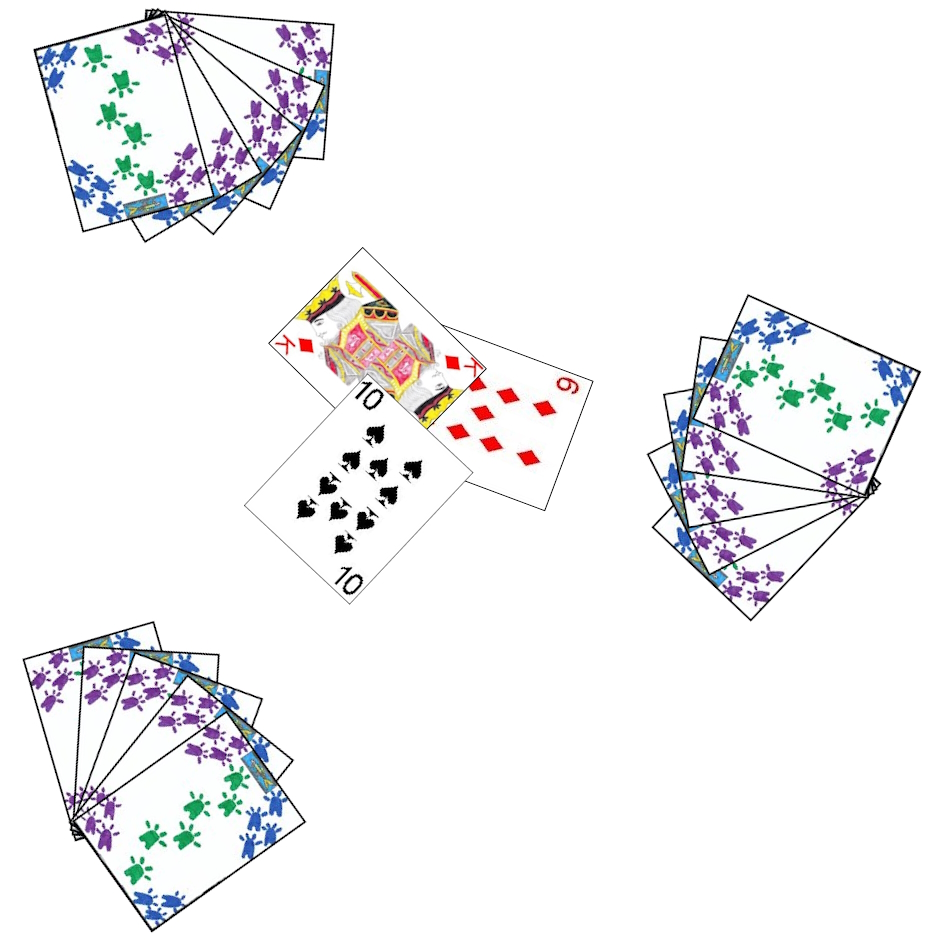 The customary method of determining first dealer is that the player who happens to be first handling the deck
of cards to used for play is set as the first dealer, with the role of dealer than rotating in a counter-clockwise direction around the table after each hand. This dealer should thus thoroughly shuffle the deck and offer it to the player at his immediate left for the cut. After the cut, this player would then begin dealing the cards, starting with the player at his immediate right and continuing in a counter-clockwise direction around the table. The dealer should deal such that each player receives 10 total cards. The dealer should also deal a two card face-down talon (or "kup") to the center of the table.
The customary method of determining first dealer is that the player who happens to be first handling the deck
of cards to used for play is set as the first dealer, with the role of dealer than rotating in a counter-clockwise direction around the table after each hand. This dealer should thus thoroughly shuffle the deck and offer it to the player at his immediate left for the cut. After the cut, this player would then begin dealing the cards, starting with the player at his immediate right and continuing in a counter-clockwise direction around the table. The dealer should deal such that each player receives 10 total cards. The dealer should also deal a two card face-down talon (or "kup") to the center of the table.
After each player has received their hand of ten cards, the players pick up their hands for examination, and a round of bidding occurs. The player to the immediate right of the dealer has the first opportunity to bid and the bidding continues in a counter-clockwise direction around the table. This first bidder must make a valid bid of at least 5. Each other player in turn must then either make a higher bid or may pass. Once a player passes, they are no longer permitted to make any additional bids during that same hand. The bid is that bidders estimate of the minimum number of tricks he intends to win during the hand, if given the privilege to set the trump suit for the hand. The highest standard bid is 10, however this bid (or any other bid) can be overcalled by the bid of "Meksiko" which is also a bid to win ten tricks, without the use of the talon and using no trump suit for the hand.
The bidding continues until a high bid is followed by two consecutive passes, with the player who thus made the highest bid set as the declarer for the hand. If the high bid was anything other than a bid of "Meksiko" the high bidder turns over the two cards comprising the talon, such that all players can see these cards. After all players have the opportunity to view these cards, the declarer then adds these two cards to their hand, and then discards any two cards from their hand, face-down to the side. These discarded cards are out of play for the remainder of the current hand. After making this discard, the declarer than announces one of the four suits to be used as the trump suit for the hand.
If the high bid was a bid of Meksiko, however, the talon cards are not touched and not used during the hand and the hand will then be played without the use of a trump suit.
After the bidding and announcement of the trump suit (or with the use of no trump suit, in the case of a Meksiko bid), play of the hand begins. The declarer leads the first card to the first trick and each other player, in a counter-clockwise direction around the table, plays one card to the same trick.
The leader to a trick may play any card of choice still remaining in their hand to start the trick. Each other player, if they have a card of the same suit as led to the trick, must play such a card. If they have no card of the same suit as led to the trick, must instead play a card from the trump suit if they have one. If the player has neither a card of the suit originally led to that trick or from the designated trump suit for the hand, may play any card remaining in their hand to the trick.
After all three players have played a card to the trick, it is then determined who has won the trick. If the trick contains any card from the designated trump suit for that hand, the highest card in that suit is considered the winner of the trick. If the trick contains no cards from the designated trump suit, the trick is won by the player of the highest card in the suit originally led to that trick.
The cards won in tricks should be then played in a face-down stack in front of the player winning them, with each set of cards from a trick placed in such a manner that it can be clearly seen how many tricks that player has won. The winner of the trick then leads the first card to the next trick.
After all ten tricks have been played and won, scoring for the hand can occur. If the high bid was a bid of "Meksiko" and the declarer managed to win every trick during the hand, that player earns 20 points. However, if the player lost one or more tricks, the declarer must instead subtract 20 from their current score. If the bid was a numerical bid and the declarer manages to win at least as many tricks as their high bid, the player earns one point for each trick they won during that hand. However, if the player fails to win at least as many tricks as bid, that player must subtract from their current ongoing score a number equal to their bid on that hand.
Each opponent of the declarer earns one point for each trick that they manage to win during that hand.
Once, after scores have been calculated at the end of a hand, one or more player reaches or exceeds 51 total positive points, the player with the highest score is then declared the game winner. If two or more players tie for the highest score, whichever of these players (if any) was the declarer on that hand is declared the winner. If neither of the high scoring players with the tied scores on that hand are the declarer, whichever of these tying players won more tricks on the last hand is declared the game winner. If both of these players won the same number of tricks on that last hand, the game is considered a tie amongst those two players.
|
|