Noms is a trick taking game that is known to be very popular in the English Royal Navy and is thus found to be played in many of the places in which this Navy may visit. This game also goes by a number of other names, including "Nomination Whist", "Nommy", "Nommie" and "Nominations". This game should not be confused with the game Blackout which is sometimes also played under the name "Nomination Whist", but is an entirely different game.
Noms is played by four players and uses one standard 52 card deck. There are no set partnerships in the games, however there will often be temporary partnerships and alliances formed during many hands. The ranking of the cards in the deck as used to play Noms is as follows, from highest to lowest: Ace, King, Queen, Jack, 10, 9, 8, 7, 6, 5, 4, 3, 2.
Determination of seating positions and first dealer can be performed in a number of ways with a cut for high card a common method. Using this method, each player would draw a card from a shuffled, face-down deck. The players would then take a choice of remaining seats at the table in order of highest drawn card to lowest. The player drawing the highest card of all is set as the first dealer. If multiple players draw cards of the same rank, each of those players would discard the initial card drawn and draw again, continuing to draw until drawing a uniquely ranked card. After each hand, the role of dealer rotates in a clockwise direction around the table.
It should be noted on the first hand of a game, the dealer should thoroughly shuffle the deck and cut the deck before dealing. However, on each subsequent hand during a full game, the current dealer simply gathers all the cards from the won tricks in the previous hand, cuts the deck and deals the hand (without shuffling). The traditional rules specify a specific method of dealing. Each hand is dealt in four rounds of card distribution, with each player receiving either three or four cards in each round of card distribution. The following chart shows the number of cards dealt during each round of the deal to each specific:
|
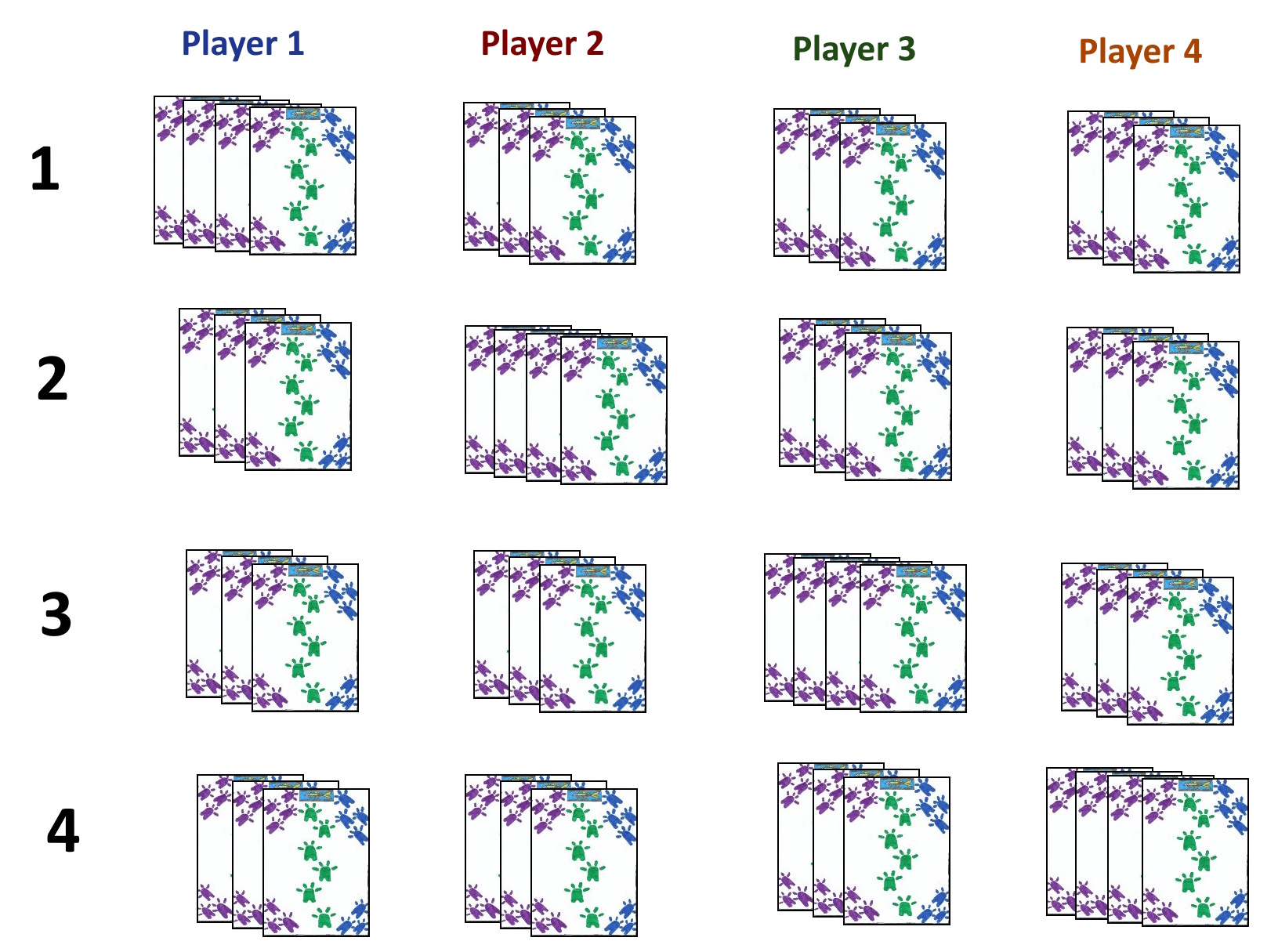 |
The end result is that each player should receive 13 total cards after the deal. This same pattern of dealing is used for each hand.
After the cards have been dealt a round of bidding occurs, starting with the player to the immediate left of the current dealer. There are six possible bids which a player can make, shown in ascending order, from lowest to highest:
- Ten - This is a bid to win 10 or more tricks during this hand, potentially with the aid of an as yet unknown partner.
- Eleven - A bid to win 11 or more tricks during the hand, potentially with the help of an unknown partner.
- Twelve - A bid to win 12 or more tricks during this hand, possibly with the assistance of an unknown partner.
- Thirteen - A bid to win every trick during the hand, potentially with the aid of an unknown partner.
- Mis - A bid for the player, playing alone, to lose every trick during the hand. The hand is played with no trump suit.
- Mis a Vis - A bid for the player to win no tricks during the hand, with this bidder exposing his hand face-up on the table after play of the first trick. No trump suit is used during play of this hand.
The bids continue in a clockwise direction around the table, with players passing or making a bid higher than any previous bid on this hand. If a player passes, they may still bid on a subsequent round of bidding. Once a high bid is followed by three consecutive passes, the bidding ends, with the high bidder set as the "Player" for this hand.
If all four players initially pass (no player makes a bid), the cards are then gathered together and sorted in a specific manner. Each player thus divides his the various suits (in the following suit order; hearts, clubs, diamonds, spades), and then arranged within each of these suits in ranking order from highest to lowest. Each player's complete set of cards are then gathered in order around the table starting with the player to the left of the dealer, and formed into the deck, which is then cut once by the next dealer in turn and redealt. This next hand is then played with doubled scoring (called a "double hand").
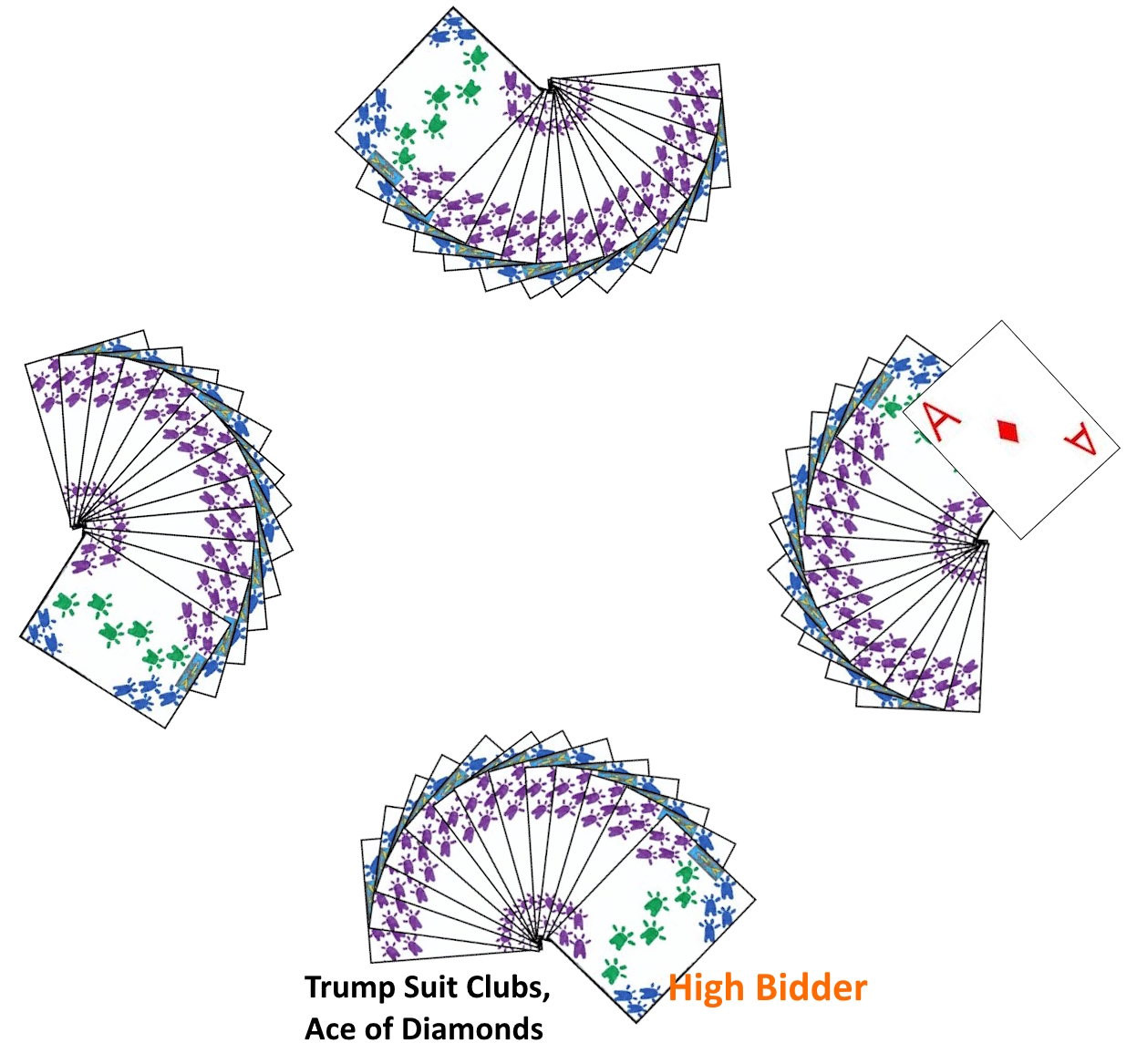 The high bidder then has the privilege of leading the first card to the first trick which may be any card of that player's choice. In a numerical bid (10, 11, 12 or 13) the high bidder also makes two announcements. First they announce a suit to be used a trump suit for the hand (or may also announce "No trump" to use no trump suit for the hand) and then announces (or "nominates") a specific card (by rank and suit). The holder of that particular card then becomes the hidden partner for this player. The player who has that particular card in hand, however makes no indication that they have this card, and thus it will only become apparent which player has this card through play of the hand. If the announcer does not name a suit for the announced card, it is assumed the card would be of the announced trump suit. If a player makes no announcement for the trump suit, it is also assumed that the card led by that player to the first trick is set as the trump suit for that hand. A player may also intentionally name a card that they already have in hand, in which the player will play alone with no partner, but the other players will not initially know this. If the high bid was "Mis" or "Mis a Vis", no trump suit is announced and the player does not name a card as the player will always play those bids alone.
The leader to a trick may lead any card of choice from their hand. Each other player in a clockwise direction then plays one card from their hand to the same trick. If the player has a card in the same suit as originally led to that trick they must play it. If they have no such cards, they may play any card to that same trick still remaining in their hand, including a card from the trump suit (if any).
Each trick is won by highest card of the trump suit played to the trick. If the trick contains no cards in the trump suit it is won by the highest card in the suit originally led to that trick. The winner of each trick leads the first card to the next trick. The winner of the trick should thus gather the four cards played to the trick and place them in a pile near himself containing all his won tricks.
After all tricks have been played and won, scoring for that hand is then determined. In a numerical bid, if the high bidder (and his hidden partner, if any) combined, manage to win at least as many tricks as bid, both these players earn a number of points equal to that bid. However, in a numerical bid, if the bidder and his hidden partner win fewer than the bid number of tricks, the opposing players win the amount of the bid. If the high bidder played without the aid of a partner, he alone scores for a successful bid, or all three opponents score if the bid is not successful.
In a bid of "Mis" if the player manages to lose every trick he earns 13 points, and in a bid of "Mis a Vis" if the player wins zero tricks he wins 26 points. However, if the player wins even one trick, each of the opponents earns this score instead.
In a "Double Hand" all scores are doubled for that hand, allowing for potentially high bids and scoring.
If, after calculating scores for a completed hand, one or more players is found to have reached a score of 101 or higher, the player with the current highest point total is declared the game winner.