Pan is a card game commonly played in Poland of the shedding type with players attempting to avoid being the last player with cards still in hand. In the Polish language, the name of the game translates to the title "Mr." or "Gentleman". The game is also known by a surprisingly large number of other names, often the result of some three word acronym, as the scoring mechanism of the game assigns the last player to be rid of their cards a letter in the name of the game. For example, another common name of the game is "Historyczny Upadek Japonii" which translates to English as "Historical Collapse of Japan" with the losing player assigned a letter from the acronym "HUJ".
The game is played using a reduced 24 card deck. This deck can be created from a standard 52 card deck by removing all cards of rank eight and lower. The ranking of the cards that remain are as follows (from high to low): Ace, King, Queen, Jack, 10, 9. The suit markings on the cards are generally irrelevant in this game, with the importance being upon the rank of the cards played. The game is usually played by 2 to 4 players, each playing independently.
Determination of seating positions and first dealer can be performed using any manner of method, with a draw for high cards quite common. Using that method, each player thus draws one card from the shuffled, face-down deck. Any players drawing cards of the same rank would thus discard those cards and draw another. The players would then take their choice of seats in order from highest drawn card to lowest. The player drawing the highest ranked card of all is set as the first dealer. After each hand, the role of dealer rotates from player to player in a clockwise direction.
The designated dealer for the hand, then shuffles the deck and offers it to the player at his right for the cut. After the cut, he then begins dealing the cards, one-by-one and face-down. Continuing to deal until the entire deck has been dealt out.
 Whichever player has been dealt the nine of hearts (♥) always has the first play, and the turns then rotate around the table in a clockwise direction. This first play must
thus consist of the nine of hearts. However, if that player has all four nines in hand, he may thus play these cards as well if preferred.
Whichever player has been dealt the nine of hearts (♥) always has the first play, and the turns then rotate around the table in a clockwise direction. This first play must
thus consist of the nine of hearts. However, if that player has all four nines in hand, he may thus play these cards as well if preferred.
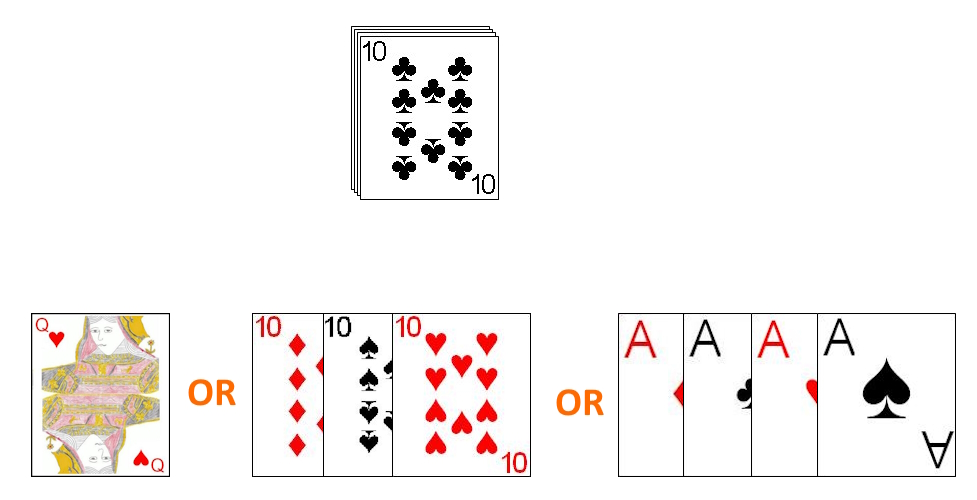
After the first turn, on each player's turn, he may make one of several plays to the top of the play pile, from the following (played face up on the play pile):
- The player may play one card of a rank that is higher than the top card on the play pile.
- The player may play exactly three cards that are of the same rank as the current top card on the play pile.
- The player may play exactly four cards that are of a higher rank than the top card of the play pile.
- If the player can make none of these plays, he must instead pick up cards from the play pile. If the play pile contains fewer than four cards, the player takes all the cards on top of the bottom card of the play pile, the nine of hearts, which is never taken. If there are more than four cards in the play pile, he must take a minimum of three, but may take as many as he prefers over that number (excepting the nine of hearts which must always remain as the bottom card of the play pile).
After a player takes any one of these actions, his turn ends and the next player in rotation has his turn. Once a player manages to play the last card from his hand legally to the play pile, he drops from the hand. Once the play is down to just two remaining players, after the first of these players plays his last card, the remaining player has one remaining turn. If that player manages to play the last of his cards on that turn, the hand is a draw. However, if that last player is not able to play the last of his remaining cards, he is the loser of that hand and he is assigned a letter from the name of the game. Once a player has collected all three letters (i.e., first a "P" then an "A", and lastly an "N") from the name of the game (and thus losing three hands), the game ends and that player is the loser of the entire game.