Determination of first dealer and seating position can be performed using a variety of methods, with a draw for low cards a common method. Any players drawing cards of the same rank should discard those cards and draw a replacement. Using that method, each player would draw one card from the face-down shuffled deck, with the players taking seats in order of cards drawn, from lowest to highest. The player drawing the lowest card of all is set as the first dealer. After each hand, the role of dealer rotates around the table in a counter-clockwise direction.
The designated dealer should thoroughly shuffle the deck and offer it to the player at his left to cut. This player cuts the deck and hands the bottom portion of the pack to the dealer to use for the deal. The dealer then deals these cards in a counter-clockwise direction around the table starting with the player at his immediate right. Each player should receive a total of 11 face-down cards. If the cut packet used to distribute these cards was exactly the number of cards needed to complete the deal with the current number of players, the player who cut the deck immediately earns 50 points. As an example, in the three player game, if the cutter managed cut exactly 33 cards, the cutter would immediately add 50 points to his current ongoing score. After the cards are dealt the two halves of the cut deck are reunited, and stacked face-down in the middle of the table. The top card from this stack is then turned over, face-up, and set beside the stock to start the discard pile.
The player to the immediate right of the dealer has the first turn, and the turns rotate around the table in a counter-clockwise direction. As in most Rummy type melding games, a player's turn consists of several moves:
- Draw: To start his turn, a player will first draw a card. He may draw the top, face-down card from the stock pile or must take the entire discard pile. If he draws the top card from the stock pile he adds the card to his hand and continues play. However, if the player takes the discard pile, he must meld the top card from the discard pile on this same turn.
- Meld: After the draw, the player may then, if able and willing, make legal melds to the table. The standard legal melds that can be made in Pináculo are as follows:
- Set: Three or more cards, all of the same rank.
- Escalera: Three or more cards of the same suit and in direct sequential order.
- A player must then end their turn by making a discard, taking any card of choice remaining in their hand and placing it on the top of the discard pile. The exception to requiring a discard is that a player may play all his cards to legal melds on his turn will not need to thus discard. If a player ends the turn, after discarding, with only one card remaining in their hand, they must announce this by shouting "Pumba!". Failure to make this announcement forces that player to take a -50 point penalty from their current accumulated score and on their next turn must draw from the stock (they are forbidden from drawing from the stock pile on their next turn).
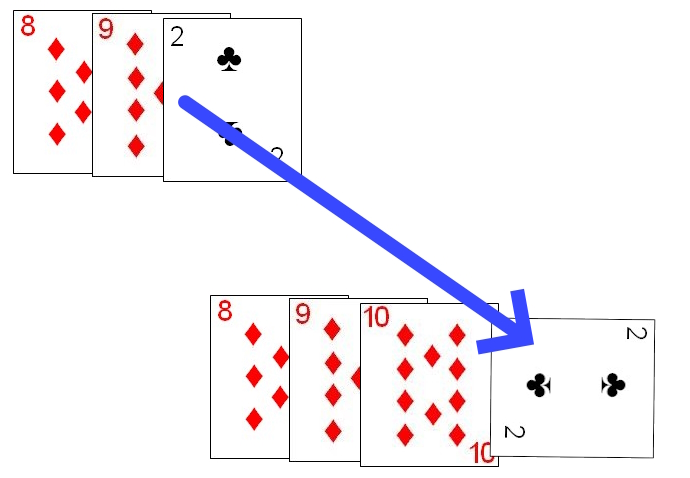 Melds may contain any number of wild cards (twos and Jokers), however, they every specific must contain at least two natural cards. A player should keep his melds in front of himself on the table, as players earn points for melds made during the hand. Players may also lay off cards to existing melds on the table, but only melds that player had previously made.
If a player has a total accumulated score of 750 or more points at the beginning of any hand, that player is said to be barbelé. The first meld that player makes on that turn must have a combined total of at least 70 points. If the player attempts to make a lower total meld, it must be taken back into the player's hand and that player is imposed a penalty of -50 points.
If a player has the natural card replacement for a card being represented by a wild card (2 or Joker) as any card in a set or as one of the end cards in an escalera, the player may then replace the wild card with the appropriate card from the hand and then move the wild card to one end of the meld (this can score bonus points at the end of the hand).
 Each player earns a number of points based on melds they have made. Certain special melds, called premium melds, carry a special value, as follows:
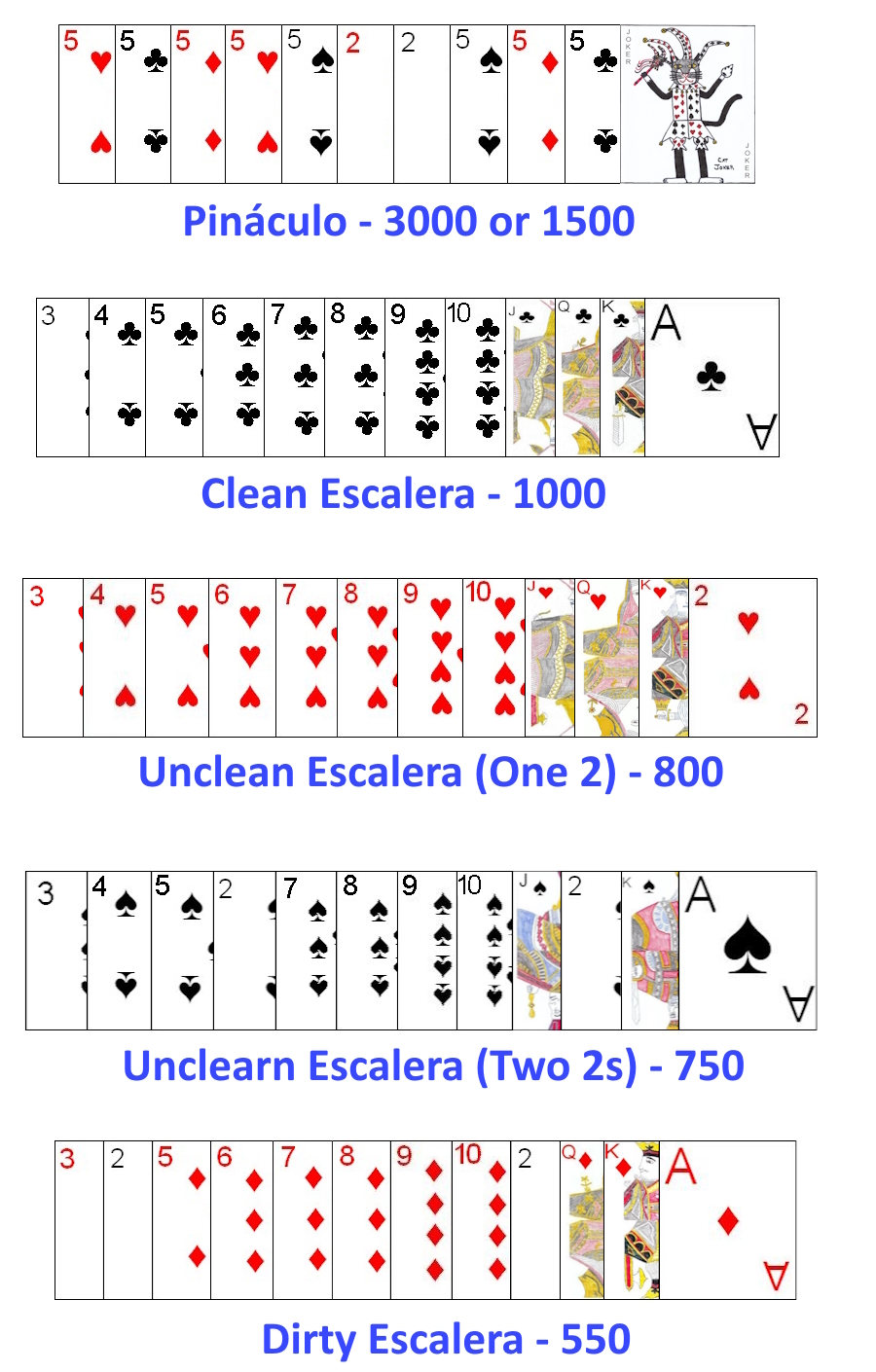
- Pináculo (Pinnacle) in one turn: This is a meld consisting of a set of 11 cards all of the same rank, all laid down during one turn. This meld, by necessity will include three or more wild cards. This earns the player making this meld 3000 points.
- Pináculo (Pinnacle), gradual : This is 11 cards, all of the same rank which has been formed over the course of multiple turns, which carries a scoring value of 1500 points. As there are only 8 of a specific rank found in the deck to be used for the game, the meld will also contain at least three wild cards.
- Clean Escalera: This is a sequence, in suit, of 12 cards (3 to Ace) containing no wild cards. This meld earns the player a total of 1000 points.
- Unclean Escalera (with one deuce): This is a 12 card sequence of cards all of the same suit, which contains exactly one wild card. This wild card must either be a Joker or a wild two in which the suit of the two is the same as the rest of the cards forming the sequence. This meld has a total scoring value of 800 points.
- Unclean Escalera (with two deuces): This is a 12 card sequence of cards all in the same suit, containing two wild cards. The two wild cards as found in the escalera may either be Jokers or wild twos of the same suit as all the natural cards in that same sequence. This meld earns the player making the meld a scoring value of 750.
- Dirty Escalera: This is a 12 card sequence of cards all in the same suit, containing one or more wild cards, in which any of these wild cards are of a different suit than the other cards in that escalera. This meld has a total scoring value of 550.
- Eight Natural Aces: This is a meld consisting of eight Aces, and containing no wild cards (twos). This meld has a scoring value of 1000 points.
- Eight Natural Courts: This is a meld consisting of either eight Kings, eight Queens or eight Jacks, and containing no wild cards. This meld earns that player 750 points.
- Seven Natural Aces: This meld consists of seven cards in the rank of Ace, and containing no wild cards. This meld has a scoring value of 400 points.
- Seven Natural Courts: This is a meld consisting of seven Kings, seven Queens or seven Jacks, with no additional wild cards. This meld has a score of 300 points.
- Six Natural Aces: This is a meld consisting of six Aces, and containing no wild cards. This meld has a scoring value of 300 points.
- Six Natural Courts: This is a meld consisting of either six Kings, Queens or Jacks, which earns that player 200 points.
- Aces (with wild cards): This is a meld consisting of six Aces, which may contain a maximum of one wild card. This meld has a value of 180 points.
- Courts (with wild cards): This is a meld consisting of six Kings, Queens or Jacks, which may contain, at most, one wild card. This meld has a value of 120 points.
For forming any of these bonus melds, the player earns the indicated value instead of the specific value for each card comprising the meld. However, for any melds that are not one of these special melds, the player earns a number of points for the meld based on the cards forming the meld, as per the following chart:
| Card | Point Value |
|---|---|
| Joker | 30 Each |
| Two | 20 Each |
| Aces | 15 Each |
| High Cards (8, 9, 10, Jack, Queen, King) | 10 Each |
| Low Cards (3, 4, 5, 6, 7) | 5 Each |
In addition, there are several other bonuses that a player can earn at the end of a hand:
- Eight Naturals: If a player manages to form a meld that consists of eight cards, all of the same rank, that player earns a bonus of 50 points plus the individual value of each card forming that meld.
- A player who manages to deplete his hand earns 20 bonus points.
- A player who manages to deplete his hand without the use of a wild card on his last turn, earns double the points for every meld made on that same turn.
- A player who manages to meld all 11 of his cards on the same turn, doubles the scores of all melds and cards on that hand. If the player uses no wild cards, he quadruples the value of all those melds or cards instead (this is instead of the normal 20 point bonus for depleting the hand).
- Wild cards that were replaced by the natural card in a player's melds earns the player bonus points. For each such wild card Joker that was replaced by the natural card, the player earns 30 points, and for each wild card two that was replaced the player earns 15 points in an escalera or 30 if in a set.
Once any player melds or discards his last card, the hand immediately ends. After each player scores for any melds they have made to the table during that hand, they must then subtract from their accumulated ongoing score a number of points based on the value of each card remaining in hand (see the chart above which shows the value of each such card).
The game continues in this manner until one or more player, at the end of hand after all scores have been calculated, if any player has reached or exceeded 1500 total accumulated points, that player is declared the winner. If multiple players have managed this, the player with the highest total score is declared the game winner.