Push or "Push Rummy" is a Rummy game that is played similarly to several of the Contract Rummy family of Rummy type games but it also has several unique differences that make it a distinct
and different player experience. Push is played using two standard 52 card decks shuffled together with the addition of four total Jokers. The ranking of the cards in the deck as used for sequence melds are as follows: Ace, King, Queen, Jack, 10, 9, 8, 7, 6, 5, 4, 3, 2, Ace. It should be noted that Aces can be considered high (the highest card after King) or low (the lowest card before the two), but a meld may never have an Ace as a middle card in that meld (such as King, Ace, Two
and three of clubs). All Jokers and twos are considered wild cards in this game and may be substituted in a meld for any other card. A two can also be used as an actual, natural two as appropriate.
Push Rummy is designed for play by four players in two partnerships consisting of two players each. Determination of seating positions and first dealer can be performed using a variety of methods. One of the most common such method is to have each player draw one card from a shuffled deck. The players drawing the two highest cards would thus play as one team, being opposed to the players drawing the two lowest cards. Each player should be seated at the table directly across the table from his partner. The player drawing the highest card of all is set as the first dealer for the game and thereafter, the role of dealer rotates in a clockwise direction around the table after each hand.
The dealer should thoroughly shuffle the cards and offer the cards to the player at his right for the cut. After the cut, the dealer then begins distributing the cards, starting with player at his immediate left and continuing in a clockwise rotation around the table. The number of cards dealt is dependent
upon which round in the sequence is being played. As in most other games of this type, the game is played over a series of rounds, with the melding requirements different on each of these rounds as is the number of cards dealt to each player. The following chart shows the five rounds played during a game of Push, the
specific number of cards dealt to each player, and the specific initial
melding requirements for that round:
| Round | Cards Dealt to Each Player | Initial Melding Requirement |
|---|
| 1 | 6 | 2 Sets of Three Cards |
| 2 | 7 | 1 Set of Three Cards and 1 Run of Four Cards |
| 3 | 8 | 2 Runs of Four Cards |
| 4 | 9 | 3 Sets of Three Cards |
| 5 | 10 | 2 Runs of Five Cards |
After the dealer has dealt the appropriate number of cards for that
round, he then places the remainder of the deck in the center of the
table as the stock pile and turns over the top card of the deck to start
the discard pile. If this card is a Joker or two, he adds that card back
into the deck (buries the card) and turns over the next card instead
from the top card of the stock (repeating the process if the next card is also any wild card). The player to the immediate left of the dealer has the first turn.
Each turn consists of a number of actions for which a player will take:
 Draw:
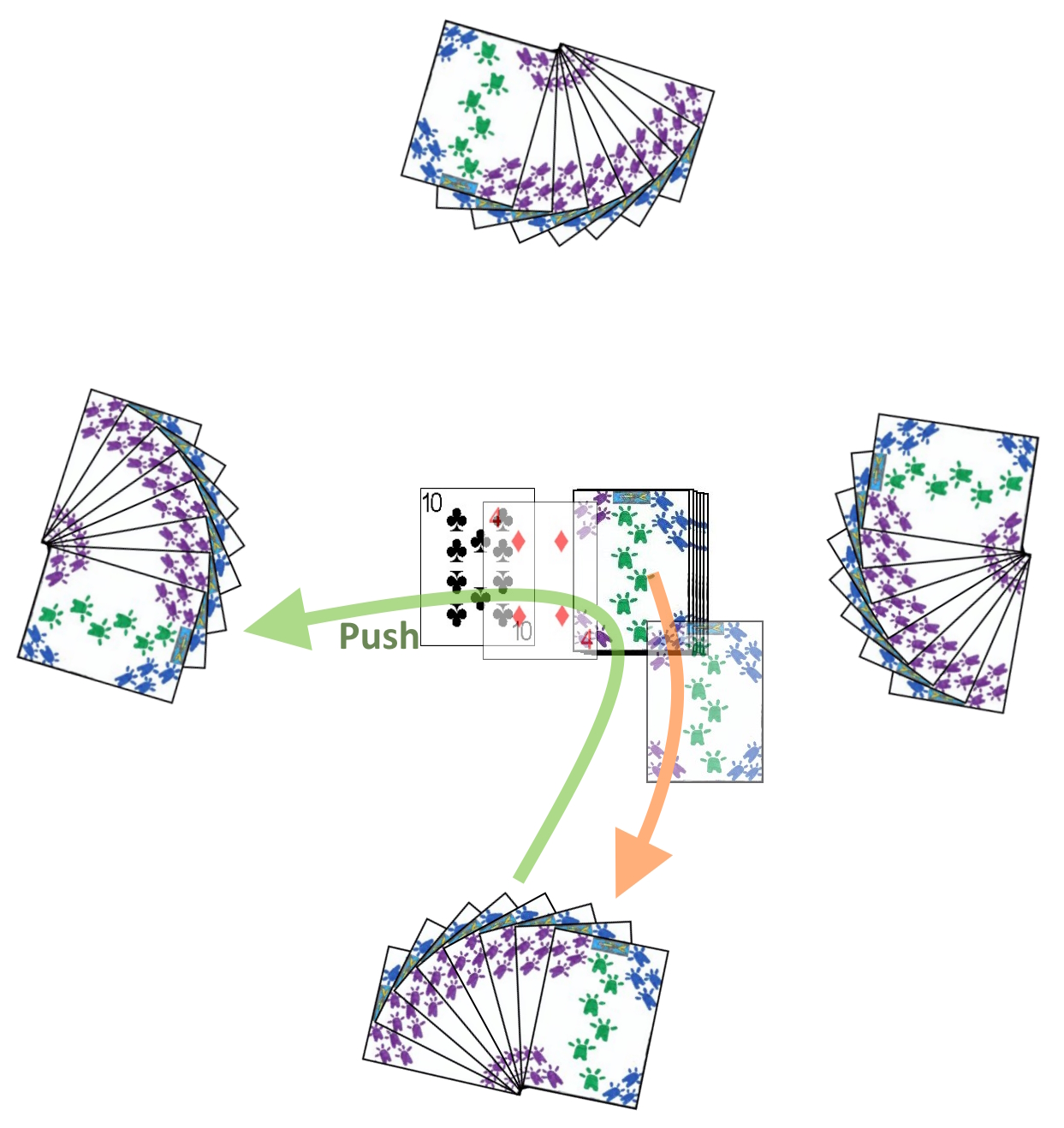
Draw: To start his turn, each player will have the opportunity to draw a card. If the player wants the top, exposed, card from the discard pile, they can thus take this card and add it to the hand. However, if the player prefers not to draw the top card of the discard pile, he follows a different procedure. He takes the top, face-down card from the stock
pile, turns
it over and places it on top of the current top-most, face-up card of the discard pile and passes both of these cards (called pushing) to the player at his immediate left. That player on the left than adds both cards to their hand. The player who "pushed" the cards then takes the next top card from the face-down stock adding it to his own hand
and continues with his turn.
Optional Melding: After the draw, a player on his turn may then meld cards, if willing and able. A meld consists of legal combinations of cards. The following are the legal meld types allowable in this game:
- Set:
A set is a collection of three or four cards all of the same rank. No two cards in this Set can be of the same suit, however.
- Run:
A Run is a collection of three or more cards all in direct sequential order and all of the same suit. It should be noted, unlike in most Contract Rummy type games, in Push, a Sequence of three cards is considered a legal meld.
The first meld any player makes to the table must fulfill the Initial
Melding Requirements listed in the chart above. Thus, a player is not entitled to make any melds to the table until first making a meld that fulfills that initial requirement. Once that initial requirement has been fulfilled by that player, he may then, on the same turn or subsequent turns play additional, legal melds to the table. A player may also add cards (laying off) to other melds on the table, which had been melded by any player. If a meld contains any wild cards and there is any doubt as to what card (rank and/or suit) that card represents, the player making that meld must state this. If a player on his turn (who has already made an initial meld on the current hand) has the actual replacement card for a wild card in an existing meld on the table, he may replace the wild cards (taking it into his hand) and replace it with that natural card (this is called rescuing the wild card). If a 2 is actually representing itself in a meld, this card cannot be so rescued. In adding cards to existing melds on the table (once permitted), a player may add cards to any other melds already on the table.
Discard: Each player then ends the turn by discarding any card from his hand, face-up to the top of the discard pile.
The game continues in this manner until any player manages to "go out" by
either melding all of his cards (over one or more turns) to the table, or
by melding all but one card and then, discarding his last card as his
normal discard to end the turn. Once any player manages this, the hand
immediately ends. In addition, if the stock pile is exhausted, and a
player would want to draw from this pile (which has no cards), the hand also immediately ends.
Once a hand so ends, scoring is performed for that hand. The partnership containing the player who managed to deplete his hands scores zero for the hand (regardless of the cards still remaining in the hand of the partner of the player who depleted his hand). The opposing partnership however, must add to their current accumulated score a number of points based on the cards left remaining in both of those partner's hands:
| Card | Point Value |
|---|
| Wild Card (2 or Joker) | 20 Each |
| Aces | 15 Each |
| 10, Jack, Queen, King | 10 Each |
| 3, 4, 5, 6, 7, 8, 9 | 5 Each |
After all five rounds have been completed the accumulated scores for both partnerships are thus compared and the partnership with the lower score is declared the game winner.
Cap It: Another game which is played almost identically to Push is "Cap-It". The game is thus played the same as standard Push with a few differences.
The first difference is that there are no partnerships, with each player playing for themselves. As such, Cap-It can be played by from 3 to 6 players. If the game is to be played by more than 5, one additional deck (including two Jokers) should be added to the deck used for play. The specific series of
contracts to be played in this variant is also slightly different, with the following showing the specific meld requirements on each of the five hands comprising a game:
| Deal Number | Number of Cards in Hand | Meld Requirements |
|---|
| 1 | 10 | Two Groups of three cards each |
| 2 | 10 | One Group of three cards and one Sequence (run) of four cards |
| 3 | 10 | Two Sequences of four cards each |
| 4 | 10 | Three Groups of three cards each |
| 5 | 10 | One run of three cards and another run of seven cards |
After all five rounds have been completed, the player with the lowest accumulated score is declared the winner.
Other than these differences Cap-It is played the same as standard Push.
6 7 8 9 10: "6 7 8 9 10" is another game which closely resembles Push Rummy. The game takes it's rather unusual name from the number of cards in the base meld for each of the
five deals which constitute a complete game. The game is best for two players but can be played also by three or four. When played by two or three the game is played using one standard 52 card deck. If played by 4 two such decks are shuffled together. The ranking of the cards used in this deck, for purposes of sequence melds, is as follows (from high to low): Ace, King, Queen, Jack, 10, 9, 8, 7, 6, 5, 4, 3. Twos are considered wild cards and thus can be used as a replacement for any other card in a meld, and thus should not be used to represent an actual two in a meld.
The designated dealer should thoroughly shuffle the deck and offer it to the player at his right to cut. After the cut, the dealer then deals the cards, one-by-one and face down, starting with the player at his right and continuing in a clockwise direction around the table. He continues dealing until each player has a total of ten cards. The dealer then lays the remainder of the deck down in a pile at the center of the table as the stock. Lastly, the top card from the stock is turned up and laid beside the stock as the discard. If this is a two, it is shuffled back into the deck and the next card turned instead (if this is also a two, the same procedure is followed until a non-two is exposed).
The player to the right of the dealer has the first turn and play rotates around the table in a clockwise direction. Each turn consists of multiple parts:
- The player first reviews the current top card of the discard pile to determine if the player wants the card. If the player prefers to take this card, he takes the card, adding it to his hand. Otherwise, if the player does not want the card, he passes this card, along with the top card from the stock to the next player at his left, who simply adds these cards into their hand. If the stock only contains one card, the player must always take the discard into their hand.
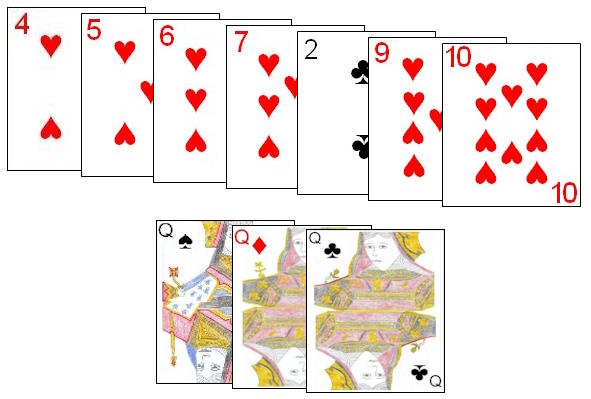
- After the draw phase, the player may then, if able and willing, make melds to the table. As in most other forms of Rummy, two types of melds are allowed in this game, sequences and sets. A sequence is three or more cards in direct ranking sequence and a set is three or more cards, all of the same rank. However, before a player is entitled to make a meld, they must fulfill a basic requirement for that hand or deal. The following chart shows these requirements for each of the five deals in a game:
| Deal Number | Required Meld |
|---|
| 1 | A six card total meld, consisting of two sets consisting of three cards each. |
| 2 | A seven card total meld consisting of one run of four cards, and one set of three. |
| 3 | An eight card total meld consisting of two different runs of four cards each. |
| 4 | A nine card total meld consisting of three sets of three cards each. |
| 5 | A ten card total meld consisting of one run of seven total cards and a set of three cards. |
|
|
 |
A player may make no melds or lay off cards to other melds already on the table until they are able to make this initial meld. Once a player makes the initial meld, on the same turn or subsequent turns, they may make new melds of any type, or lay off cards to existing melds already on the table (made by any player). In addition, if a player has the natural card for which a two is substituting in a meld on the table, the player may replace the card and take the two into their hand for later use. A player must end his turn with a discard.
- A player then ends their turn with a discard. A player may never discard a two and, if that player drew the discard
on this turn, may not discard that same card on the same turn.
Once a player depletes his hand during his turn, discarding his last card, the hand immediately ends and scores are calculated. Each player then adds to their accumulated score a number of points based on the cards remaining in their hand, as per the following chart:
| Card | Point Value |
|---|
| 3, 4, 5, 6, 7, 8, 9 | 5 Points Each |
| 10, Jack, Queen, King | 10 Points Each |
| Ace | 15 Points Each |
| 2 | 20 Points Each |
After each of the five hands has been completed, the player with the lowest accumulated score is declared the game winner.
Copyright © 2015 CatsAtCards.com. All rights reserved.