The game is played using a 36 card deck which can be created by removing all cards of rank five and lower from a standard deck. The rank of the cards in the reduced deck used for the game are ranked as follows, from highest to lowest: King, Queen, Jack, Ace, 10, 9, 8, 7, 6.
As noted, the players should thus be divided into two teams of three players each. These can be pre-determined teams or players can draw cards or use any other method to determine the teams. The players should be seated at the table such that each player has a player from the opposing team at his left and at his right. Each team should then select one player (usually the most experienced Sizette player) to have the role as team captain or governor.
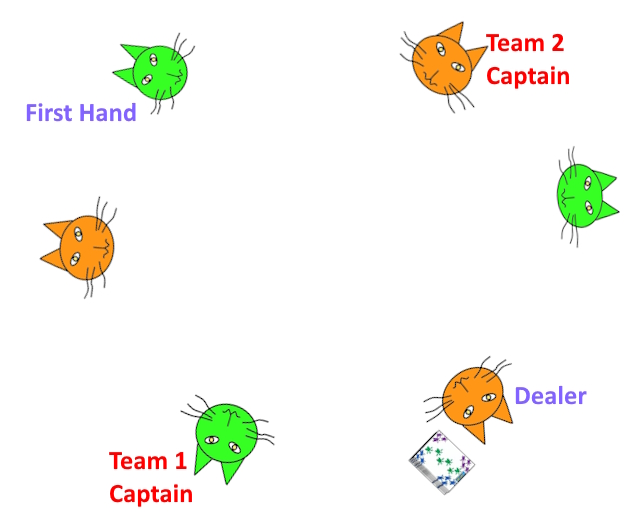 Before play begins, the players should each draw a card from the shuffled deck to determine which player will be the first player to lead to the first trick. The player drawing the highest card during this draw would thus be designated the player to thus have the first play (sometimes called "First hand"). This first hand player then hands the deck to any player from the opposing team, with the player thus receiving the deck designated as the first dealer. This dealer would then gather
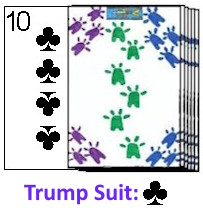
all the cards and thoroughly shuffle the pack. He would then offer it to the player at his immediate left for the cut. After this the dealer then begins dealing the cards. He deals the cards in a counterclockwise direction around the table starting with the player at his immediate right. He deals the cards in three card packets, continuing around the table until each player has a total of six face-down cards. The last card dealt, which will be part of the dealer's hand, is dealt face-up. The suit of this card sets the trump suit to be used for the hand. After every player has the opportunity to see this card and identify the trump suit, the dealer adds the card into their hand. After each hand, the next player in a counter-clockwise direction from the current dealer is then set as the dealer for the next hand.
Before play begins, the players should each draw a card from the shuffled deck to determine which player will be the first player to lead to the first trick. The player drawing the highest card during this draw would thus be designated the player to thus have the first play (sometimes called "First hand"). This first hand player then hands the deck to any player from the opposing team, with the player thus receiving the deck designated as the first dealer. This dealer would then gather
all the cards and thoroughly shuffle the pack. He would then offer it to the player at his immediate left for the cut. After this the dealer then begins dealing the cards. He deals the cards in a counterclockwise direction around the table starting with the player at his immediate right. He deals the cards in three card packets, continuing around the table until each player has a total of six face-down cards. The last card dealt, which will be part of the dealer's hand, is dealt face-up. The suit of this card sets the trump suit to be used for the hand. After every player has the opportunity to see this card and identify the trump suit, the dealer adds the card into their hand. After each hand, the next player in a counter-clockwise direction from the current dealer is then set as the dealer for the next hand.
Before play of the hand begins, the team on which the "first hand" player is a member are allowed to discuss their hands. However, this should be done in a way as to help determine the best strategy for play without revealing too much information to the opponents. This is usually accomplished by that team's captain asking various questions of the players on his team. These players may thus provide or ask for any type of information about the hand, but, as noted, the team does not want to reveal too much information to the opposing team. All information must be clearly asked for or provided, no secret signals may be used, and all information must be truthful. Once these players have thus discussed there hands, the First hand player, makes the first lead to the first trick. The captain, based on the information exchanged, will then direct this player as to how they should play the hand. During the course of the hand, he may continue to direct the players on his team as to a suggested play, however, after the initial discussion, the players may no longer exchange information about their hand.
After the first hand plays his first card to the first trick, the opposing team may then discuss their hands in the same way, with the Captain asking questions and providing information to the players comprising his team. Once this team has the opportunity to discuss the play, the player to the immediate left of the first hand, plays the next card to the first trick. After these initial discussions, only the captain may provide information to his teammates and then only as a recommended play to the trick. A player is never absolutely required to follow the instructions of the captain, however it is usually recommended as the captain is often the most experienced player at the game.
The leader to a trick may play any card of choice to start the trick, which of course may be influenced by the Captain. Each other player, in a counter-clockwise direction around the table, then players a card from their hand to the same trick. The captain of the team will usually make a suggestion or direction as to what the player should play. In playing to an existing trick, a player must play a card of the suit originally led to that trick if having such a card. If the player has no cards of the suit originally led to the trick, he may play any card of choice from his hand, including a card from the trump suit.
After each layer has played one card to the trick, it is determine who has won this trick. If the trick contains any cards of the trump suit, the highest such card wins the trick. If no cards from the trump suit are found in the trick, it is instead won by the highest card of the suit originally led to the trick.
It should be noted who won the trick, and the cards set aside face-down and out of play. The winner of each trick then leads the first card to the next trick.
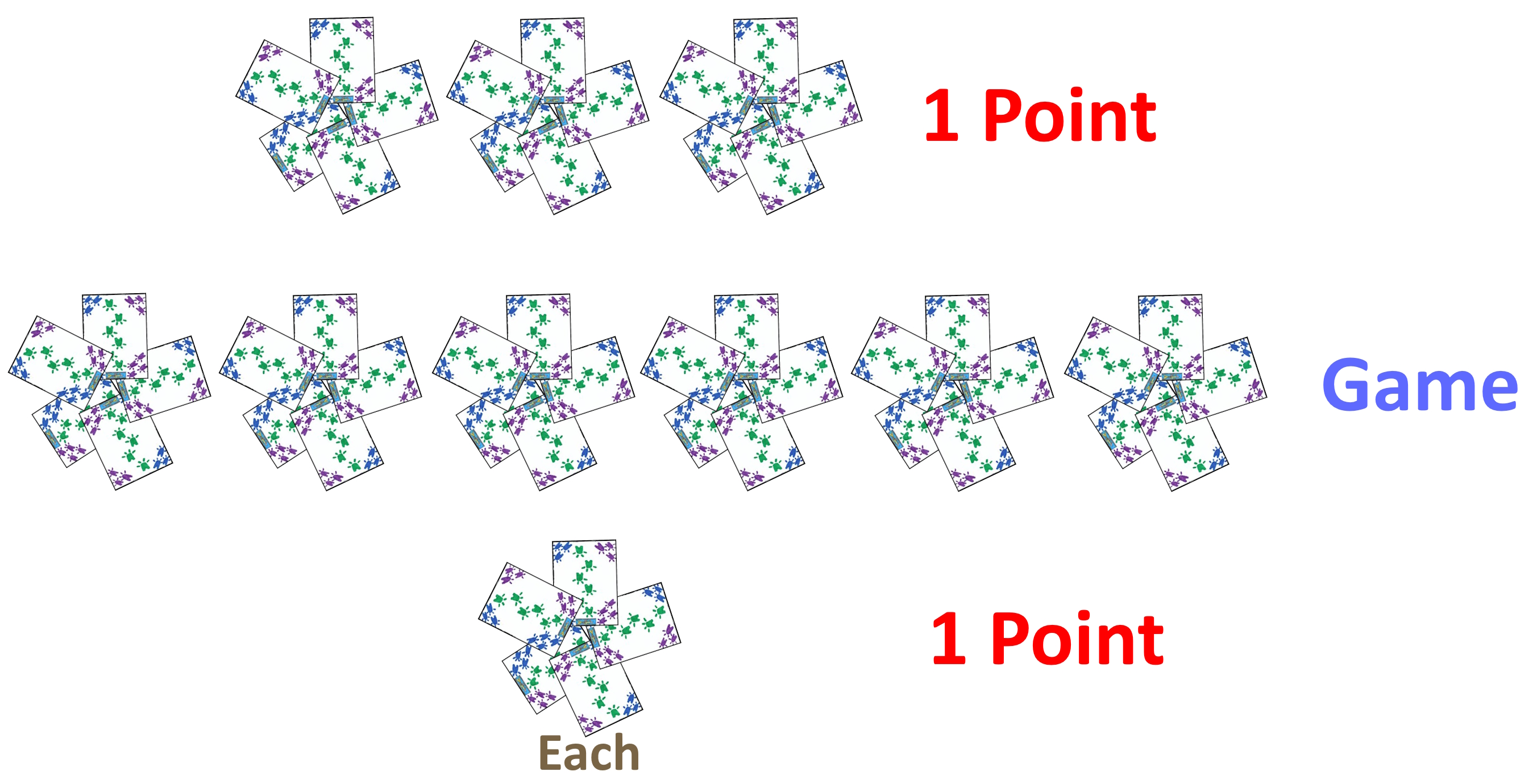
The first team to win three tricks is the winner of the hand and scores 1 point for their team, after which the hand is usually terminated. However, if a team manages to win the first three tricks, they may continue playing, attempting to win every trick during the hand. If they manage to thus win every trick (called the "volley"), they win two points instead. If they fail to win every trick, that team still earns one point for being the first to win three tricks during the hand.
The first team to win 7 total points is then declared the overall game winner.
Variations and Optional Rules
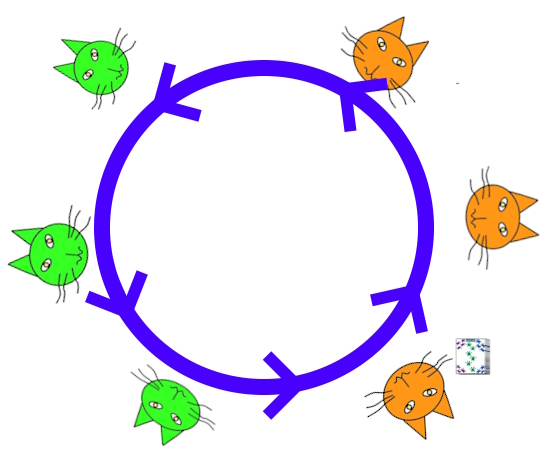 Alternate Team Seating Arrangements: While most commonly the game is played with each player sitting between two members of the opposing team, there is one published account of the game with a different and rather unusual seating arrangement. In that variant, all three players from one team sit consecutively around the table. Thus, you have in a rotation around the table, first all three players from the first team followed by all three players from the second team. Other than the change in the seating arrangements, the game is played identically to the standard game.
Sixte: A variant of Sizette is also played in which there are no teams, with each player thus playing independently. This game is usually played using the same 36 card deck as used in Sizette, but is sometimes also played using the full 52 card standard deck. The ranking of the deck is the same as is used in Sizette.
Determination of the first dealer can be performed using a variety of methods, with a draw for high cards most common. Using that method, whichever player were to draw the highest ranked card from a shuffled deck is then set as the first dealer. After each hand, the deal rotates around the table in a counter-clockwise direction.
The designated dealer for that hand should then thoroughly deal six cards to each player, usually in two packets of three cards each. These packets are dealt in a counter-clockwise direction around the table. If the 36 card deck is being used, the dealer shows the last card dealt to himself to the rest of the player, with the suit of this card setting the trump suit to be used for the hand. If the larger 52 card deck is in play, the dealer instead, after each player has the requisite number of cards, sets the remainder of the deck in the center of the table and exposes the top card from this remaining stack, with the suit of this card set as the trump suit for that hand.
As each player is playing for themselves, there is no captains and no communications regarding the cards or strategy a player will use. The player to the immediate right of the dealer plays the first card to the first trick, and each player in a counter-clockwise direction then plays a card to that same trick.
The leader to a trick may play any card of choice from their hand to start the trick. Each other player in turn, then must play a card of the same suit as led to the trick if they have such a card. If they do not have such a card, the player may play any card remaining in their hand to that trick, including a card from the designated trump suit.
After each player has played a card to the trick, it is determined who has thus won the trick. If the trick contains any cards in the trump suit, the highest card in that suit thus wins the trick. If the trick contains no cards of the trump suit, the highest card of the suit originally led to that trick wins it. Cards won in tricks should be set aside, face down, near the player winning that trick. The winner of the trick then leads the first card to the next trick.
 After every trick in the hand has been played and won, it is then determine which player, if any, scores for that hand:
- If any player manages to win every trick during the hand, that player immediately wins not only the hand, but the entire game.
- The first player to win three tricks during one hand earns one point.
- If each player wins exactly one trick, the player to win the first trick of that hand earns one point.
- For any other arrangement of tricks won, no player scores during that hand.
Quadrette: Quadrette is essentially a four player variant of Sizette, which appears to have derived from that game. In some locales this game was known as Quadretta. The participants are divided into two teams of two players each.
Quadrette uses the 32 card Piquet pack, which can be formed from a standard 52 card deck by removing all cards of rank lower than seven. The ranking of the cards as used in this game is as follows (shown from highest to lowest): King, Queen, Jack, Ace, 10, 9, 8, 7.
For determination of the first dealer and partnerships, a series of draws is performed. The players begin, in turn to draw cards from the top of the shuffled deck. The first player to draw any King, is set as the first dealer. The players continue drawing (excepting the player who drew that first King), with the next player to draw the other King of that same color (red or black) set as that player's partner during the hand. These players should be seated directly across the table from each other, with each player sitting such that a member of the opposing team is seated at their left and right. After each hand, the role of dealer rotates in a counter-clockwise direction around the table.
The designated dealer then thoroughly shuffles the deck and offers it to the player at his left to cut. After the cut, he then begins dealing the cards, usually in face-down packets consisting of four cards in a counter-clockwise direction around the table. He continues dealing until each player has a total of four face-down cards. The dealer then deals the last card (which will be part of the dealer's hand) temporarily face-up to the table, such that all players can see the card. The suit of this card determines the trump suit to be used during the hand.
As in Sizette, before play begins, each team should nominate one of their players as the team captain. This is usually the player with the most experience at playing this game. Throughout the hand, this player will then provide direction to his partner on recommended plays. Thus, after the deal, and before the first card is led to the first trick, the team which is on lead will thus discuss their hand. This takes the form of the captain asking specific questions (based on the cards in his hand) of his partner, and his partner answering. The main idea is to gather as much information about the hand without providing too much information to the opponents. The questions asked and the information provided in the response must be clear and true, with no special codes or hidden signals allowed. Once that team has completed this question and answer session, the lead player should then play the first card to the first trick.
After the first lead, the opposing team then has a similar question and answer session in which the captain attempts to determine the general cards and strengths of the partners hand. After this discussion, the second player then plays a card to that same trick. After the initial discussion, no additional querying information about the hands may be performed, however the team captain is expected to make suggestions and direction on what card his partners should play to each trick.
The leader to each trick may play any card remaining in their hand. Each other player, in a counter-clockwise direction, then plays one card to that same trick in turn. In playing to an existing trick, a player must play a card of the suit originally led to that trick if they have one. If the player has no such card, they may play any card to that trick, including a card from the designated trump suit.
After all four players have played one card to a trick, it is examined to determine who has thus won the trick. The player of the highest card in the trump suit (if any) is the winner of the trick. If the trick contains no cards in the trump suit, the highest card of the suit originally led to the trick wins it, instead. Cards won in tricks should be set aside and out of play. The winner of each trick leads the first card to the next trick.
The first team to win four total tricks is declared the winner of the hand, and is awarded one point for this. The hand is usually terminated once a team wins these four tricks. However, if a team wins the first four tricks of the hand, that team can opt to continue on, in an attempt to win all eight tricks. If the team manages to thus win every trick during the hand, they score 2 points for this accomplishment. If they fail to win all eight tricks, they are still entitled to earn 1 point for being the first team to win four tricks during that hand.
Before the game a target score (such as 7) is set, and whichever team is first to reach or exceed this target score is declared the game winner.
 "Modern" Quadrette: The rules given above are for the classic, original version of Quadrette, which was commonly played in the mid to late eighteenth century and later. However, the game as mostly played now has undergone some changes.
The first difference is that instead of eight cards, each player receives a total of six cards, usually dealt in three packets of three cards each. The dealer then lays the remainder of the deck down in the center of the table as the talon. The dealer then turns the top card of the talon, and slides it partway under the talon. The suit of this card sets the trump suit to be used for that hand.
Whichever team manages to first win four tricks is declared the winner of the hand, earning one point. If a team manages to win all six tricks, they earn 2 points instead. If both teams manage to win exactly three tricks, both teams score one point.
The dealer and the player at his immediate right are always set as the captain for the team, thus the role of these captains will change on each hand. After the first trick has been played, only the captains may speak, usually to give guidance on play of the hand.
Whichever team manages to first reach a pre-designated target score is then set as the winner. In all other aspects the modern rules are played the same as with the classic rule set.
Copyright © 2015 CatsAtCards.com. All rights reserved.