Tribello is a trick-taking card game designed for three players. The game originated in the state of Illinois in the United States of America in the early 21st century, however it has since expanded and has regular players throughout the country. Tribello is a sort of hybrid game with features from Whist, "quota" games (such as 3-5-7), and "compendium" games (such as Barbu).
The game is played using one standard 52 card deck. The ranking of the cards as used for this game is as follows, from highest to lowest: Ace, King, Queen, Jack, 10, 9, 8, 7, 6, 5, 4, 3, 2.
Determination of seating positions and first dealer can be performed using a variety of methods, with a draw for high cards commonly used. This method consists of each player drawing a card from the shuffled deck. If multiple players draw cards of the same rank, they should discard these and draw again, continuing until drawing a card that no other player has yet drawn. Once each player has thus drawn a unique card, the players take their preferred seats at the table in order of highest card drawn to lowest. The player drawing the highest card of all is set as the first dealer. After each hand the role of dealer rotates in a clockwise direction around the table.
The designated dealer on each turn thoroughly shuffles the deck and offers it to the player at his right to cut. After the cut the dealer then begins the deal, dealing the cards in a clockwise direction around the table, one-at-a-time and face-down. Although there are only three participants in the game, the dealer deals four hands of thirteen cards each, with each player receiving such a hand, and a fourth hand also dealt, called the "pickup". There is no set rule specifying when the pickup hand receives it's cards during the deal, but the same pattern should be used during each hand.
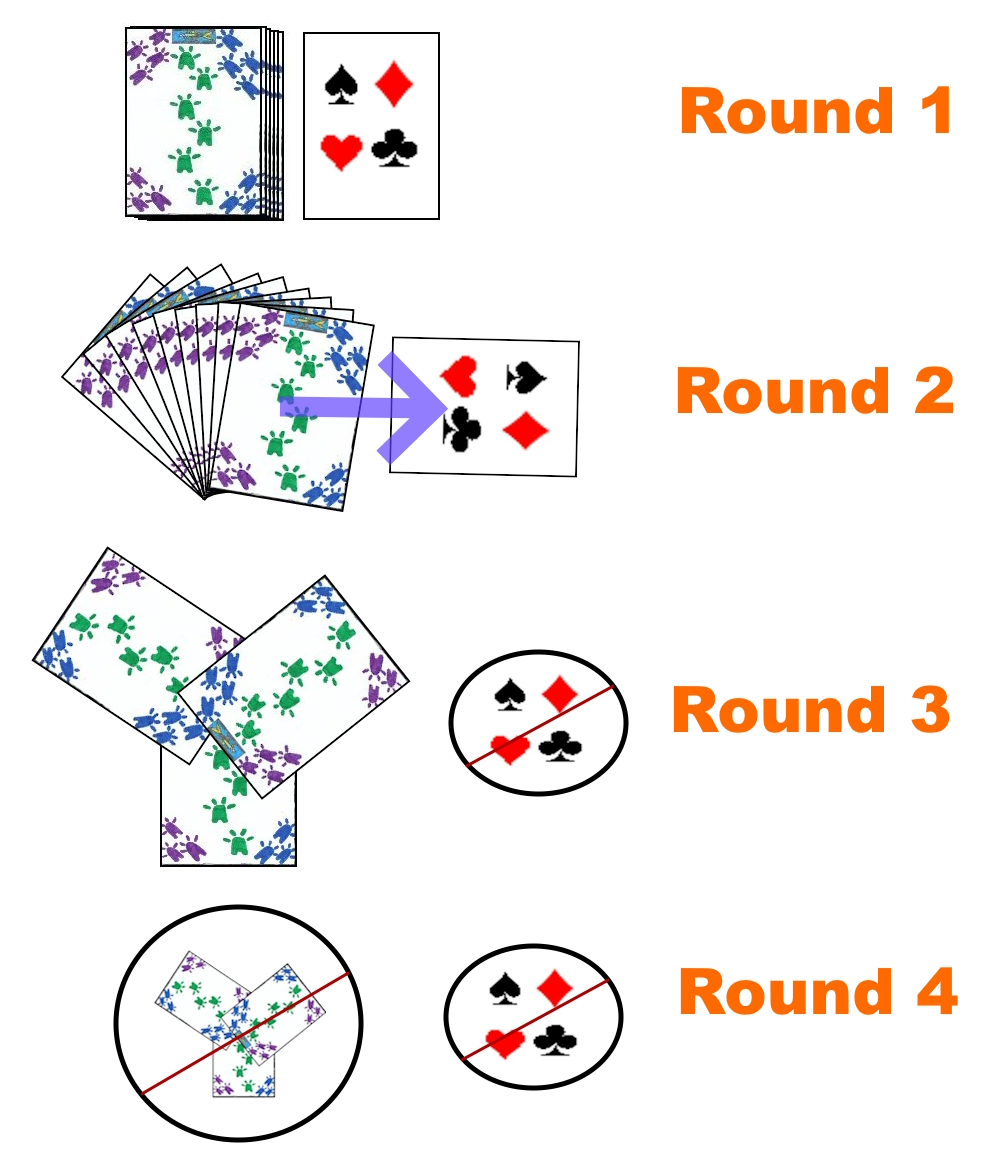 The game is played in a series of four rounds, with each round consisting of three deals, with each player dealing one time during each round. Thus, a full game consists of twelve total deals. Determination of the trump suit to be used for the hand, and the players' goal changes with each round. In addition, in a feature borrowed from quota type card games, each player also has a specific minimum or maximum number of cards they are expected to win on each hand.
As mentioned the determination of trump suit and the scoring are somewhat different during each of the rounds:
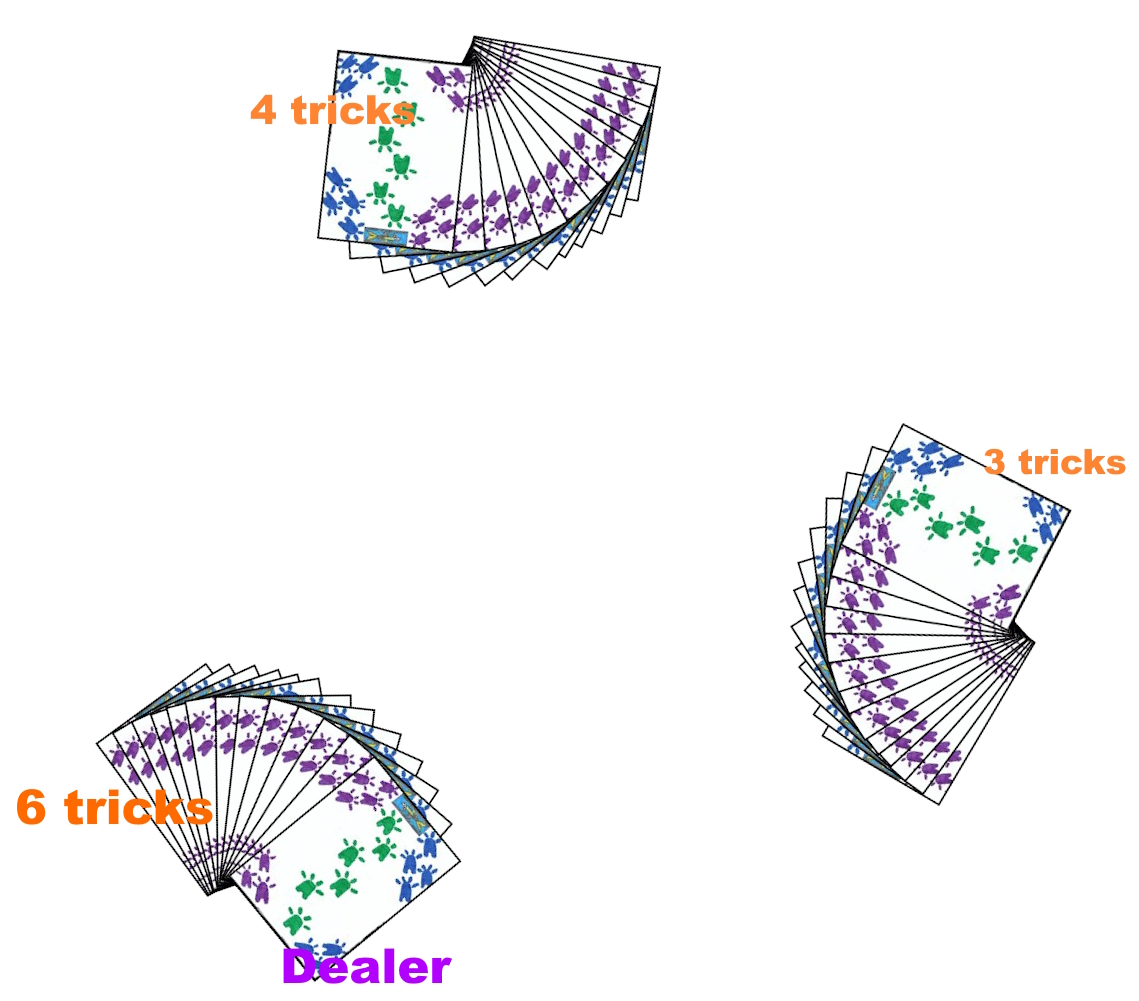
- During the first round (of three hands), before the deal the deck should be cut, and the suit of the cut card is set as the trump suit for the hand. In addition each player has a specific number or quota of tricks they are required to win during the hand. The dealer for that hand has a quota of six tricks, the player at his immediate left has a quota of four tricks, and the player at the right of the dealer has a quota of three tricks.
- During the second three hand round, the dealer of that hand examines his hand and then declares a trump suit of his choice to be used for the hand. Similar to the first round, the dealer has a quota of six tricks, the player at his left a quota of four and the player at his right a quota of three tricks to win during that hand.
- During the third round, the hand is played with no trump suit. And similar to the first two rounds, each player has a specific minimum number of tricks they are expected to win during the hand. The dealer six, the player at his right four and the player at the dealer's left, three.
- The fourth round is also played using no trump suit. However during this round (called nullo), players will instead attempt to win as few tricks as possible. During this hand, each player has a maximum number of tricks that they will attempt to take. The dealer's quota is three tricks, the player at his right has a quota of four tricks, and the player at the dealer's right a quota of six.
On the fourth round, however the scoring is calculated significantly differently. For this round, for each trick "under" or "below" his specific expected quota for the hand, that a player wins, the player is entitled to add one point to his current accumulated score. However, if a player wins more tricks than his expected quota during this last hand, he must subtract one point from his current ongoing score for each trick more than his quota that he won during the hand. On any hand, during any round, if a player wins exactly his quota of tricks he neither adds or subtracts any points from his ongoing score.
 Play of the Hand:
On each round, after the cards have been dealt and the player's have examined their hands, the players have an opportunity to trade cards with the extra pickup hand. The dealer has the first opportunity to do this. If he wants to thus exchange some cards, he must first discard that number of cards to the side (face-down), and then draw an equal number of cards from the face-down pickup hand. If there any cards remaining in the pickup hand after the dealer's exchange, the player at his right may then do the same, discarding any number of cards up to the total number remaining in the pickup hand and then drawing that same number of cards from the pickup. If there are still any cards remaining in the pickup hand after the second player has thus discarded and drawn, the player to the dealer's right may then discard up to a maximum number of cards as remain in the pickup hand and then draw an equal number of cards from the pickup.
After the players have thus had the option to exchange cards, play of the actual hand begins. The dealer leads the first card to the first trick. Each other player, in a clockwise direction then also plays one card to that same trick. If the player has a card of the same suit as originally led to that trick he must play it. However, if the player has no cards of the suit as originally led to that trick, they may play any card from their hand (including one from the trump suit, if the hand features a trump suit).
After each player has thus, in turn, played one card to the trick, it is examined to determine who has won the trick. If, during a hand that features a trump suit, the trick contains any cards from the designated trump suit, the player of the highest card in that trump suit thus wins the trick. In hands without a trump suit, or if the trick contains no cards in the trump suit for the hand, the trick is won by the highest card of the suit originally played to the trick.
Each player then compares the number of tricks so won to his given quota for that hand and scores as described above. Once all twelve hands have been played, the player with the highest positive score is declared the game winner. It should be noted, with the scoring mechanism used in this game, the net sum of all players scores (should equal zero).